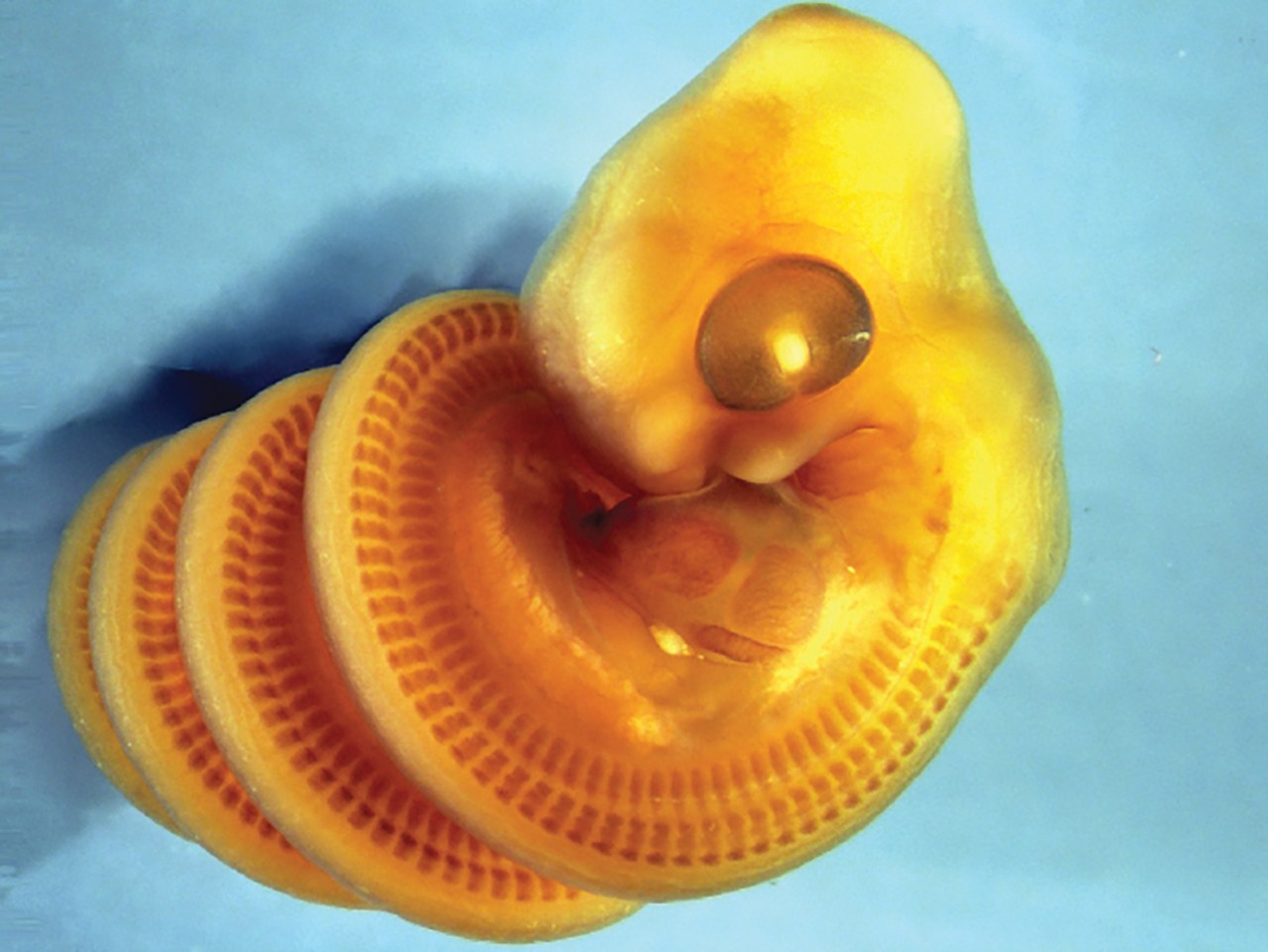
There’s something special you might not know about snake embryos: They form in a tight spiral shape, usually in a clockwise direction. This packaging trick is the reason they can hatch with the longest body of all the vertebrates. Now, researchers have published a new study that explains why.
Based on an analysis of more than 900 embryo images, the researchers determined that the spine grows so quickly that the gut can’t keep up. That developmental mismatch creates the spiral, giving the spine room to grow while also staying connected to the digestive tract until it can catch up. As the yolk inside the snake egg is on the left of the embryo, the twist is typically clockwise away from it.
Read more: “Here’s How Snakes Defy Gravity to Stand Up”
“It’s like when you adjust the length of a strap and the longer, buckling side of the loop twists,” senior study author Tetsuto Miyashita, from the Canadian Museum of Nature, explained in a statement.
Some snakes can have more than 400 vertebrae in their backbone, and so, laying the foundation for those bone segments in a small egg requires some clever biological engineering. The coiling solves the problem of how to fit a very long animal in such a restricted space.
The researchers think their findings could have wider implications too, beyond the realm of snake embryos, as the spiral is one of nature’s favorite structural patterns. Or as Alexandra Weber, lead author of the study, put it in a statement, “There’s a touch of mystery to spirals, and we’re only beginning to understand how these shapes are produced in animals, such as our looping intestine, snail shells, and now these beautifully coiled snake embryos.” 
Enjoying Nautilus? Subscribe to our free newsletter.
Lead Image: Raul Diaz, California State University Los Angeles