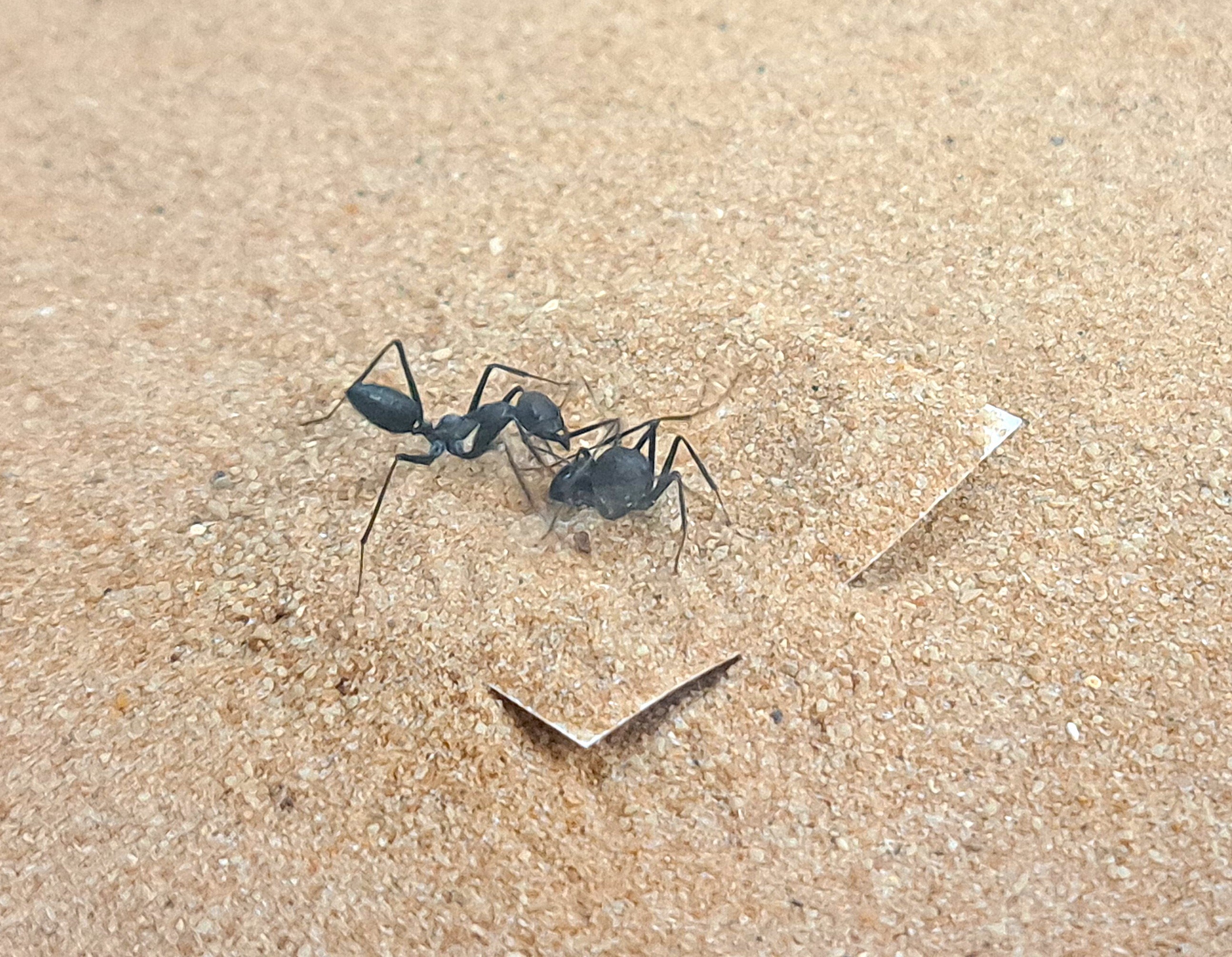
The Sahara Desert isn’t exactly a paradise for insects. The dry air and scorching temperatures mean these little critters are always in danger of desiccating or dying of heat exhaustion. But arthropods are nothing if not adaptable, and several species have evolved to withstand the harsh conditions, like the black desert ant (Cataglyphis nigra).
These little ants scurry around on long legs (abdomens pointed skyward to prevent overheating) in search of less fortunate insects to haul back to their relatively cool underground nests. They forage in zigzag patterns, occasionally glancing over their shoulder to check the position of the sun so they know the way home. When they find some food, they make an efficient beeline (or antline) directly back to the nest to avoid succumbing to the heat.
Read more: “Plants and Their Ants: When Flora and Fauna Team Up”
Of course, not every ant is so lucky. Some find themselves unable to make the return trip and wind up stuck in the searing desert sand. If one of their nestmates finds them there, they might stop to pull off a rescue mission. But not always. A new study published in the Journal of Experimental Biology is investigating why some ants turn a blind eye.
Biologists from Johannes Gutenberg University in Germany and Tel Aviv University in Israel set up an experiment to separate the good samaritan ants from their lazy brethren. They restrained a worker ant in a sandy enclosure and released another individual from the same colony. If the ant made an effort to bite, pull, or dig out their ensnared coworker, they were labeled as “rescuers”; if they approached but didn’t lend a hand, they were deemed “non-helpers.” The researchers then extracted the RNA from sensory regions of the brains to capture any differences in gene expression.
The team found clear differences within the mushroom bodies, a pair of neural projections in insect brains involved in olfactory learning and memory (and yes, they look a little like tiny mushrooms). “In rescuing animals, 15 genes were more active, including genes associated with odor perception, hormonal regulation, metabolic processes, and immune functions,” study author Luisa Maria Jaimes-Nino of Johannes Gutenberg University explained in a statement. “Across all the tissues examined, we found a total of nine genes that were more active in rescuing ants than in non-rescuing ants.”
Interestingly, while many of the upregulated genes were related to olfactory and memory retrieval, some were involved in the immune system. Previous studies have shown these genes are involved in behavior like sleep, activity, and social aggregation. It now appears they have a broader role in ant sociality as well.
“It’s highly plausible that immune-related genes are co-adapted to modulate behavior even in the absence of infection,” the researchers wrote. “An alternative explanation is that ants engaging in rescue behavior may face an increased risk of injury or infection, making the upregulation of immune pathways potentially adaptive.”
Still, the researchers stress that there’s no one gene that triggers the rescue response. Instead, it’s a combination of several interacting processes, including alarm signals, nervous system processing, and other molecular signaling pathways.
Basically, there’s a lot going on inside those little ants when they decide whether or not to stop and help a compatriot in distress. 
Enjoying Nautilus? Subscribe to our free newsletter.
Lead Image: Susanne Foitzik