A team of paleontologists monitoring construction of a rail terminal in the Brazilian state of Maranhão made a surprising discovery circa 2021—a massive new species of long-necked dinosaur. They published their description of the find in the Journal of Systematic Palaeontology.
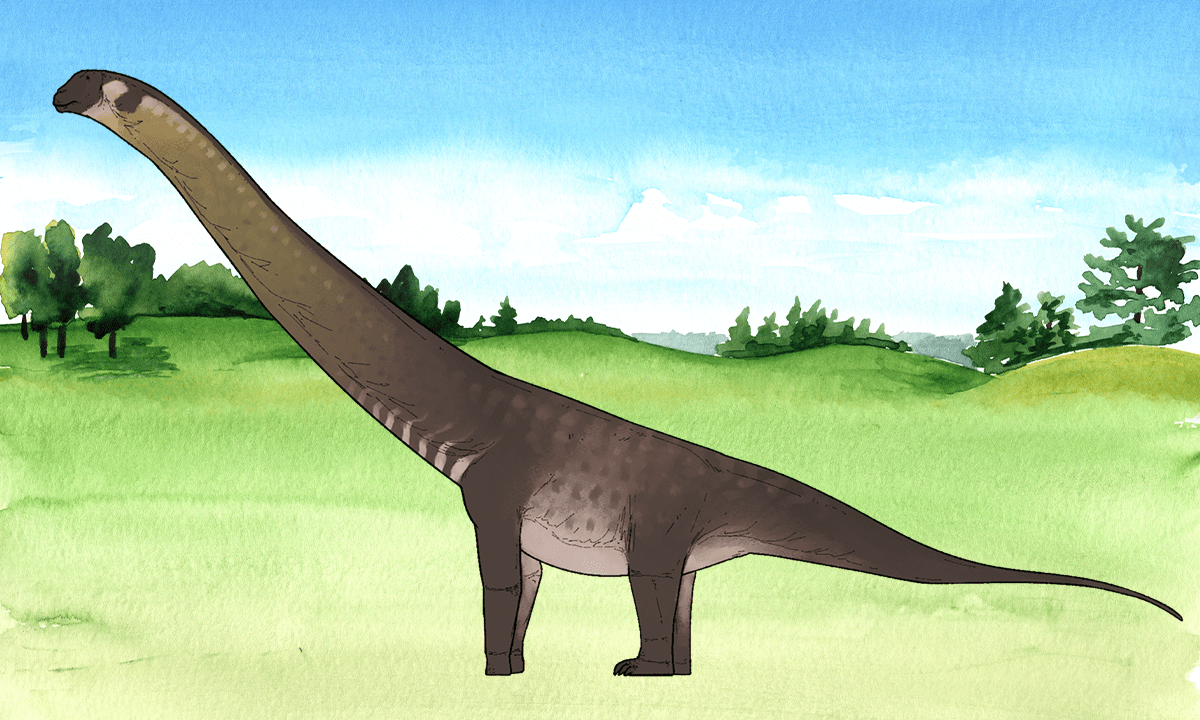
The new dinosaur species, dubbed Dasosaurus tocantinensis, was an estimated 66 feet long, making it remarkably large for sauropods discovered in the area. The paleontologists say the find pushes back the clock on the evolution of certain bone remodeling patterns that allowed these gargantuan beasts to grow so large.
“It’s the largest known dinosaur for Maranhão, which has other species, but not sauropods like this one; rather, it has smaller ones, such as the diplodocid Amazonsaurus maranhensis, which was about 10 meters long,” study author Elver Luiz of the Federal University of the São Francisco Valley said in a statement.
Read more: “Conjuring Imaginary Creatures”
D. tocantinensis originated in Spain, and an analysis revealed it’s closely related to a sister species (Garumbatitan morellensis) discovered on the Iberian Peninsula in the early 2000s. Unlike early Spanish colonizers who came to South America by boat, D. tocantinensis had a relatively shorter route to travel, and one that took place entirely over land. Around 120 to 140 million years ago the lumbering beasts came to the continent via the horn of Africa when Earth’s landmasses were squished together into the megacontinent Gondwana.
The paleontologists stress that this find wouldn’t have been possible without conservation laws guarding fossil recovery, and they’re currently negotiating with the construction company to continue excavating the site.
“Brazil is a tropical country with dense vegetation,” study author Max Langer of the University of São Paulo said. “Geologists and paleontologists rely heavily on human activity to excavate, expose the rocks, and reveal the fossils. If we map Brazil’s fossil sites, we’ll see highways and quarries. These projects are important for understanding our heritage. But it’s obvious that specialized monitoring and artifact recovery are necessary, which doesn’t always happen.”
You never know what you’re going to find when you start digging. 
Enjoying Nautilus? Subscribe to our free newsletter.
Lead image: Connor Ashbridge / Wikimedia Commons and dariaustiugova / Adobe Stock