When Alireza Zamani was a boy, he wanted a pet tarantula. He liked that they were big, colorful, and easy to take care of—you can just feed a tarantula a cricket once a week and they will live for decades. But his home country of Iran didn’t have the kind of pet trade that exists in the United States or Europe; in fact, scientists hadn't yet identified any species of the spider in his country. Rather than wait, he became a scientist himself—an arachnologist and taxonomist—and made tarantulas and other spiders his life’s work.
Not long ago, Zamani was thrilled to get a message on his Instagram account. It contained photos of a male tarantula living in the Zagros Mountains of Northwestern Iran, a diversity hotspot. Zamani had been looking for such a spider for years. He suspected that the species itself was unknown to science, but immediately recognized it as belonging to the Chaetopelma genus, one found in Turkey and other regions in the Middle East and Lebanon. The photos had first been shared on a private WhatsApp group for exotic pet enthusiasts.
Tarantulas are a diverse family of spiders: More than 1,000 species are known around the world, and they come in many sizes, exhibit a wide variety of behaviors, and live in many different habitats, including tropical, subtropical, and desert regions. Tarantulas of the Americas are generally more docile and have less potent venom than those in Europe and the Middle East, says Zamani. Tarantulas can attack prey or disable predators either using their fangs, with which they can inject venom that paralyzes, or by shooting thousands of poisonous hairs from their abdomens. If these hairs get into the airways of smaller mammals, such as rodents, the hairs can kill them.
Tarantulas and other spiders are among the most important bio-controllers of insect populations, says Zamani, consuming some 400 to 800 million tons of insects each year around the globe. In this way, they help to control the spread of disease. They also can serve as prey for certain large birds. Given the way insect populations are crashing, it may come as no surprise that spider populations around the globe are declining as well.
To be certain of his identification of the species in the photo, Zamani needed a specimen, so he linked the naturalist who had originally snapped the photos of the spider, Mehdi Gavahyan, with another naturalist friend of his from Tehran. Together the two of them found a female in a silk burrow in the same mountainous area and sent it along to the scientist.
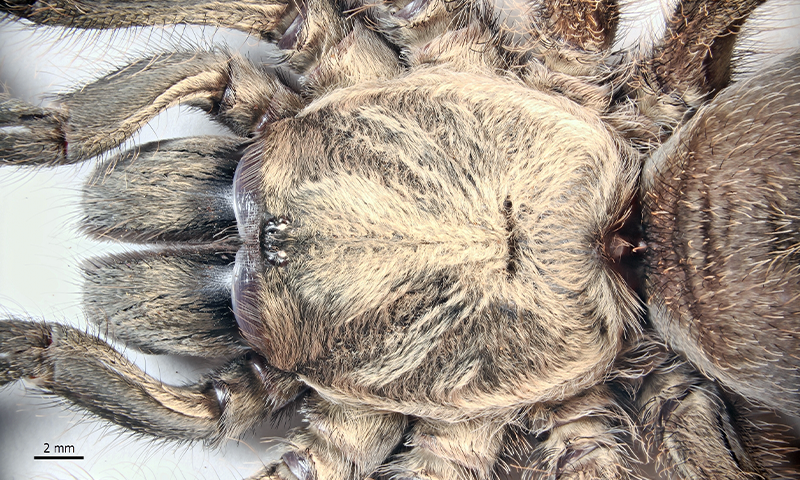
The spider measured about 3.5 inches long in leg-span—equal to the width of the average male human hand—and sported wooly golden hairs on its back. But Zamani says he was most interested in the spider’s sex organs, the primary feature by which tarantulas are identified. In this case, the organs were much more elongated than those of other Chaetopelma species. He instantly knew he had been correct to suspect the tarantula was a distinct species.
Zamani named the spider the Persian Gold Tarantula after its golden hairs and the country where it lives (Iran is also known as Persia). It marks the first record of Chaetopelma in Iran—the easternmost record of the genus within its entire known range—and only the third known species of tarantulas in the country. The closest recording until then of Chaetopelma had occurred over 200 miles westward. Zamani published his findings, together with a colleague, in the journal ZooKeys.
Zamani and his co-author are hoping to work toward a full taxonomy of the genus. They note in their paper that one species that has been included in the Chaetopelma genus, from Cameroon, likely does not belong. Zamani himself would also like to identify more tarantula species in Iran. No doubt they would make the next edition of his first book, Spiders and Scorpions of Iran, the first field guide devoted to the arachnids of the Middle East. 
Lead photo: The Persian Gold Tarantula was named for the wooly golden hairs on its back and legs. Credit: Kari Kaunisto.