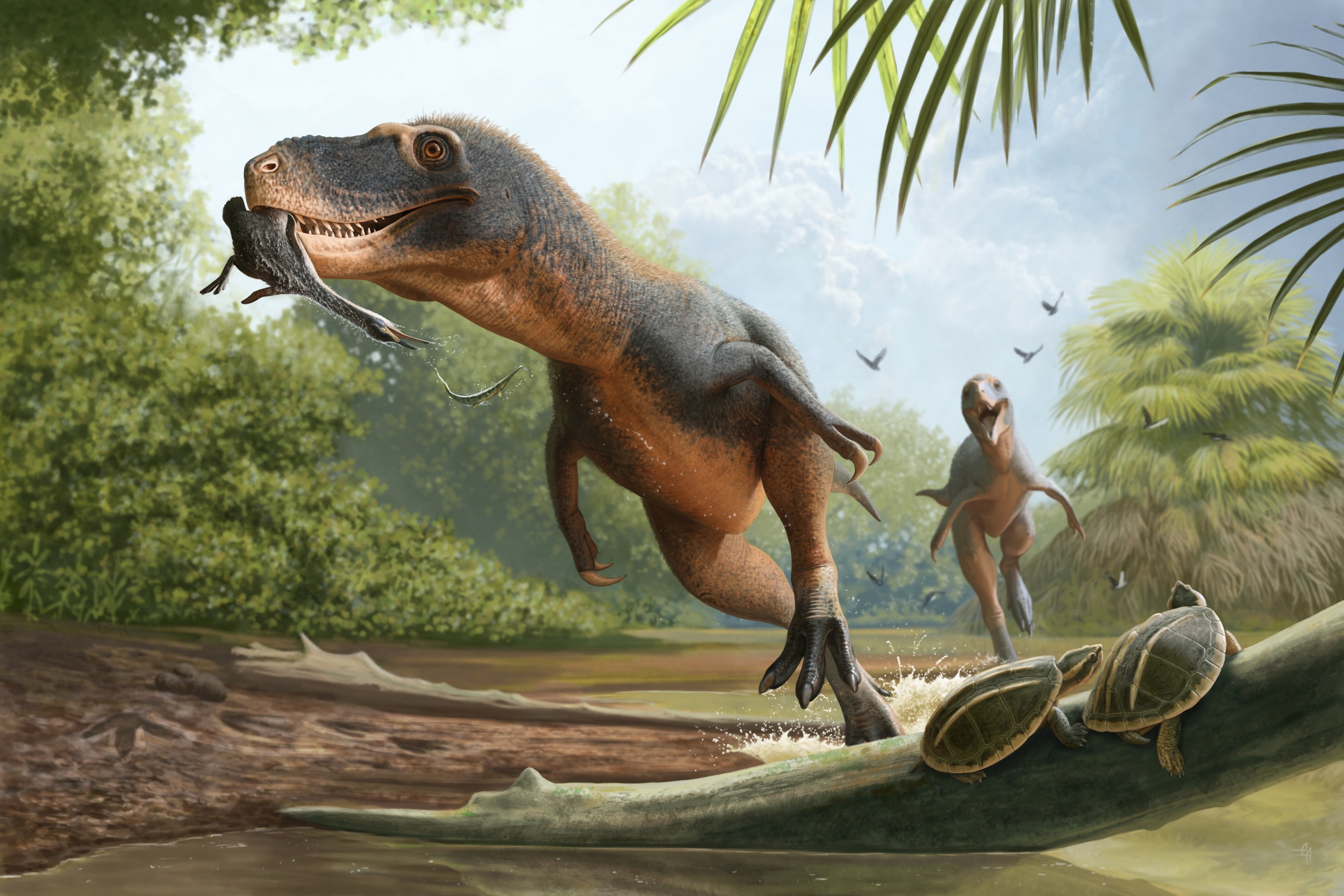
The island of Great Britain wasn’t an island at all 215 million years ago. Instead, like all land on Earth, it was part of the massive supercontinent, Pangaea, featuring hilly terrain rising above dry, sun-scorched lowlands. There, a curious creature stalked through the grass: a long-legged crocodilian that was newly described in a paper published in The Anatomical Record.
Described as a “reptilian greyhound,” this prehistoric crocodilian bore a resemblance to another long-limbed relative of crocodiles, Terrestrisuchus, but showed some differences worthy of investigation. Unlike modern crocs, both species were likely agile and fast-moving, living their lives on land where they hunted small prey.
The specimen in question was first unearthed in 1969 from fissures along the Bristol Channel. In the late Triassic, the region was dotted with limestone caves perfect for capturing the remains of animals, creating pockets of fossil-rich sedimentary rock for future paleontologists to pick through. This particular fossil languished in the Natural History Museum collection before attracting the attention of study author and Ph.D. student Ewan Bodenham of University College London.
Read more: “When We Were Lunch”
“My Ph.D. project is looking at the evolutionary relationships of these early crocodiles,” Bodenham said in a statement. “So we conducted a detailed anatomical description of this specimen, making comparisons to other early crocodiles to determine if it was another specimen of Terrestrisuchus or if it was something new.”
After meticulously studying the fossil, Bodenham determined there were 13 key differences that separated it from Terrestrisuchus, which meant it was a new species worthy of a new name: Galahadosuchus jonesi. The genus (Galahadosuchus) is a reference to the legendary Sir Galahad, known for his uprightness and a nod to the crocodilian’s upright stance. The species name (jonesi) was a little more personal for Bodenham; he chose it to honor his former physics teacher, David Rhys Jones, who encouraged him to pursue a career in science.
“We named it after my secondary school physics teacher,” Bodenham said. “Mr. Jones was just such a good teacher, not only in being able to explain things well, but you could tell that he was genuinely interested in the sciences. I think that really inspired me.”
Bodenham broke the good news to Jones over a Zoom call.
“Good God, what an honor. What a privilege,” Jones responded.
You can watch a video of their exchange here. 
Enjoying Nautilus? Subscribe to our free newsletter.
Lead image: ©Matt Dempsey