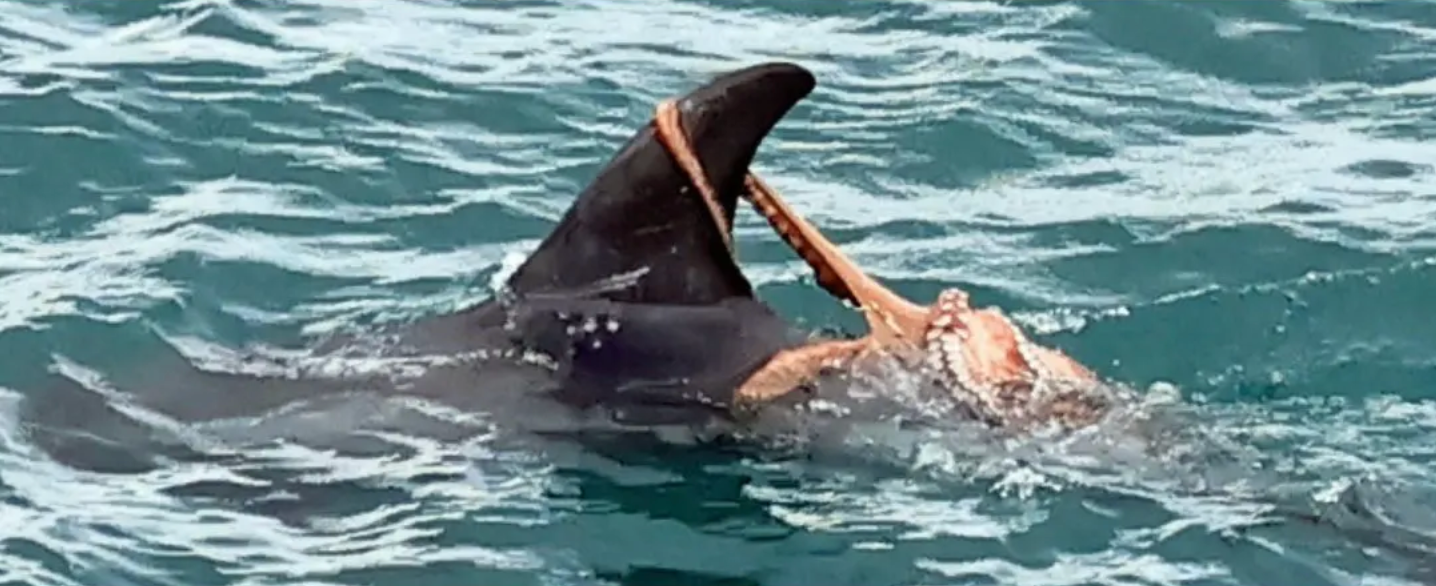
Dolphins, with their exceptional echolocation abilities, are skillful at catching fish. But some fish, like Chinook salmon, are too big for them to capture and swallow whole.
In the first recorded instance of hunting cooperation between dolphins and orcas, a new study published today in Scientific Reports describes how dolphins benefit from associations with orcas, which catch Chinook salmon, carry them to the surface, and break them into smaller pieces.
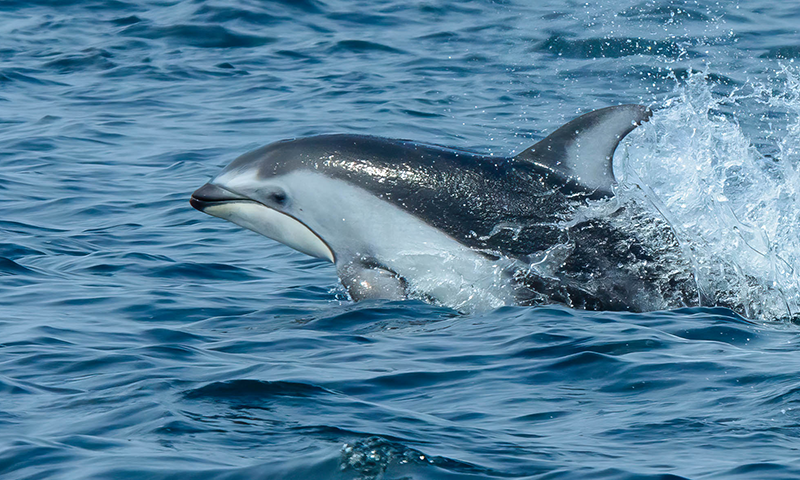
Killer whales (Orcinus orca) that live along the coast of British Columbia feed almost exclusively on big, adult Chinook salmon, which can weigh as much as 30 pounds. Pods of Pacific white-sided dolphins (Lagenorhynchus obliquidens) have been observed swimming near the killer whales. An individual dolphin needs about 20 pounds of food per day, a daily diet that the marine mammals typically fill out with smaller prey fish, such as sardines, herring, and capelin.
Since both dolphins and killer whales are known to use coordinated hunting strategies to round up and capture prey, scientists figured that their proximity to each other off the coast of British Columbia was coincidental. Perhaps both the killer whale pod and the dolphin pod were homing in on fish-rich areas but not competing due to their distinct diets, the researchers reasoned.
But the team was surprised when they tracked nine killer whales around Vancouver Island. Collecting data using a variety of methods—aerial drone footage, photography from the research boat, customized multisensory tags that captured 3-D dive data while recording vocalizations and collecting underwater video from whales’ perspectives—the researchers learned that killer whales were frequently following dolphins around.
Read more: “The Story of a Lonely Orca”
In total, the scientists recorded 25 instances of killer whales changing course after encountering dolphins. Four of the tracked killer whales, plus three nontagged whales, were recorded interacting with dolphins. When the killer whales caught and shared Chinook salmon with each other, dolphins stayed nearby, in at least one case, scavenging on the scraps of fish. There was no evidence of the killer whales trying to chase the dolphins off.
The dolphins appeared to get a free meal out of the arrangement and perhaps protection from other killer whale pods, which sometimes prey on the dolphins.
But what might the orcas get from such a cooperative hunting strategy? In the paper, the study authors hypothesize that the arrangement “may improve the ability of killer whales to detect Chinook.” When the killer whales changed course to stay near dolphins, they might have been eavesdropping on dolphin echolocation. Killer whales echolocate during hunting, too, but two sets of echoes may be better than one in locating targets.
Further study may confirm whether this truly qualifies as cooperative hunting. 
Enjoying Nautilus? Subscribe to our free newsletter.
Lead image: Courtesy of the University of British Columbia (A.T rites), Dalhousie University (S. Fortune), Hakai Institute (K. Holmes), Leibniz Institute for Zoo and Wildlife Research (X. Cheng)