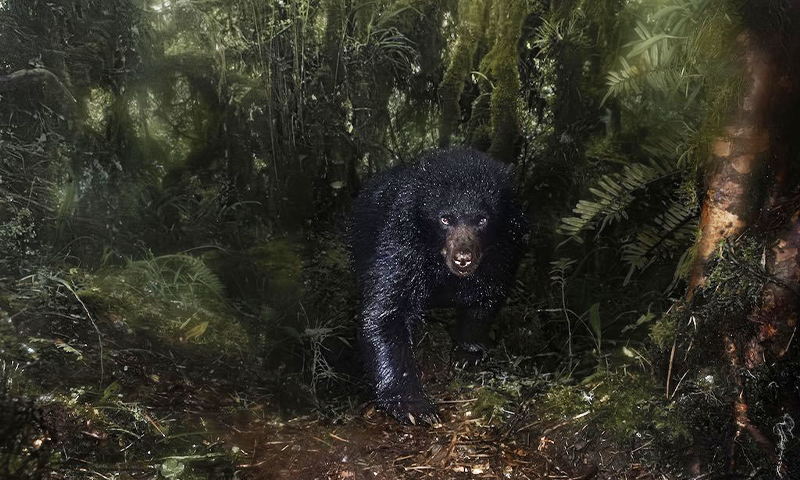
An elusive Andean bear emerges from the shadowy undergrowth of Colombia’s highland rainforests. Eyes narrowed with intense focus and an inky black paw outstretched, the massive ursid—nicknamed Nariz de Calavera (Skull Nose)—appears ready to pounce on the photographer.
Fortunately for Santiago Monroy García, the picture was taken with an elaborate system of camera traps that allowed him to observe and photograph the bear from a distance, and without significant disturbance to its natural habitat. Monroy García, whose image won the “Animals” category of the Close Up Photographer of the Year competition, noted that the frigid temperatures, dense foliage, and humidity of the Ecopalacio Nature Reserve actually helped generate this shot: A few raindrops on the camera lens created subtle textures and blurs that rendered the bear in sharp focus, giving its surroundings a dreamlike, haunted appearance.
Monroy García made several failed attempts before capturing this shot. Intensely shy and solitary by nature, Andean bears are the only known ursids native to South America and are dwindling in numbers, largely due to habitat fragmentation, agriculture, and poaching. Though relatively little is known about the bears, recent photography-based research efforts have shed light on previously undocumented behaviors. In a study published late last year, researchers used collared cameras to trace Andean bears' activities, providing a unique “bear’s-eye-view” of the mammal’s environment. Scientists recorded novel insights about their feeding preferences, canopy-based mating practices, and a rare instance of infanticide and cannibalization.
Despite the fact that fewer than 18,000 Andean bears remain in South America, these mammals have managed to capture the imagination of cultures worldwide. This species, called ukuku in the Quechua language, has historically held spiritual and cultural significance for Andean peoples. And in England, the beloved Paddington Bear is, himself, an Andean bear who claimed to have emerged from the dark forests of Peru—much like Nariz de Calavera, pictured here.