In the lush forests of Brunei, Indonesia, and the Philippines, dwells Rafflesia, one of the most mysterious and enigmatic flowers on Earth. Parasitic in nature, the plant itself has neither leaves nor roots, living most of its life hidden from view as a web of filaments inside the vines of another plant called the Tetrastigma.
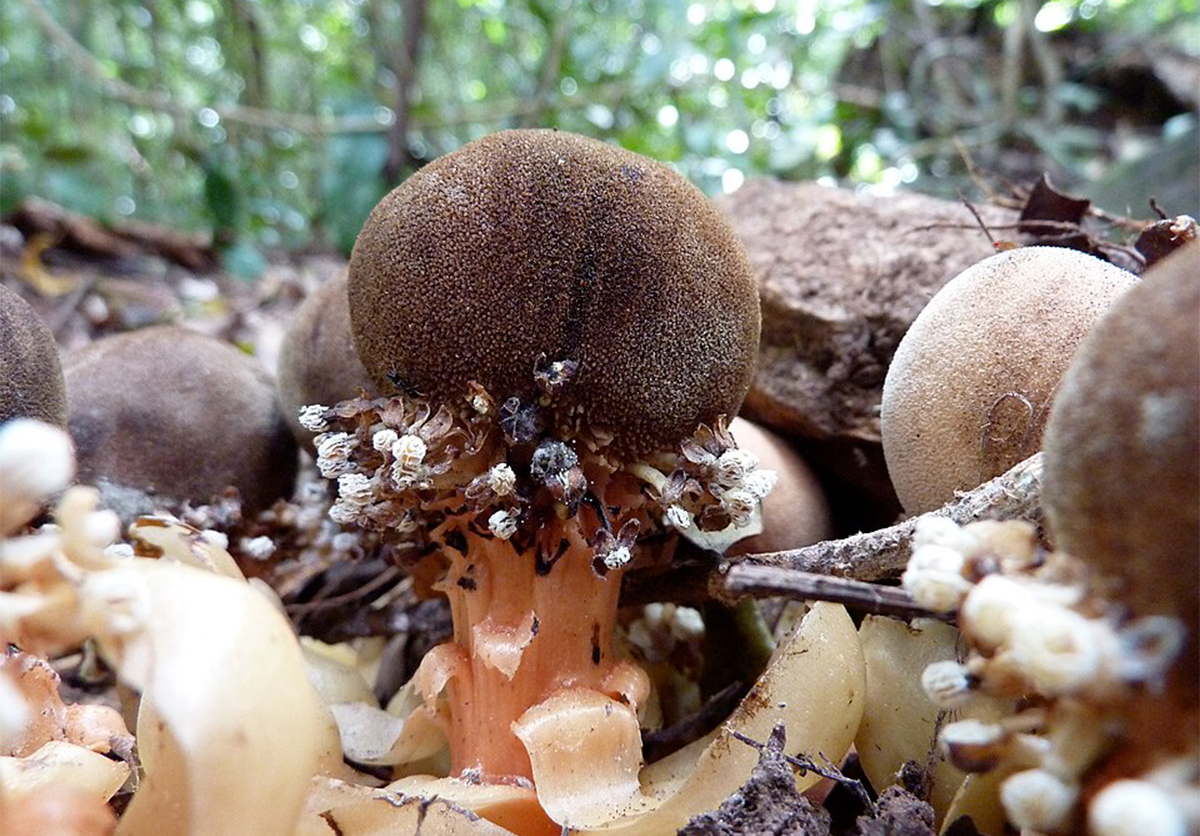
After four to six years of germination, the Rafflesia pops a bud—a brown cabbage-like sphere the size of a soccer ball—through its host’s tissue that may take up to nine months to bloom. Opening unexpectedly, almost always at night, the bud erupts into a stunning, five-lobed red blossom, over three feet in diameter—the biggest flower on the planet.
Its scent, however, makes a mockery of its beauty: Rafflesias smell like rotten meat.
Rafflesia has been known to scientists for about 200 years—and has been used in botanical medicine by the Indigenous populations of Southeast Asia for much longer. Yet, it is so rare and invisible most of the time that scientists know very little about its unusual biology.
Rafflesias smell like rotten meat.
“There are definitely more questions than answers,” says Chris Thorogood, deputy director of the University of Oxford Botanic Garden. Thorogood belongs to a niche group of scientists who call themselves Rafflesiologists. This self-selected group worries the curious flowers will disappear and take their botanical secrets with them—before they are even understood.
Scientists have cataloged 42 Rafflesia species—with new species identified every year—but most of these are edging toward extinction as humans decimate their forest habitat to clear room for agriculture. Thorogood and his team recently published a paper calling for the preservation of the species. Among other things, they suggest making the flower “an icon” for plant conservation in the Asian tropics. (It already likely inspired one of the more popular Pokémon characters, Vileplume, which scatters toxic pollen that can trigger allergy attacks.)
What we do know about Rafflesia is both majestic and macabre. Rafflesia evolved its stink to attract different types of pollinating insects—not bees or wasps, who favor fragrant blooms, but flies, which prefer foul smells. “If you want to attract a fly rather than a bee, you don’t want to smell nice,” says Thorogood. Flies prefer decomposing flesh, as that’s where they lay their eggs. With its deep red hues, even the appearance of Rafflesia’s massive flower mimics, to some extent, the flesh of a dead animal. In fact, there’s nothing there for the larvae to eat. “They may sometimes lay their eggs on the flower, and then their offspring will just perish,” Thorogood explains. It's a bit of a dead end, as it were.
But the Rafflesiologists are still trying to figure out how the pollination process works. Rafflesia plants are either male or female, and the male ones produce a thick, sticky sludge of yellow pollen. “It looks like butter that has been left out of the fridge, when it gets really soft,” says Thorogood. As flies enter the male flowers hunting for a place to lay their eggs, the pollen rubs onto their bodies. But what happens after that is an open question: One would think the flies would then carry it to a female plant and pollinate it. But because the blooms are so rare, it’s unlikely that any flies will find one nearby, Thorogood says. The plant may produce seeds, but scientists are still debating how they disperse. Some insist that ants help spread the seeds around in the jungle. Others believe that small forest animals may swallow the seeds—and poop them out. “We don’t have a united account of how the seeds are distributed,” Thorogood admits. So far, cultivation of the plant has proven difficult.
In their study, Thorogood and colleagues outline a few avenues to saving the massive stinkers—from propagating Rafflesia outside their native places to designating habitat protections to raising awareness through ecotourism, as some local conservation groups have done. “If people don’t have an awareness or care, [the species] won’t win this battle,” Thorogood says. His team hopes that the growing conservation efforts to save the world’s biggest stinker of a flower will bear fruit. 
Lead photo by Chris Thorogood.