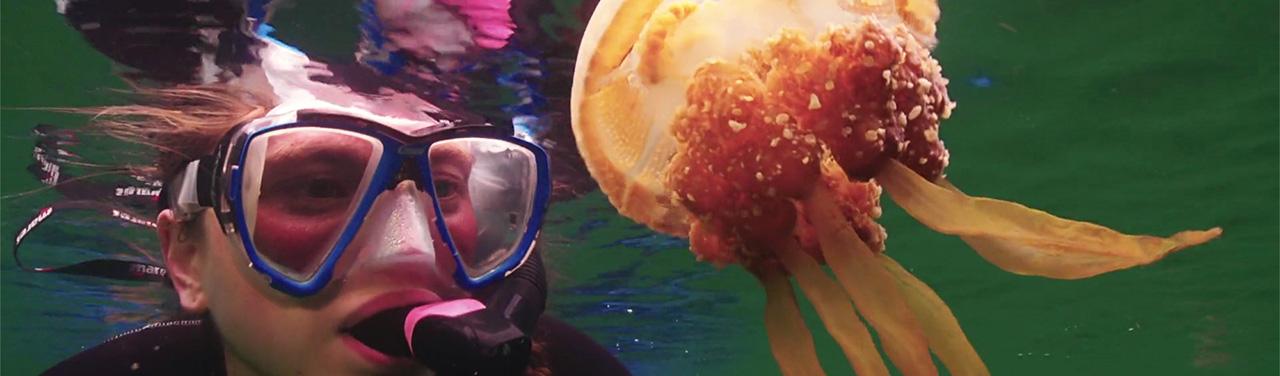
From the moment my mom gave me goggles—when I was about 3 years old—I’ve been studying the wondrous world under water. As a child, we spent the summers in Spain, and I would return with only my back tanned, from swimming all day, every day, face down in water: exploring the details of life on the rocks; watching the barnacles winking at me underwater; testing the anemones to see which ones stung (possibly not the smartest exercise). From a very young age, I was passionate about the sea: How many species are there, how were they formed, and how can we protect them?
Now, as a marine biologist, I still spend as much time as possible in the sea. Most of my explorations are in the Coral Triangle, which spans the seas between Indonesia, Malaysia, the Philippines, Papua New Guinea, Timor Leste, and the Solomon Islands. Though we recognize this region as the global epicentre of marine diversity, it’s shocking how little we actually know about it. In fact, it is estimated that less than one-third of the region’s marine species have been described. All these unknowns hamper our understanding of the delicate balance in the ecosystem. In truth, the processes that shaped the extremely high diversity that we see in the Coral Triangle, and the processes that keep it in place, still remain a mystery. It’s that mystery that drives my research.
A major focus of my research is marine lakes—pockets of seawater surrounded by land. These are giant natural laboratories of evolution. Unlike the oceans, where barriers to dispersal are less evident, marine lakes offer a clearly defined bit of sea that is isolated. In their isolation, we can actually get a controlled sense of how species communities formed over time, and under what circumstances.
Misool, in West Papua, Indonesia, is an island teeming with undiscovered marine lakes. During our research trips, each lake we explore is a different adventure with its own character and challenges. But all the lakes are magical—beautiful and peaceful and unique. In some cases, we were possibly the very first people to set our eyes on that particular lake. In the process of becoming a marine biologist, I became an explorer.