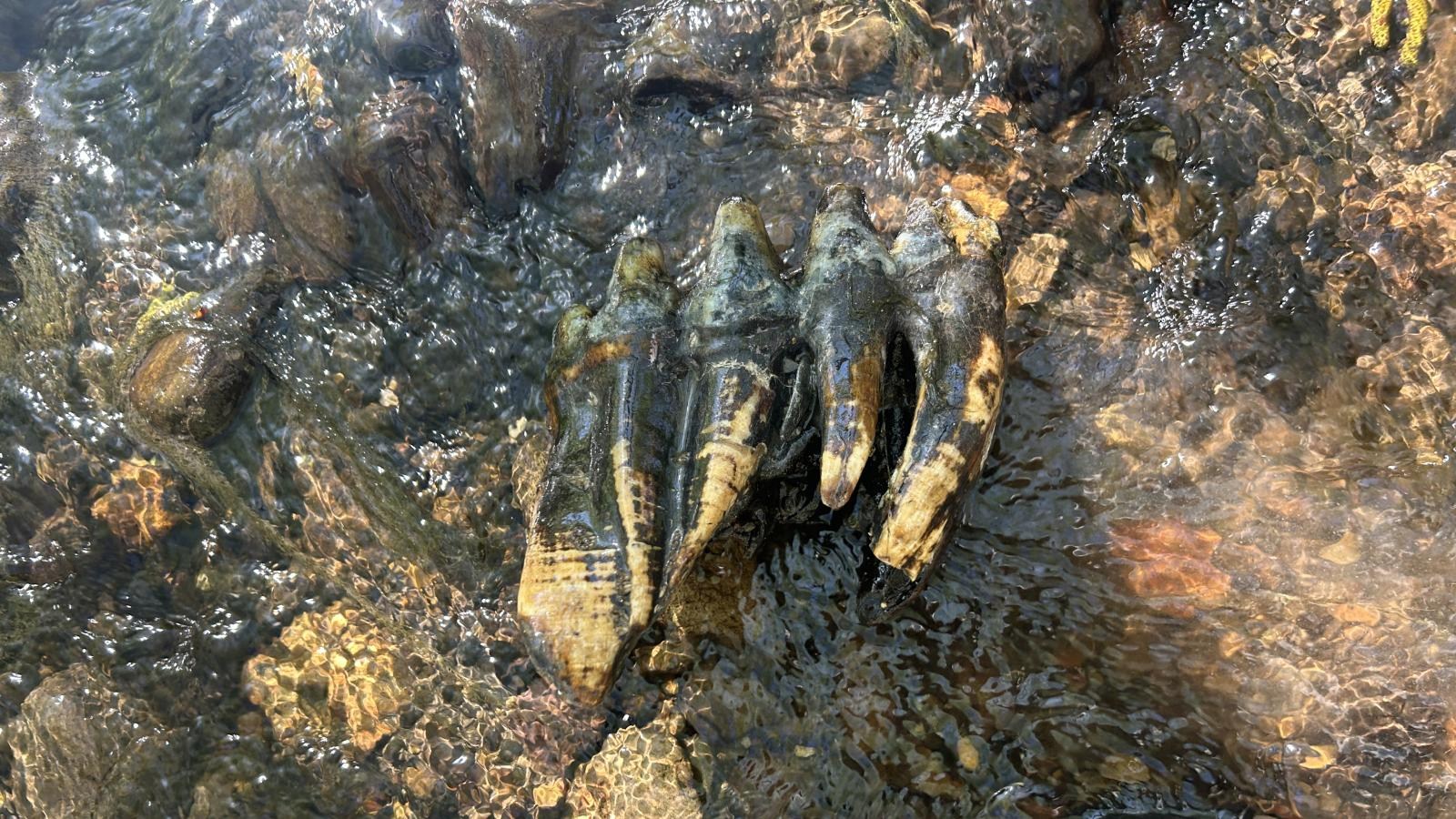
A little piece of fossilized elephant bone found in southern England offers a window into the life of our human ancestors. Just 4.3 inches by 2.4 inches, the triangular fossil bone came from either an elephant or a mammoth, given its density and thickness. It was recovered from a well-known archaeological site in Boxgrove, England, in the 1990s, but only now—thanks to advances in imaging techniques—recognized as an elephant bone tool, according to a study published in Science Advances.
Imaging with 3-D scanning and electron microscopy of the bone fragment revealed telltale clues on its surface. The battered pattern of notches, pits, and other impact marks, coupled with embedded flint flakes, suggested it served as a hammer to touch up flintstone tools. Because the bone is softer than the flint, it would have worked as a “knapper” to sharpen a flint stone by knocking flakes off its edges.
“Collecting and shaping an elephant bone fragment and then using it on multiple occasions to shape and sharpen stone tools shows an advanced level of complex thinking and abstract thought,” explained co-author and anthropologist Silvia Bello in a statement.
Read more: “The Natural World Is an Elephant World”
Whether the bone was scavenged from a carcass or extracted from a hunted animal is unknown. Two of the largest members of the elephant family lived in Europe during the Middle Pleistocene: Eurasian straight-tusked elephants (Palaeoloxodon antiquus) and steppe mammoths (Palaeoloxodon antiquus) that both stood almost 13 feet tall. Hunting them would have been a formidable task, but the study authors conclude that the bone was relatively fresh because it deformed a bit during its use.
Both these elephant species were uncommon in prehistoric southern England, suggesting that the elephant bone tool was a rare find. The carcass it came from may have also provided other raw materials like teeth, tusks, skin, fat, and edible meat. Based on the time and place, the study authors surmise that the bone toolmaker was either an early Neanderthal (Homo neanderthalensis) or a Homo heidelbergensis.
“This remarkable discovery showcases the ingenuity and resourcefulness of our ancient ancestors,” said lead author and archaeologist Simon Parfitt in a statement. “They possessed not only a deep knowledge of the local materials around them, but also a sophisticated understanding of how to craft highly refined stone tools.” 
Enjoying Nautilus? Subscribe to our free newsletter.
Lead image: Brennan Stokkermans / Wikipedia