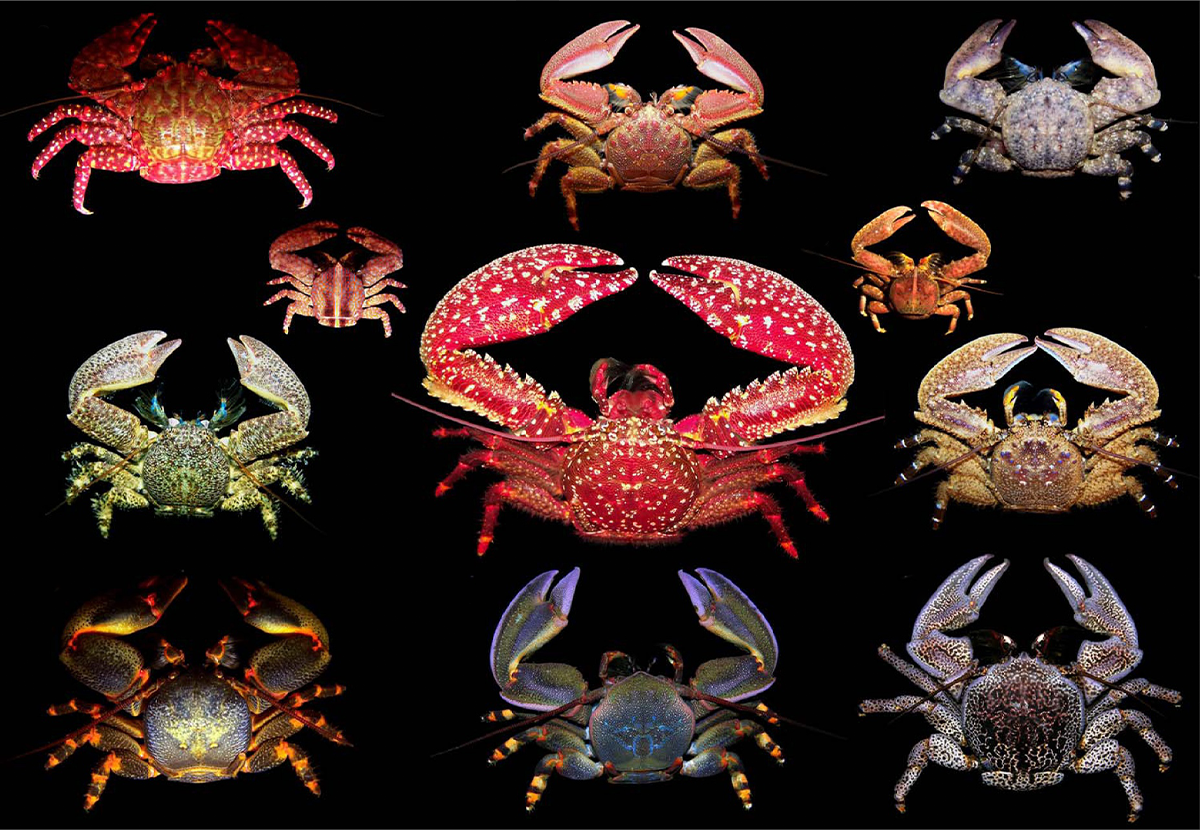
Nature abhors a vacuum, but it loves a crab. The crab’s wide, flat body plan has independently evolved multiple times in decapod lineages in a process called “carcinization” (which you may know from the popular 2019 meme). Oddly, even though crab-shaped decapods keep popping up in the family tree, the most famous crab innovation—walking sideways—seems to have evolved only once. That’s according to a reviewed preprint published in eLife.
So-called “true crabs,” or members of the infraorder brachyura, mostly scuttle sideways, but there are a few rebels who still tend to move forward and backward. “Despite the rich information available on true crabs, data concerning their locomotor behaviors are sparse,” study author Yuuki Kawabata of Nagasaki University said in a statement. “When did their sideways locomotion originate, how many times over the years did it evolve, and how many times did it revert?”
To find out, the research team selected 50 species of true crabs, placed them in a circular arena, and recorded their movements with an overhead video camera. After conducting a behavioral analysis, they determined 35 of the species moved sideways while 15 were forward-walkers and mapped the data onto existing crab family trees.
Read more: “Are Crabs Truly Crabby?”
They discovered that sideways locomotion evolved only once from a forward-walking ancestor, but had remarkable staying power after that. “This single event contrasts starkly with carcinization, which has occurred repeatedly across decapod species,” Kawabata said. “This highlights that while body shapes may converge multiple times, behavioral changes such as sideways walking can be rare.”
As for why this is the case, the researchers say sideways locomotion represents such a dramatic change it could interfere with other behaviors like burrowing, mating, and foraging.
The study also revealed that crabs got quite an assist from external events. According to the researchers, sideways walking evolved around 200 million years ago, right after the Triassic-Jurassic extinction. With so many ecological niches open and an expansion of shallow ocean habitats, the newly evolved crabs scuttled in to fill them.
Again, nature abhors a vacuum, but it loves a crab. 
Enjoying Nautilus? Subscribe to our free newsletter.
Lead image: J. Antonio Baeza / Wikimedia Commons