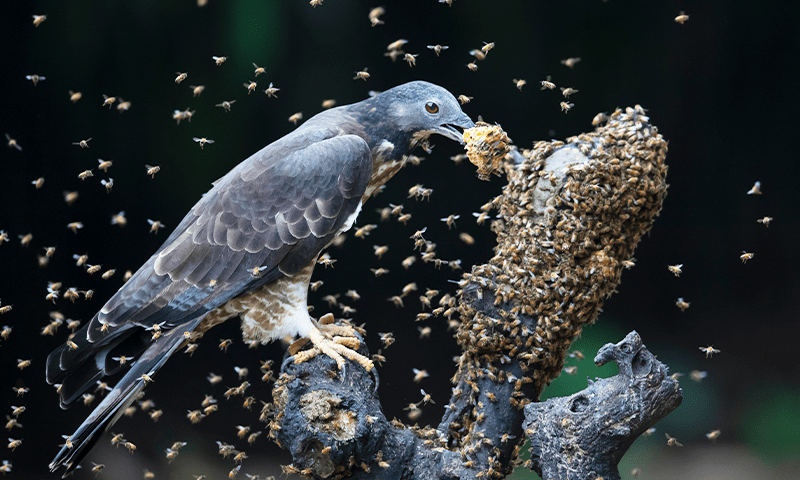
Few animals can stand their ground against a swarm of angry bees, but this crested honey buzzard appears unperturbed. Although the bird belongs to the same family as flesh-eating kites, hawks, and eagles, its main food is bee and wasp pupae and larvae—the developing brood found inside the insects’ nests. When the buzzards encounter a colony of honeybees—as in the image above, captured by photographer Staffan Widstrand in western Taiwan—they will lunch on honeycombs, too.
Crested honey buzzards (Pernis ptilorhynchus) can feed on enraged, stinging insects thanks to a number of adaptations. Their feathers have central shafts that branch into barbs and then into smaller barbules, much the way veins branch into capillaries. Those barbules hook onto each other and form a shield against incoming stingers, and are woven more thickly around sensitive areas such as beaks, eyes, nostrils, and necks. A couple of additional defenses help them resist painful piercings: A special membrane covers their eyes and a substance coats their feathers that may also serve as a repellent.
To find their buzzing prey, honey buzzards frequent forests near farms, rivers, and glades—open areas where it is easier to search for ground-nesting bees and wasps. Once they home in on a colony, the birds use their stout legs, talons, and toes to dig for their quarry. To penetrate nests hanging from trees, a buzzard will launch itself talons first, like an MMA fighter going for the knockout kick. As the airborne troop swarms, more honey buzzards join the fray, ripping the nest apart in chunks, then flying to nearby trees or to the ground to feast. Sometimes, the birds will even alight on a nest as the irate colony struggles to fight them off. The birds only shake their heads in annoyance.
Crested honey buzzards can feed on enraged, stinging insects thanks to a number of adaptations.
Those heads are remarkably small—pigeon-like, at the end of long buzzard necks—though the bird’s crownlike crest lends it a regal air, as does its roughly 155-centimeter (5-foot) wingspan. With plumage varying in color depending on life stage or geography, they’re routinely mistaken for other birds—likely a case of mimicry, when one species copies the physical or behavioral traits of another. In raptors, this often occurs when a weaker species, such as a honey buzzard, imitates a stronger one, offering some protection from attack. In one instance, naturalists misidentified a rescued honey buzzard as an osprey and fed it a diet of fish for several weeks before a visiting colleague offered the bird a piece of honeycomb. True to its name, the buzzard came back for seconds.
Crested honey buzzards range across eastern Asia and the Indian subcontinent, and are a familiar sight from sea level to 1,800 meters (5,900 feet). Some flocks—which can number in the thousands—soar hundreds of kilometers to breed in Siberia, northeast China, North Korea, Taiwan, and Japan. In autumn, birds returning to their wintering ground in China catch a tailwind that carries them 680 kilometers (420 miles) across the South China Sea. But climate change could jeopardize that feat as wind patterns change, threatening to ground the birds unless they adapt.
Some crested honey buzzards appear to be adapting to changing environmental conditions by following their prey into new territories. Over the past 20 years, bird sightings have surged across the Arabian Peninsula, where the sparsely populated desert has seen rapid recent growth in farms, suburban parks, golf courses, and tree plantations—all perfect habitat for crested honey buzzards and the bees and wasps they depend on. 
A version of this story originally appeared in bioGraphic, an independent magazine about nature and regeneration powered by the California Academy of Sciences.