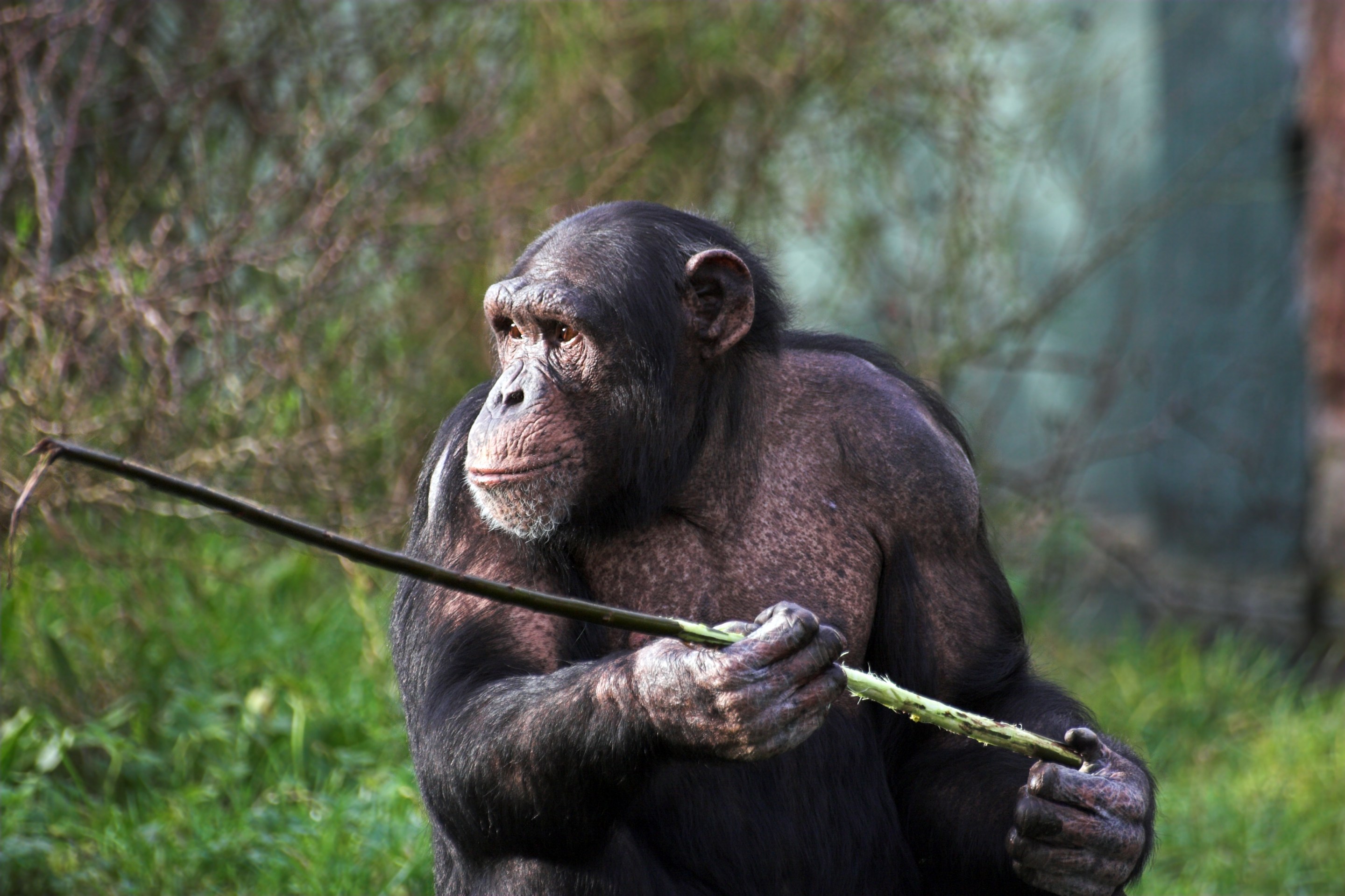
Thanks to the pioneering work of Jane Goodall, chimpanzee tool use is well-known, upending the historical exclusionary notion of “Man the Tool User.” Now, more than a half-century later, a study published in Frontiers in Psychology follows up on her work with the discovery that experienced chimps serve as mentors to novice chimps in manipulating tools.
Led by primate researchers at the University of Barcelona in Spain and the Jane Goodall Institute in Senegal, the study focused on wild western chimpanzees (Pan troglodytes verus) in the savanna of Dindefelo, Senegal. Camera traps were installed at 25 locales where chimps were known to actively forage for ants, termites, and algae. About 15 hours of footage revealed a surprise: 33 instances of chimps taking tools from other chimps after watching them forage.
Read more: “Chimps Have Accents Too”
“Receiving food and tools from experienced individuals, which we call food or tool transfer, may help chimpanzees learn to use technology to extract foods that are difficult to access,” said lead study author Andreu Sánchez-Megías, a doctoral student, in a press release.
Tools mostly got handed from skilled tool users to less experienced ones, in many cases (30 percent of instances) from mothers to their offspring. After acquiring a tool, the youngsters spent significantly more time fishing for insects, resulting in more mouthfuls of food. In contrast, the handover typically signaled the end of feeding or a reduction in feeding for the teachers. For example, a mother “Soukki” inserted a dipping stick into an ant colony, left it there, and brought her baby daughter “Saïsaï” over to extract it and eat the ants.
“Teaching … requires an active role from the teacher, who must modify their behavior to facilitate the transmission of information to the learner,” explained Sánchez-Megías, “and this is why teaching is thought to have evolved to transfer information that is too complex to be acquired through simpler mechanisms, such as individual or observational learning.”
As in humans, the study authors also observed a couple of instances of tool theft, where a chimp reached for another’s tool, resulting in an altercation. The original tool holder tried to smack the would-be thief.
There’s probably a lesson in that, too: You’ve always got to protect what’s yours. 
Enjoying Nautilus? Subscribe to our free newsletter.
Lead Image: Clivia / Adobe Stock