At first, the manure was just harmlessly foaming. Only later on did things get lethal.
Hog farms in the Midwest are great big barns sitting on top of great big pits filled with a great deal of awful-smelling manure. The pigs walk about on a slatted floor that lets manure fall into the pit several feet below. Around 2007, farmers began noticing pig poop acting funny. The normally liquid mixture started producing foamy bubbles, rising up and up, past the slats, right to the pigs’ cloven hooves.
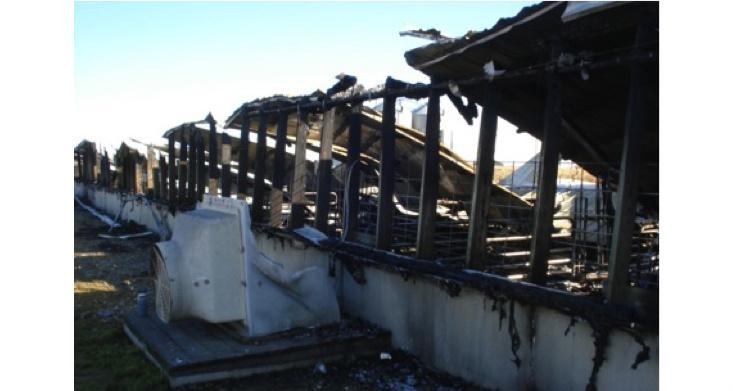
Then it got worse. Among the gases in the bubbling foam are two of special note: methane and hydrogen sulfide—both highly flammable. All it takes is a small spark and Kaboom! In September 2011, a barn explosion killed 1,500 pigs and seriously injured one worker. It was just the most serious in a string of barn explosions that have cost farmers millions of dollars in the past several years.
Scientists have scrambled to solve the mystery of the exploding hog-manure foam, but no straightforward answer as emerged so far. As a matter of physics, every foam needs three components: gas, stabilizer, and surfactant. Manure is normally teeming with microbes, which produce gases like methane and whose cells can act as stabilizers. Therefore the surfactant—any chemical such as soap that lowers the surface tension of liquids to allow bubbles to form—is a likely candidate for what’s new.
Around the same time that foaming manure became a problem, farmers also started feeding their pigs more and more distiller’s dried grains with solubles (DDGS), a cereal-like byproduct of ethanol production. DDGS is full of plant fibers and long-chain fatty acids—plausible surfactant candidates. Since the US provides huge subsidies for making ethanol from corn, DDGS was cheap and plentiful source of animal feed. It makes economic sense, at least.
DDGS has been a suspected culprit of foaming manure from the beginning (one magazine called it a “pig bang theory”), but experiments are still inconclusive. A comparison of manure from different diets with and without DDGS did not find the manure of DDGS-fed pigs to be particularly foamy (pdf). This lab experiment, however, only looked at manure incubated in bottles for up to 40 days.
Manure pits are a different beast. The manure sits for up to a year before it’s pumped out, during which time it stews and decomposes, and all sorts of chemical processes take place. The yearlong accumulation also makes it difficult for researchers to make any conclusions comparing manure pits at farms because the pigs’ diets can often change. On top of that, DDGS content itself is not consistent, varying by season and by refinery. That could be why foaming manure is a problem at some DDGS-feeding farms but not others.
With no known cause for foaming manure, there’s no going at the root of the problem. The best short-term solution farmers have come up is antibiotics. Rumensin 90, an antibiotic normally used to prevent bloating in cattle, has been repurposed to prevent gas in pig manure pits. It works, though no one knows why. Scientists have hypothesized that shifts in the microbial community—either from DDGS feeding or from another cause—may have a role in foaming manure as well.
All the unknowns around exploding hog manure foam suggest being careful about unintended consequences. Farming accounts for 80% of all antibiotics sold in the United States, and widespread use of antibiotics in farm animals contributes to the development of deadly antibiotic-resistant infections in people. Rumensin 90 is at best a short-term fix, not long-term policy. If the foaming manure is indeed linked to DDGS, then the consequences of an earlier, poorly thought-through policy—incentives for producing ethanol—is quite literally blowing up in our faces.
Sarah Zhang is a science journalist based in Washington, DC. Follow her on Twitter @sarahzhang.