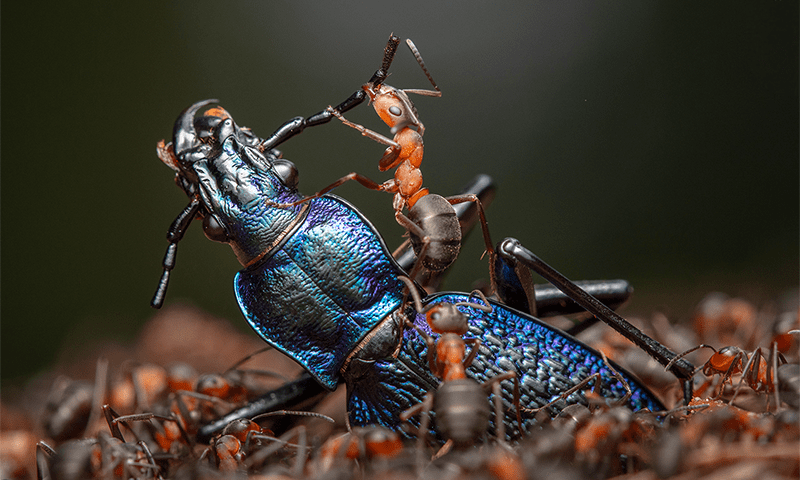
A lone ant summits a fallen blue ground beetle (Carabus intricatus), lifting a limb as if waving a victory flag over its unfortunate victim. German photographer Ingo Arndt captured this triumphant scene to document the chaotic experience that is feeding time for a colony of wood ants (Formica polyctena).
Ants of the Formica group primarily dwell in Europe and are known for their voracious appetites and ability to scavenge prey much larger than themselves. Though these ants are equipped with sizeable mandibles and can spray formic acid from their abdomens, their true predator’s advantage lies in their sheer carrying capacity: Wood ants can carry prey and other objects up to 50 times their own weight, often across foraging trails dozens of feet from their home nests.
And they are even stronger en masse. Wood ants prefer to form colonies of hundreds of thousands of individuals, many of whom dwell inside massive mounds constructed of organic material found on woodland forest floors. These nests serve as the nursing grounds for egg-bearing queens and female worker ants, while larger groups of males mobilize outside of the nest to forage for food and take down unsuspecting prey.
Scientists have observed curious “farming” behavior in these industrious ants, whose primary diet consists of honeydew, the sugary substance produced by sap-eating aphids. Formica ants tend to their aphids as if they were livestock, protecting the smaller insects and their host plants from predators in exchange for the aphid’s secreted honeydew. This mutualistic relationship allows the hard-working Formica colonies to carry as much as 2,000 pounds of aphid secretions back to their colonies a year.
Arndt, whose image won the invertebrate behavior category of the Wildlife Photographer of the Year competition, says that this colony swarmed all over his body mere minutes after he laid down near the nest. Yet the wood ants swiftly redirected their attention to their prey, carving the beetle with impressive efficiency.