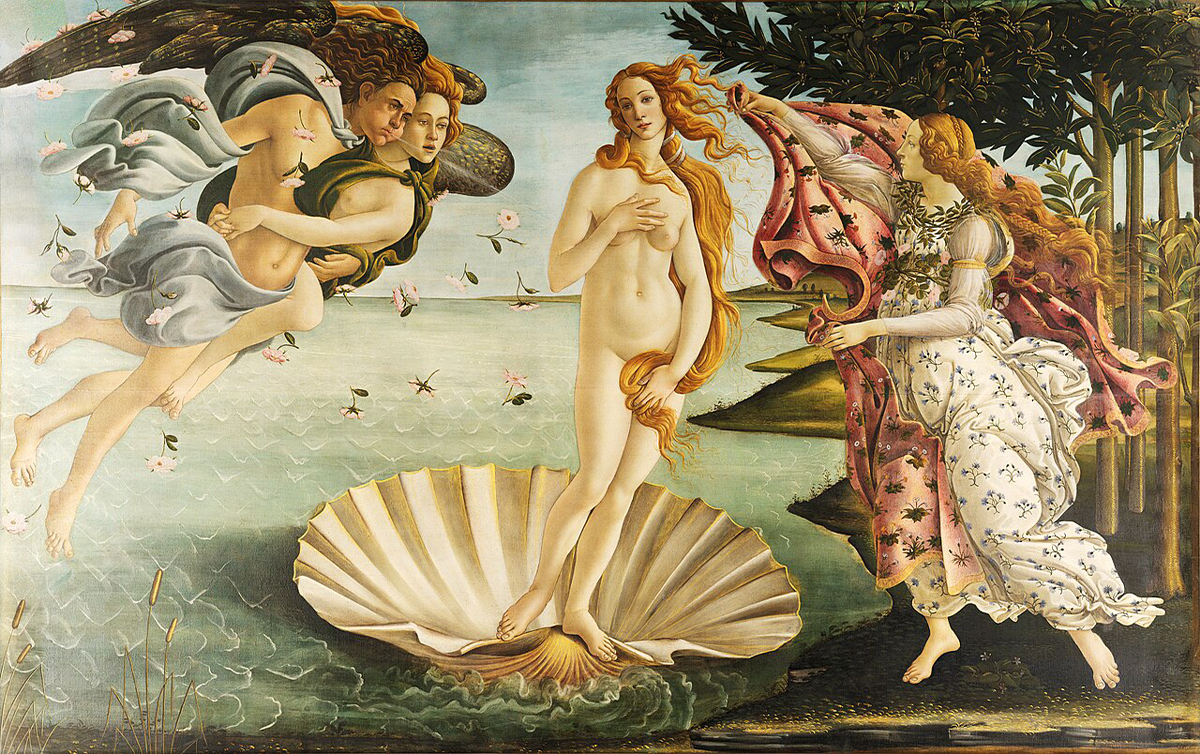
She was the model of Renaissance beauty. A figurative goddess. You may not know her name—Simonetta Vespucci—but you almost certainly know her when you see her. She is Venus, emerging from the sea atop a heavenly scallop shell, in one of the most famous Renaissance paintings of all: The Birth of Venus by Sandro Botticelli. And she died before the master ever put paint to canvas.
Vespucci was muse not just to Botticelli, but to other Florentine painters and poets. And her untimely demise at age 23 has inspired her contemporary physicians and modern-day researchers for some years.
In 2019 scientists used a facial recognition algorithm trained on a deep learning model to analyze depictions of Vespucci, concluding that she likely suffered from a tumor on her pituitary gland, which can cause characteristic facial changes. Now, a team of researchers led by Paolo Pozzilli, an endocrinologist at the Università Campus Bio-Medico di Roma, who coauthored that 2019 paper, has revisited the curious case of Vespucci’s death, bringing historical accounts of her final days to bear. Their research was published in Endocrinology, Diabetes & Metabolism last week.
Pozzilli and his colleagues suggest that the Florentine noblewoman likely died when her pituitary tumor bled profusely after some incident of acute trauma, potentially suffered while dancing at one of the balls she frequented or from a physical assault.
Read more: “Why Beauty Is Not Universal”
The story goes that Vespucci collapsed at a ball in April 1476 after a copious nosebleed. In the space of a few days, she was bedridden. According to correspondence between her father-in-law and an influential patron of Renaissance artists, Vespucci suffered terribly in her waning days. More nosebleeds, a runny nose, high fevers, crushing headaches, and vomiting spells plagued the young woman.
Doctors attending to Vespucci were stumped. One, Maestro Stephano, thought her illness was somehow ingrained, perhaps brought on by living in her husband’s mansion. But Maestro Moyse disagreed. He thought Vespucci was dying of consumption.
Pozzilli and his coauthors argue, however, that Vespucci may have danced herself to death. Balls during the Renaissance often featured alte danze, which involved quick movements and jumps. This frenetic dancing could have caused her pituitary tumor to swell quickly, eventually killing her. “Letters between Piero Vespucci and Lorenzo de'Medici about Simonetta’s final days discuss how she collapsed during a ball and was then resting in a darkened room where she suffered from terrible headaches, hallucinations, vomiting, and high fever,” said Domiziana Nardelli, Ear Nose and Throat (ENT) Resident at the Universita Campus Bio-Medico di Roma and coauthor on the paper. “These are all symptoms of a rapidly expanding pituitary tumour.”
The authors also suggest that Vespucci could have been assaulted by a man near the end of her life. Renaissance poet Lorenzo Sardi intimated that Vespucci was ambushed by Alfonso II D'Aragona, Duke of Calabria, on the banks of the Arno river sometime after 1473. Such an assault, were it to happen, could precipitate a rapid growth of her pituitary tumor.
Although she died in 1476, Botticelli painted his masterpiece in the mid-1480s, years after his muse had succumbed to a traumatic, early death. So moved by her beauty, the artist asked to be buried at Vespucci’s feet shortly before he died in 1510. Indeed the painter lies entombed in a church in Florence, just outside the Vespucci family chapel. 
Enjoying Nautilus? Subscribe to our free newsletter.
Lead image: The Birth of Venus by Sandro Botticelli / Wikimedia Commons