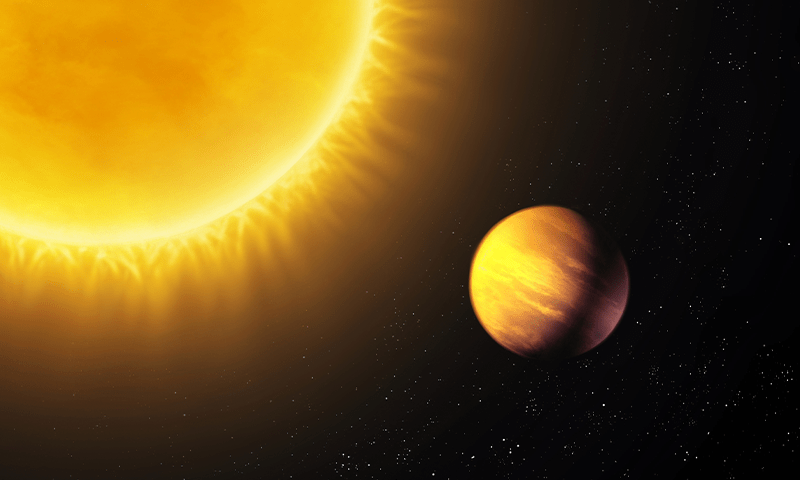
More than 200 light years away from Earth, a planet 70 percent more massive than Neptune whirls around a very sunlike star. A year on this exoplanet is shorter than a day on Earth, lasting only 19 hours. This rapid gravitational dance earned LTT 9779 b a classification as an “ultra-short-period” planet—and it’s far from the strangest thing we’ve uncovered about it.
To achieve this blistering orbit, LTT 9779 b nearly hugs its parent star—a mere 0.017 astronomical units away. (The distance between Earth and the sun is 1 astronomical unit.) This puts it more than twice as close as any artificial spacecraft has gotten to the sun. Perplexingly, given the profound heat this Neptune-like exoplanet is intercepting from its parent star, it still has a substantial atmosphere. The day side sits at a casual 1,800 degrees Celsius, a temperature which ought to be evaporating any atmosphere like Neptune's. In fact, finding a Neptune-like planet this close to its star is extraordinarily rare, to the point that this toasty zone close to the star is known as the “Neptune desert”—a region where traditionally, Neptune-like planets should have their atmospheres vigorously evaporated away in astrophysically short order, leaving behind a barren rocky core, baked to an absolute crisp.
The planet is as reflective as fresh snow.
So what is LTT 9779 b doing there?
It seems to be doing one thing exceptionally well—reflecting a lot of starlight. A new study found that LTT 9779 b reflects 80 percent of the light that hits it, making it about as reflective as fresh snow, or for a wild thermal juxtaposition, Venus. Venus’ reflectiveness is part of what makes it so bright in our morning skies; Mars, by contrast, only reflects about a quarter of the light that hits it. We understand the reflectiveness of Venus—it’s bright because its atmosphere is comprehensively covered in a layer of sulfuric-acid-laden clouds. It’s likely that cloud cover brightens LTT 9779 b, too. However, given the prodigious heat on LTT 9779 b, the clouds must be made of something more exotic than sulfuric acid.
The best theoretical explanation so far is clouds made of both titanium molecules and silicate. Silicates are a broad class of materials, including fun terrestrial materials like glass and white sand—if suspended in a cloud, these would reflect enough light to match the surprising brightness this exoplanet bounces our way.
We may be seeing this planet at an unusual stage of life. It’s possible it formed with a much more Neptune-like atmosphere—with more hydrogen and helium than it has now. Over time, the harsh starlight could have caused the lighter hydrogen and helium atoms to evaporate away, leaving behind an increasingly condensed collection of heavier elements. At some point, clouds of bright sand would have formed in the skies, which could have, in turn, abruptly shielded the planet’s remaining atmosphere from the glare of the star, beginning its bright glimmer into the vast darkness of space. 
Lead image: Nazarii_Neshcherenskyi / Shutterstock