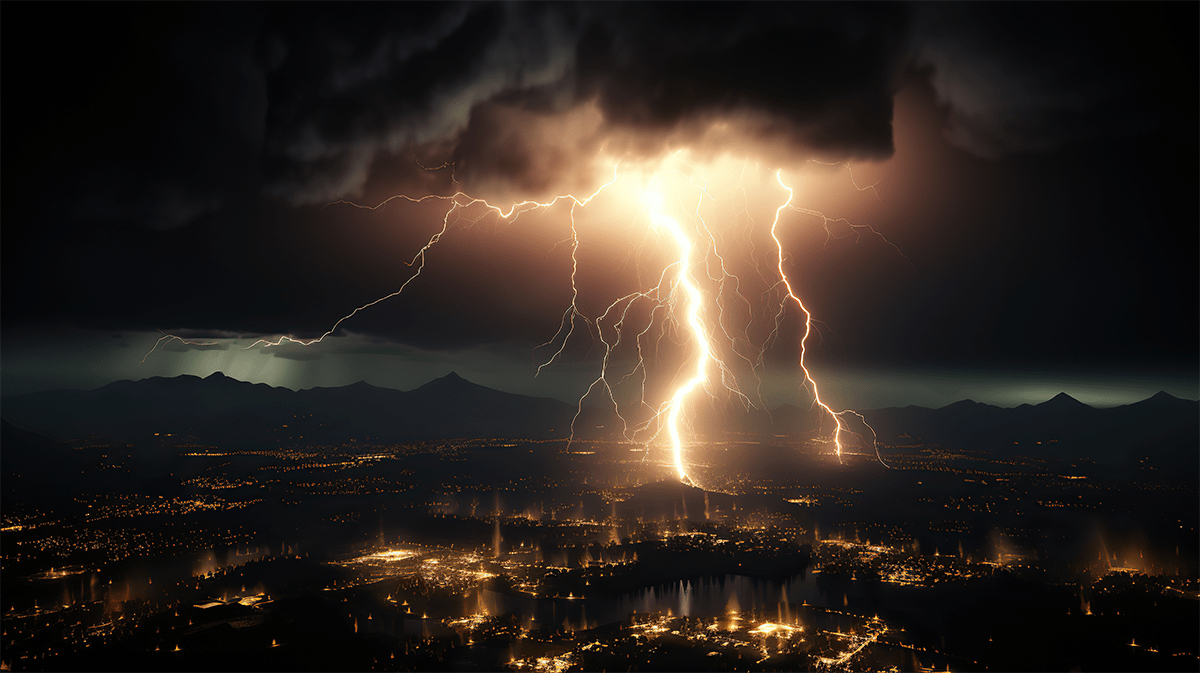
Roy Sullivan came to be known as the “Human Lightning Rod.” The former Virginia park ranger and fire lookout survived seven direct lightning strikes between 1942 and 1977, belying the old saw that lightning never strikes the same place twice. The bolts repeatedly scorched his eyebrows and eyelashes, set his hair on fire, and left him with burns and lingering nerve damage, details documented in ranger logs and medical records. He described the sensation of getting struck as akin to being “cooked inside your skin,” and developed a fear that he was being chased by some supernatural force.
Some people who survive a strike develop unusual talents that they or others attribute to the power of the lightning. Mary Anning, a pioneering English paleontologist and fossil collector, survived a strike by lightning in 1800 that knocked her unconscious when she was just 15 months old. She was likely hit by ground current or a side flash rather than a head-on bolt, but as an adult, she made brilliant contributions to our understanding of prehistoric life and extinction, something her family credited to her encounter with that celestial flash.
Tony Cicoria, a semi-retired orthopedic surgeon, took a sudden interest in piano and began composing music after he was struck by lightning in 1994, including a piece that came to him in a dream that he later dubbed The Lightning Sonata. He was using a pay phone outside of a pavilion in Albany, New York, when he was zapped. He had an out-of-body experience, and then he fell into what he has described as a river of positive energy and was resuscitated on the spot. His case was recounted by neurologist Oliver Sacks in his 2007 book Musicophilia: Tales of Music and the Brain.
Read more: “Ghostly Swamp Lightning Explained”
But lightning roulette is more often a losing game. About 1 in 10 people perish after getting struck, and many more suffer lasting and permanent injuries. A person who is struck may go into cardiac or respiratory arrest, lose consciousness, or suffer temporary paralysis. Survivors can suffer from chronic pain or long-term neurological symptoms such as amnesia, mental confusion, personality changes, and visual hallucinations.
Scientists are still trying to get a handle on what lightning does when it travels through the human body. Because strikes are random and impossible to ethically replicate in a lab, we still don’t know why a flash sometimes travels over the skin, but other times penetrates deep into the internal organs and tissues, or how ground current interacts with the nervous system on a microscopic level. Survivors often develop scars known as Lichtenberg figures, pink fractal patterns that map the route the electricity traveled. Some survivors only show neurological damage months or years after they’re struck, or develop involuntary movement disorders and changes in personality that don’t show up on traditional brain scans. Some report an uncanny ability to sense a storm coming or a sensitivity to static electricity.
Getting struck by lightning remains such an unusual occurrence that it’s become a proverbial measuring stick for vanishingly rare events. You’re more likely to get struck by lightning than to win the lottery, for instance, which is to say not very likely at all. But it’s not all about luck, and because of the lore, some people underestimate the dangers. Annual fatalities from lightning strikes have dropped almost in half, from 55 a year to 21, since 2001, when the National Weather Service launched a “lightning safety awareness week,” which runs every year from June 21 to 28.
Still, hundreds of people are injured by lightning in the United States every year, according to the National Weather Service. Direct strikes only cause 3 to 5 percent of deaths and injuries, which are instead often the result of ground current, side flashes, upward streamers, and “contact,” or when lightning strikes an object that a person is touching or leaning against. The physics of lightning isn’t like the physics of human-generated electricity. It’s a more formidable and sublime beast. In a typical flash, a charged channel zings from a cloud at a speed of 200,000 miles per hour and then flings back upward from the ground at a speed of 200 million miles per hour. Survivors may show signs of blast injury, equivalent to those from a military-grade bomb.
Those who do get hit typically waited too long to go inside or didn’t shelter long enough after the last lightning bolt zigged through the sky or the final clap of thunder rang out. Death by lightning is more common in rural and mountainous areas than urban ones, and these deaths tend to occur during the summer months, in the afternoon. People who get struck are most often on or near water (fishing, boating, hanging at the beach), or out on the land (farming, ranching, or camping).
In the end, Roy Sullivan was able to escape a lightning strike just once. He and his family were in the backyard and a storm suddenly appeared, but this time the bolt hit his wife. After that, every time a storm gathered, he would send his wife and kids into the living room and sit in the kitchen trembling by himself. Sullivan ultimately met his end in Dooms, Virginia, in 1983, at the age of 71. He died by suicide. It had nothing to do with lightning and everything to do with a mysterious, unrequited love. 
Enjoying Nautilus? Subscribe to our free newsletter.
Lead image: faiz / Adobe Stock