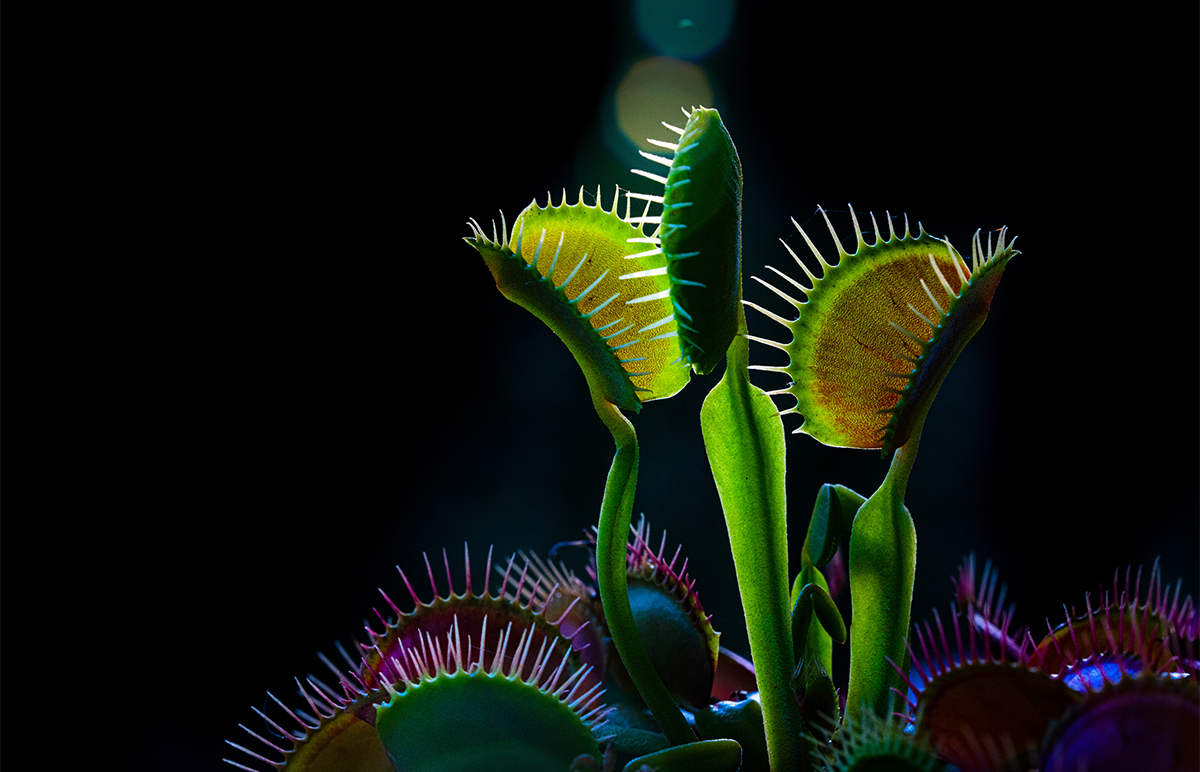
Charles Darwin was fascinated by the Venus flytrap, so much so he called the carnivorous plant “one of the most wonderful plants in the world.”
Of course, one mystery about the Venus flytrap eluded him (and several other botanists)—how its trademark trap snaps shut. But according to new research published in Science, the mystery has finally been solved.
Unlike its carnivorous relatives, the pitcher plant and sundew plant, the Venus flytrap manages to catch insects through a relatively rapid and repeatable movement, virtually unseen elsewhere in the plant world. There were two leading theories for how it manages this feat.
The first theory of the flytrap’s speedy snap involved a “push” from outside. Once triggered, water pressure in the cells lining the outer walls increased. When the outer cells swelled, the trap was sprung. Botanists from Aix-Marseille University in France, however, tested the water-pressure theory and found it took too much time (at least 30 seconds) to be the mechanism responsible.
Read more: “Darwin Was a Slacker and You Should Be Too”
The second theory involved a somewhat opposite mechanism. Instead of the outer cells swelling to push the trap closed, they relaxed, allowing the more turgid inner faces of the trap to pull the trap closed. Using a highly sensitive probe to measure the stiffness of cell walls on both the inner and outer surfaces of the trap, the researchers confirmed the second theory.
Here’s how it works: When an unlucky insect trips the hairs lining the trap, it causes an unknown secondary signal that leads the stiff cell walls on the outside of the trap to relax, which takes about a second. Over the course of that second, the elastic energy stored in the trap becomes unstable, causing it to snap shut.
According to the researchers, this action represents the fastest mechanical change in cell walls that’s ever been measured. They also say it could have applications beyond plant science, offering insights into “muscle-free, bioinspired actuation.”
Either way, the case of how the Venus flytrap captures bugs is now closed. 
Enjoying Nautilus? Subscribe to our free newsletter.
Lead image: gee1999 / Adobe Stock