To view the video, click the “play” icon above.
Deep in the woods”: The opening line of narration is perhaps a little unnerving, a Grimm way to begin a wildlife documentary, especially considering it is filmed on the sunny Canary Island of La Gomera. But, deep in the woods, delving into the past and surrounded by mystery and intrigue, a fairy tale is exactly what we find.
The woods belong to Garajonay National Park, and comprise a subtropical relict laurel forest. Laurel forests were commonplace during the tertiary period, but were lost to the vast majority of the world millions of years ago. La Gomera gives us a glimpse of what the majority of Europe and Northern Africa would have been like before the last ice age. It is a living fossil, offering us an insight deep into the archives of our planet’s history.
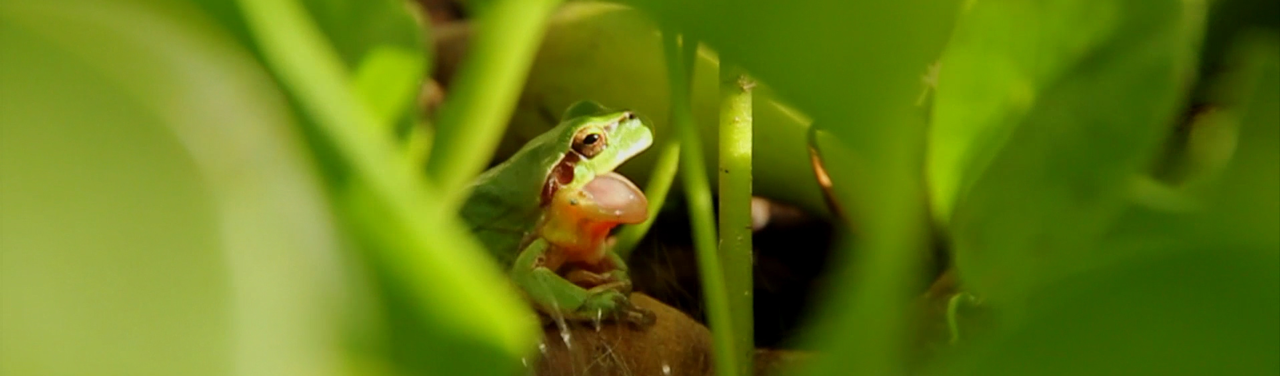
It doesn’t harbor any prehistoric beasts, but it does hold one or two secrets. How can an amphibian be one of the most successful residents on an island that is relatively arid? How can it be so lush and green, so chilly here, when this morning you were shocked at just how sunburned the day-trippers from the neighboring island of Tenerife were?
The knotted, ancient branches envelope you and a palpable density pervades the atmosphere.
Walking through the “laurisilva” that make up the forest, the glossy canopy towering up to 40 meters above your head, is akin to walking back through time. As you enter it you feel an isolating distance between yourself and whatever it was you left behind. You’re suddenly deep in the forest, wondering how long it is you’ve actually been in here. The knotted, ancient branches envelope you and a palpable density pervades the atmosphere. The sounds you hear are muffled, the masses of lichens, foliage, and mosses absorb them.
If, like me, you were afraid of the dark as a child, then just for a second, you feel a little pinch in your mind. A familiar sense of fear descends. But it’s brief. You realize you are in a beautiful, curious place and you delve deeper. You consider that moments ago you were being broiled in the brutal Canary sun. Now you’re rummaging for the coat you were advised to pack, the unnecessary waterproof that has been taking up space in your rucksack until now. Something is happening. There’s that pinch again. The temperature has dropped, there is a little wind worrying the leaves above your head, and you are becoming quite wet. But it’s not raining. The mist is coming in—the horizontal rain, or the “fog-drip effect.” It is the delicately balanced hydrological process that keeps the forest alive.
Unfortunately, this balance is being disturbed. Since the completion of this film, large areas of the forest have been destroyed by fire, and for large stretches only scorched earth and burnt stumps remain. It’s a reminder of how finely balanced the world we inhabit is, and how valuable are ancient woods like these. Filmed on location over July and August 2011 in La Gomera, this film takes us to a little-known, remarkable, and ancient part of the world—one that may be gone all too soon.
Writer and director of In the Mist, Christopher Wharton runs Skinnybeard Productions.
Clarifications
1. Average annual rainfall in areas closer to sea level is less than 350 millimeters; but in higher elevation locations, like within the Garajonay National Forest, average annual rainfall approaches 800 millimeters.
2. While there are no settlements within the national park, some islanders live at the park border. The population of La Gomera is approximately 22,000.
3. The name of the neighboring island, across a submarine volcano from La Gomera, is La Palma.