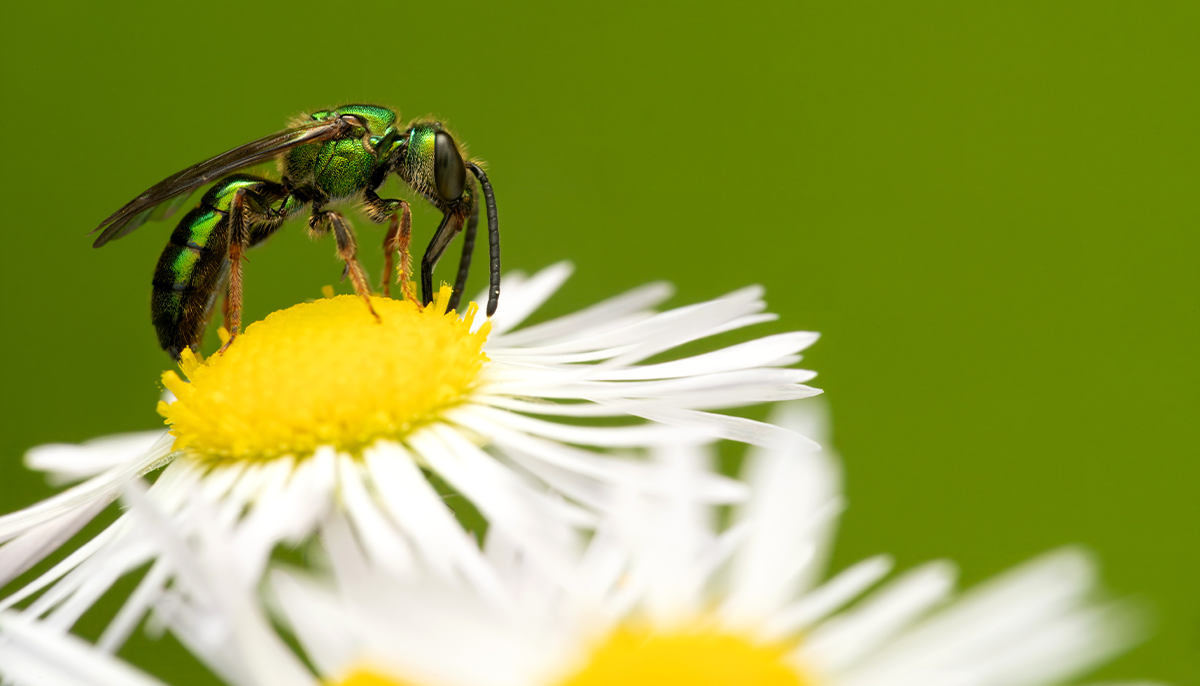
Many animals are color-change masters, shifting their appearance to hide from predators, thermoregulate, or advertise their wares to potential mates. Arctic mammals shed brown coats of fur to grow white ones for winter camouflage. Octopuses take on new hues in milliseconds by expanding and contracting pigmented skin cells. And now, a study in Biology Letters explores the science behind anecdotal reports of sweat bees (family Halictidae) taking on different colors depending on environmental conditions.
Researchers from London and the United States studied some specimens of the North American sweat bee (Agapostemon subtilior) that had been in museum collections for years and others that were recently pulled from the wild. They exposed the bees to contrasting humidity treatments: a low-humidity chamber (10 percent or less relative humidity) and a high-humidity chamber (95 percent relative humidity).
Read more: “Forget the Ordinary Honeybee; Look at the Beautiful Bees They’re Crowding Out”
The heightened humidity induced a dramatic color change within 24 hours from a deep blue-green to a paler, reddish-green. And, intriguingly, the shift was reversible. Dialing back down the humidity returned the bees to the bluer color. “These bees aren’t choosing to change color—it’s happening passively, simply in response to the humidity around them,” explained study author and Queen Mary University ecologist Madeleine Oswald in a statement.
It’s known that bees get their body color not from pigments, but from a microscopic texture that affects the way light scatters. Like blue morph butterflies or hummingbirds, a bee’s color can’t be controlled by manipulating skin cells. But, with more humidity, the micro-structures conferring color may swell, shifting an insect’s hue.
When the researchers analyzed photos of sweat bees in the wild, they noted that bees from more arid environments tended to look bluer, corroborating the lab findings. But whether the color change has any adaptive significance for the bees is unknown. This finding “adds a whole new layer of mystery to why these colors evolved in the first place,” said Oswald. “Bees are incredibly diverse and colorful—and we’re only just starting to understand how their appearance reflects the climate they live in.”
Color us impressed. 
Enjoying Nautilus? Subscribe to our free newsletter.
Lead image: Simon / Adobe Stock