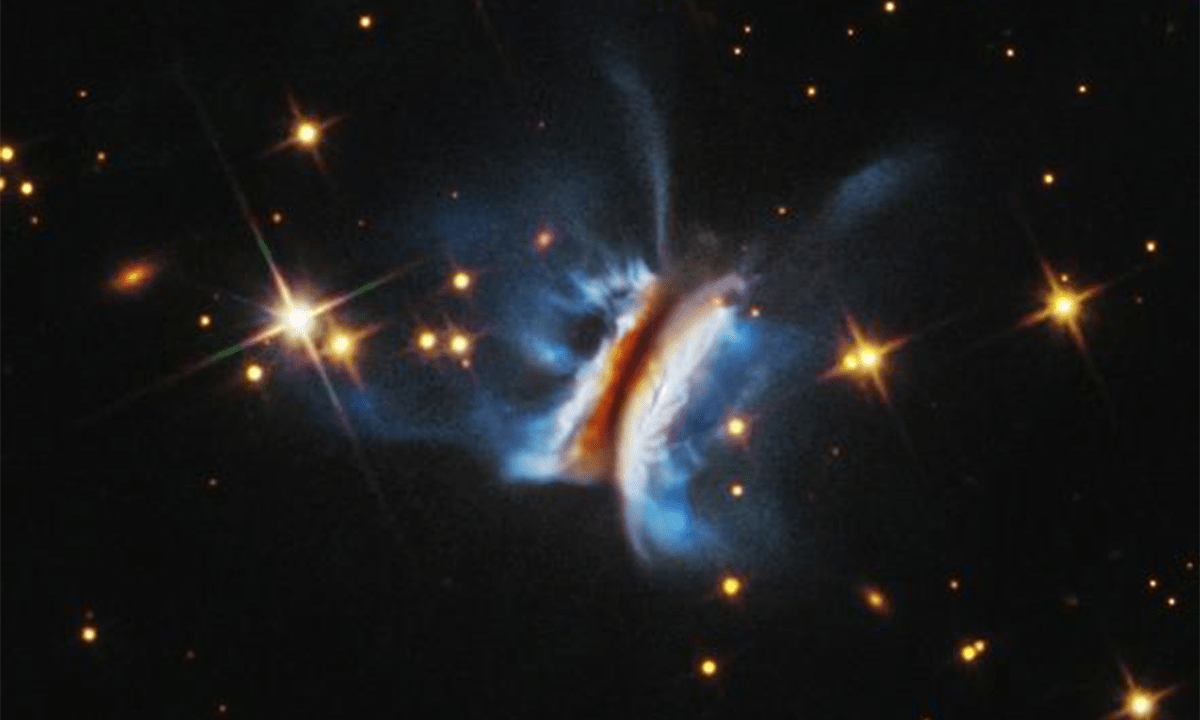
This image might look a bit like a radioactive hamburger floating in space, but you’re actually gazing at the biggest planet-forming disk ever seen around a young star. The disorderly disk has a diameter of almost 400 billion miles, or around 40 times the diameter of our entire solar system.
The size of the disk, and the fact that it is oriented with its edge facing the Earth—which blocks the central star’s glare—made it possible for NASA’s Hubble Space Telescope to capture it in great detail with visible light: Wisps of dust and gas extend farther above and below the disk than ever observed in similar systems.
Nicknamed Dracula’s Chivito, the peculiar planetary nursery was only recognized as a protoplanetary disk in 2024, and it sits around 1,000 light-years-from Earth. The name is a nod to two researchers who helped discover it, who hail from Transylvania and Uruguay—there, the chivito sandwich is the national dish.
Read more: “Visit the 7 Most Extreme Planets in the Universe”
New insights from this unique look at Dracula’s Chivito were recently published in The Astrophysical Journal.
“The level of detail we're seeing is rare in protoplanetary disk imaging, and these new Hubble images show that planet nurseries can be much more active and chaotic than we expected,” said Kristina Monsch, an astrophysicist at the Center for Astrophysics, Harvard & Smithsonian, in a statement.
Another odd detail in the Dracula’s Chivito image: Monsch and her co-authors only observed longer, antennae-like filaments of gas and dust on the northern side of the disk. “We were stunned to see how asymmetric this disk is,” said paper co-author Joshua Bennett Lovell, an astronomer at the Center for Astrophysics. This strange feature suggests that “dynamic processes, like the recent infall of dust and gas, or interactions with its surroundings, are shaping the disk,” according to the statement.
Protoplanetary disks are cosmic nurseries for planets. They form from the leftover dust and gas surrounding baby stars. The researchers suggest that Dracula’s Chivito resembles a bigger version of our own infant solar system, containing enough ingredients to spawn several gas giants like Jupiter. Ultimately, this space sandwich could help reveal new secrets about the formation of planetary systems like ours.
“Hubble has given us a front row seat to the chaotic processes that are shaping disks as they build new planets—processes that we don't yet fully understand but can now study in a whole new way,” Lovell said. 
Enjoying Nautilus? Subscribe to our free newsletter.
Lead image: NASA, ESA, STScI, Kristina Monsch (CfA); processing: STScI/ Joseph DePasquale