With every photo and video that comes back of Mars, we’re getting a clearer picture of the Red Planet: its surface, its atmosphere, its geological history, and its composition. And a spectacular new bit of footage just dropped.
It comes from the NASA Psyche spacecraft, which is on its way to the metal-rich Psyche asteroid between Mars and Jupiter.
The craft should reach Psyche in 2029, but Mars, of course, is along the way, giving NASA researchers an opportunity to test out the battery of instruments on board the probe and get a unique look at the planet at the same time.
In the time-lapse video, Mars first appears mostly in shadows—giving astronomers a valuable look at the clouds in its atmosphere; as Psyche leaves, though, we get a much fuller view of the planet and its surface.
In between its arrival (May 2) and departure (May 31), the spacecraft captured a variety of incredible shots of the Red Planet, taken with two identical cameras that photograph different wavelengths of light.
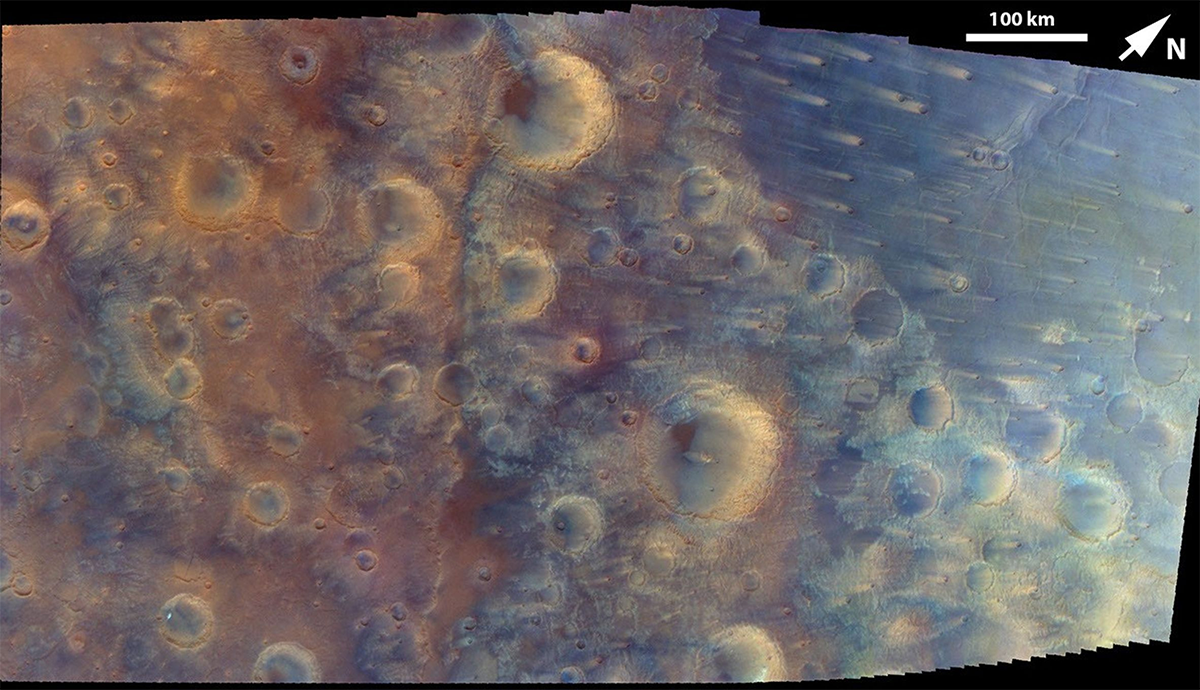
At one point, Psyche got as close as 2,864 miles from the Martian surface, snapping images of the Huygens Crater, Mars’ south polar ice cap, and windblown streaks of sand covering the surface.
Read more: “My Personal Quest to Study Supernovae on Mars”
“The imager performed brilliantly, delivering some rarely seen views of the Red Planet,” Jim Bell, the Psyche imager instrument lead at Arizona State University, said in a statement. “Besides the obvious beauty of the photos, we were also able to fully test its calibration and sensitivity to scattered light.”
Psyche possesses a number of other advanced instruments besides the cameras, and NASA scientists were able to use them to test for magnetic field and neutron readings to better understand the rocks and materials that make up Mars.
In addition to being useful trial runs for taking measurements of the Psyche asteroid, the data collected here can also be compared to readings collected on other missions, including the Curiosity and Perseverance rovers.
“The mission’s imager, magnetometer, and gamma-ray and neutron spectrometer teams worked overtime to make full use of this planetary encounter, and all instruments delivered great results,” Lindy Elkins-Tanton, principal investigator for Psyche at the University of California, Berkeley, said. “We didn’t anticipate big discoveries, given how extensively the planet has been studied, but we did complement Mars science with the data we collected through Psyche’s unique perspective.” 
Enjoying Nautilus? Subscribe to our free newsletter.
Lead image: A color mosaic of the Mars surface, collected by the multispectral imager. Credit: NASA / JPL-Caltech / ASU