Stripped down to compression shorts and bejeweled with reflective motion capture dots scattered across my body, I recently danced before an array of cameras as a team of researchers looked on. Ostensibly, I was there to help them understand lower back pain, an affliction with which I have lately become all too familiar. As part of their analysis, they capture everyday body movements performed by me and other study participants, digitizing our skeletons and seeking patterns in the pained bends and stretches of our aching bones.
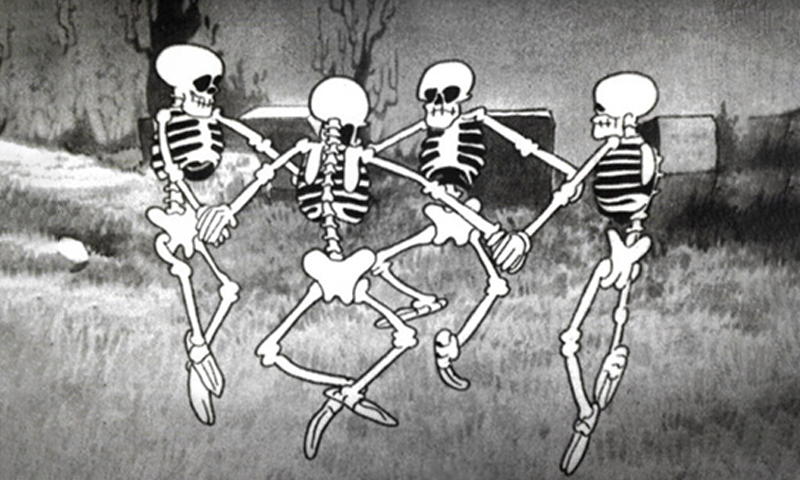
I was not asked to dance. I was told simply to bend and stretch. But for me, being transformed into a cartoon skeleton was too great an opportunity to constrain to dispassionate data collection. And being in the midst of the spooky season, I thought it appropriate to mimic a classic routine, first performed by icons of early animation. Luckily my scientific handlers indulged my whimsy. Here, I present my interpretation of 1929’s The Skeleton Dance, Walt Disney’s first Silly Symphony animated short.
First the original:
And now my take:
This all took place in the lab of Linda Van Dillen, a physical therapy researcher at the nearby Washington University in St. Louis, whose study I enrolled in after tweaking my back a few months ago while doing household chores.
Van Dillen and her colleagues seek to alleviate the suffering of people who have what they term low back pain. Worldwide, it is the leading cause of disability, afflicting nearly 60-80 percent of adults at some point in their lives. By studying people with varying degrees of aches like mine for several months after that first twinge of pain, her team seeks to characterize the transition from acute to chronic low back pain. If they can identify similarities in the ways that people with acute and chronic back pain move, doctors and therapists might be able to target specific areas of the body before that initial pang becomes a longstanding ache, Van Dillen recently told me in an email.
So, every month or so, my fellow study subjects and I travel to WashU to help Van Dillen’s team capture the characteristic movements of people in the grips of such aches and pains. When we get there, researchers cover our legs, pelvises, chests, and a single arm in reflective dots and have us perform simple movements such as bending down to pick up a box. They record everything with 8 high-tech, motion-capture cameras of the sort used in Hollywood blockbusters that bring impossible creatures to life on the big screen. Between sessions, we answer surveys that track not only our pain symptoms, but other biological and psychological factors related to our lingering discomfort.
The scientists will later analyze the data they are collecting, with the goal of improving and standardizing the evaluation process physicians use to diagnose and care for those who suffer from low back pain. By following our progress over the course of a year, Van Dillen and her team hope to emerge with a better method for early detection and treatment of such pain. These improvements could stop acute low back pain before it becomes a chronic problem, reducing “healthcare spending for this often costly, long-term condition,” she said.
A worthy scientific goal, for sure. But also a perfect opportunity for a bit of fun. Enjoy my dancing skeleton and please let it remind you—as it does me—that un-seriousness is sometimes the best medicine. 
Enjoying Nautilus? Subscribe to our free newsletter.
Lead image: Still from 1929's The Skeleton Dance, the first Silly Symphony from Walt Disney