Penguin poo, or guano, is a popular resource. Nests for penguin eggs are bowl-shaped depressions that the parents hollow into piles of guano and soil. And farmers love penguin guano for its rich nutrients, particularly nitrogen. In fact, guano harvest for farm fertilizer during the 19th century forced penguins to lay so many eggs on exposed ground that it led to population crashes.
Now, it turns out that guano is also useful for monitoring penguin recovery and responses to modern threats, as a recent study published in Current Biology used guano patterns to decipher how global climate change is affecting penguins.
“It’s exactly what it sounds like,” explained study author Michael Polito, a marine biologist at the University of California, Santa Cruz, in a press release. “We spied on penguins from space by using satellite images to figure out what they eat all around Antarctica to help explain their diet and population response to recent climate change.”
Read more: “My Life with the Penguins”
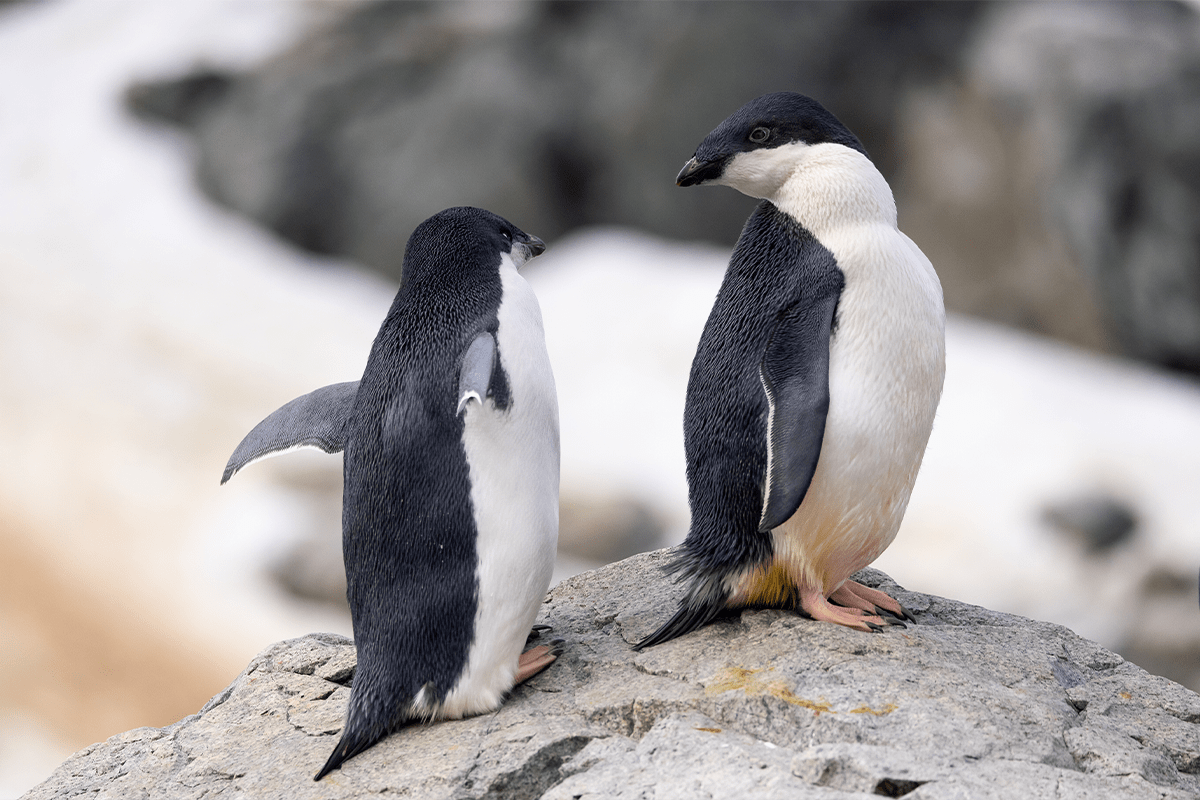
A group of wildlife biologists from several United States universities collaborated with NASA and the U.S. Geological Survey to plot annual shifts in the diets of Adélie penguins (Pygoscelis adeliae) over three decades. A 2018 study demonstrated the utility of Landsat images in penguin research, identifying an unknown colony of more than 1.5 million Adélie penguins on the Danger Islands off Antarctica. The recent study deepens the findings by analyzing guano color across Adélies’ Antarctic range to assess population health.
In combining spectral image analysis with isotope analysis of guano field samples, the researchers found pronounced geographic differences in penguin diet among the 119 known Adélie populations. In areas with more sea ice, the penguins fed mostly on fish, primarily silverfish. In areas with declining sea ice, they shifted to a krill-heavy diet, feeding lower in the food web. Furthermore, year-to-year variations in their diets were strongly linked to fluctuations in sea ice, a connection the study authors attribute to reduced abundance of silverfish during warm years.
The results also showed that colonies that had to rely on krill were more likely to suffer population declines than those eating fish. Because penguin chicks get more nutrition from fish, they tend to grow larger on a fish diet than on a krill diet. Adélie penguins must compete with seals and whales for krill as well.
Unfortunately, since data collection for this study ended in 2013, sea ice has continued to decline to record low levels. “[Adélie penguins] act as a ‘canary in the coal mine,’” said Polito, “and our study illustrates how recent warming has disrupted the Antarctic marine food web they rely on to the detriment of many of their populations.” 
Enjoying Nautilus? Subscribe to our free newsletter.
Lead image: Julie Chandelier / Ocean Image Bank