How big must a black hole be to inflict serious injuries—or even death—when whooshing through a person’s body?
This odd cosmic question was ripped from the pages of a 1974 science-fiction story, “The Hole Man,” by author Larry Niven, in which a scientist visiting Mars kills his surly captain by unleashing a black hole from an alien device.
“I wanted to see if this would be possible,” said Robert Scherrer, a physicist at Vanderbilt University, in a statement.
Scherrer recently crunched the numbers, and suggested that the mass of this deadly black hole must have been roughly equivalent to the size of an asteroid or larger, as he wrote in the International Journal of Modern Physics D. Beyond Scherrer’s fascination with the decades-old sci-fi tale, he was also inspired by his previous work investigating the hypothetical effects of macroscopic dark matter, or macros, on the human body.
Read more: “The Big Bang Is Hard Science. It Is Also a Creation Story.”
Macros are just one class of candidates proposed to constitute dark matter, a mysterious substance that may account for around 85 percent of our universe’s mass. Because no macros-inflicted human injuries have been reported, the paper argued, this constrains their theoretical sizes to exclude those that would tear through people like bullets.
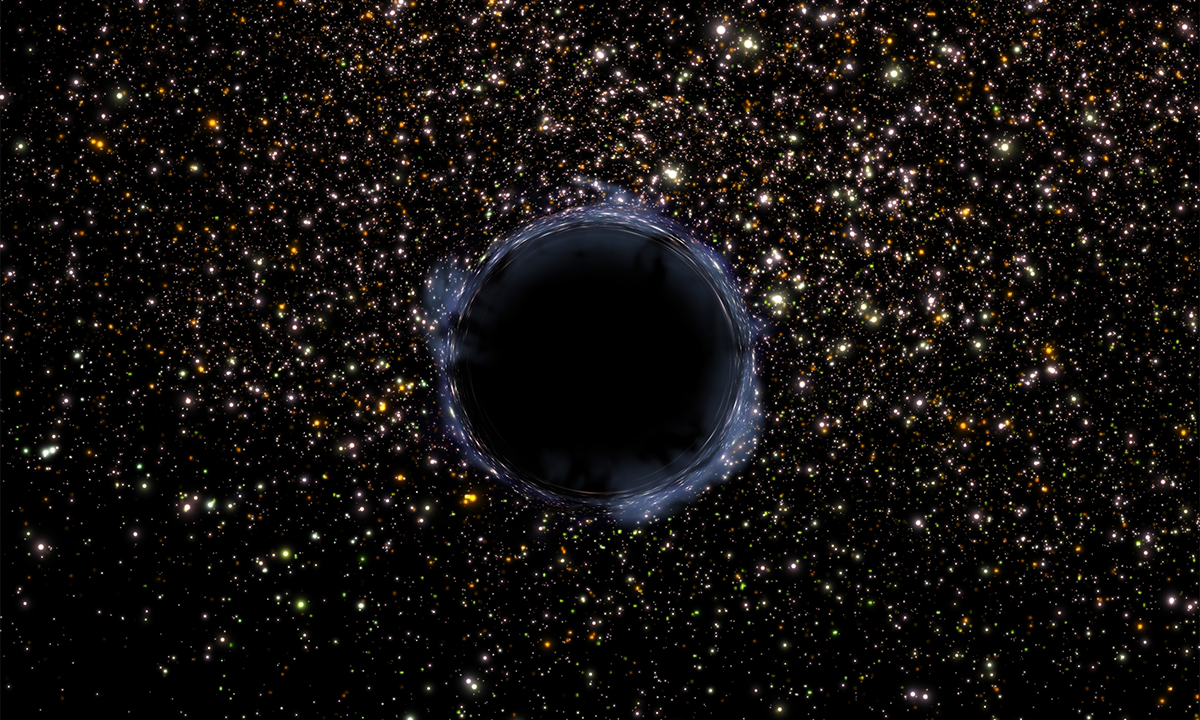
Alternatively, some or all of the dark matter that makes up most of our universe might be made of primordial black holes, which are hypothetical objects thought to have formed within a second after the Big Bang. Their masses may lie anywhere between 100,000 times less than that of a paperclip and up to 100,000 times the sun’s mass.
In his new paper, Scherrer explored two gravitational phenomena associated with a primordial black hole tearing through our flesh: supersonic shock waves and tidal gravitational forces. The former emerge when an object moves quicker than the speed of sound, creating “a powerful disturbance in the shape of a cone,” according to the statement. Meanwhile, tidal gravitational forces are associated with varying strength of gravity between two points, resulting in a stretching and pulling force.
The shock waves would bite through us like a bullet, he wrote, “destroying tissue along the way.” Then, tidal gravitational forces “would tend to tear apart cells in the body.” According to his math, Scherrer suggests that the initial shock wave would ultimately prove the most destructive aspect involved.
Don’t fret, though—we don’t know whether primordial black holes actually exist. Plus, the potential number of primordial black holes with high enough mass to do damage “is far too small to produce any observable effects on the human population,” Scherrer wrote.
So, we’re safe for now. At least until we encounter alien technology capable of the dangers portrayed in “The Hole Man.” 
Enjoying Nautilus? Subscribe to our free newsletter.
Lead image: NASA/ESA and G. Bacon (STScI)