It’s hard to get more dead than extinct. Extinct things are considered permanently annihilated: no second chances, no descendants, no return. Except that, it turns out extinct volcanoes may not be as dead as geologists had supposed. New data suggests that while they appear to be in a permanent slumber, these volcanoes may actually be quietly simmering, building up larger and potentially more dangerous stores of magma underground.
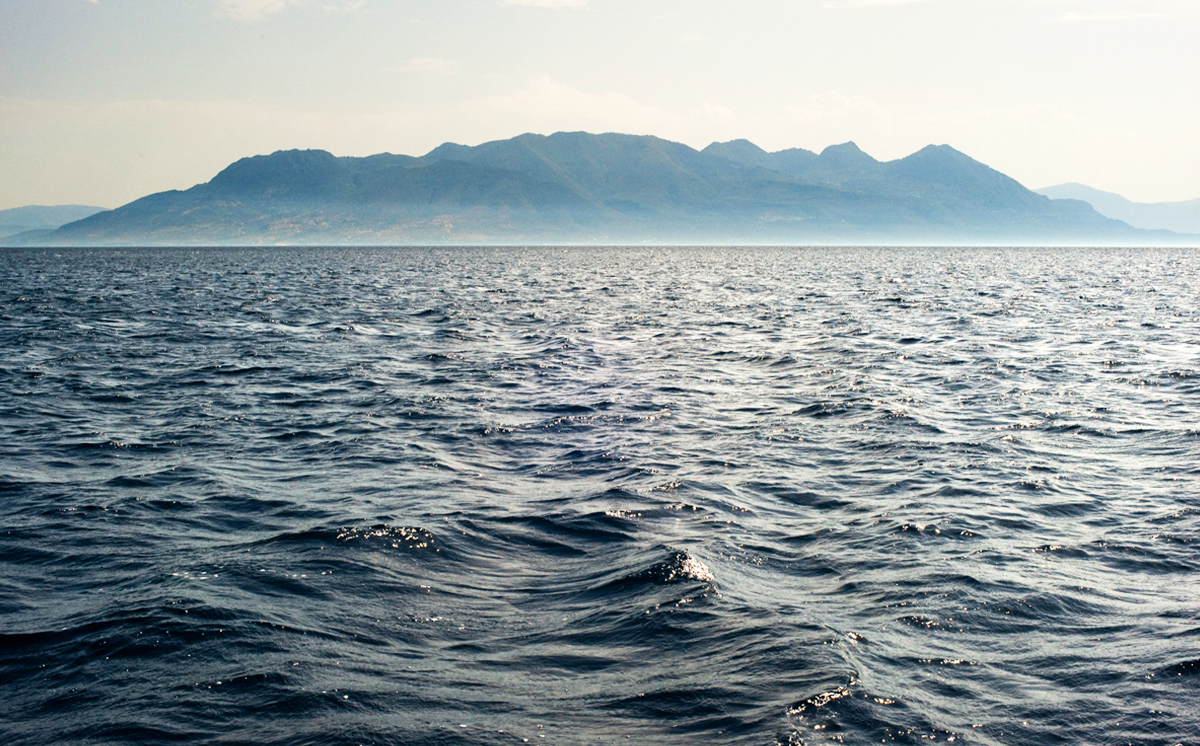
An international team of scientists recently reconstructed the long history of a 1,400-foot volcano known as Methana, near Athens, Greece, which looms over the Saronic Gulf in the Aegean Sea. Methana last erupted around 2,200 years ago. The ancient Greek historian Strabo was there—or close enough: “A seven-stage high mountain was raised from a fiery eruption, during the day inaccessible due to the heat and sulfurous odor, but at night fragrant, glowing from afar and warming the sea for five stadia, and murky,” he wrote.
Methana was considered an active volcano, not an extinct one, but when the team of scientists analyzed its ancient past, they found that in the middle of its 700,000-year lifetime, it had once slumbered for more than 100,000 years. And during that time, potent magma was quietly gathering in the volcano’s underground chambers.
This was a surprise: Geologists have long classified volcanoes as extinct if they’ve been quiet for just a fraction of that: 10,000 years. The thinking was that if a volcano hadn’t erupted for such a vast stretch of time, the source of magma must have been extinguished. Never again would it pour lava down its flanks or into villages, forests, rivers, and valleys below. The scientists determined that the opposite may be true: The quiet period can obscure magma spreading deep in the volcano's bowels. The findings have implications for many volcanoes around the world that are classified as extinct. These volcanoes often are not monitored.
“We strongly believe that we need to reassess how we define active, dormant, and extinct volcanoes, and we hope that our work will be a step forward in this direction,” wrote study author Răzvan-Gabriel Popa, a volcanologist and senior researcher at ETH Zurich in Switzerland, in an email. “It’s critical for hazard assessment, especially in areas where lots of people live.”
Read more: “The Volcano That Shrouded the Earth and Gave Birth to a Monster”
The scientists were already skeptical that “extinct” really meant forever dead when it comes to volcanoes. In recent years, some volcanoes thought to be permanently defunct have reawakened: Taftan in Iran, for example, has been showing signs of unrest since 2023, and Hayli Gubbi in Ethiopia erupted in 2025 after 12,000 years of silence, says Popa.
The team decided to investigate Methana in part because of its physical layout. Different eruptions from different time periods are all accessible and distinguishable at the surface.
“We wanted to study Methana because this volcano has a huge advantage: The different lava flows are not piled up and don’t bury each other,” says Popa. They stretch across a wide area, “each eruption forming its own hill.” This allowed them to reconstruct the long-term evolution of the volcano. “The fact that it had an eruption 2,200 years ago, combined with its proximity to Athens, a densely populated urban center, also prompted us to look at it in detail,” Popa notes.
The team found that the magma in the volcano’s chambers was rich in water, which caused the molten rock to crystallize, slowing its movement and helping to put a lid on eruptions as the magma reservoir spread. The researchers studied these crystals, known as zircon, which form as magma cools, and can act like time machines, saving information about conditions in the volcano. They dated 1,250 of these crystals across 700,000 years of volcanic history and learned that during the 100,000-year quiet period zircon growth peaked, evidence of intense magma buildup.
Methana is a subduction zone volcano, a steep-sided volcano located at a tectonic boundary where a dense oceanic plate dives beneath either a continental plate or a younger oceanic plate. As the sinking upper plate descends into the mantle, it tends to release water and gases, which melts surrounding rock. The scientists believe that many other subduction zone volcanoes may similarly be periodically flooded by wet primitive magma that then pools over time, forming crystals that prevent eruption.
Today many subduction zone volcanoes in Greece, Italy, Indonesia, Philippines, South and North America, and Japan, are considered extinct, and are therefore not currently being monitored. But they may be more alive than supposed.
Ciomadul, in the eastern Carpathian Mountains of Romania, is one such volcano that warrants closer monitoring, according to Popa. It last erupted 30,000 years ago. But recent research shows that it has an active magma supply underground. “This is a clear example of a Methana-type volcano that has been sleeping for a very long time but is building up its magma chamber,” he says. “A quiet volcano is not necessarily safe.” 
Enjoying Nautilus? Subscribe to our free newsletter.
Lead image: Ggia / Wikimedia Commons