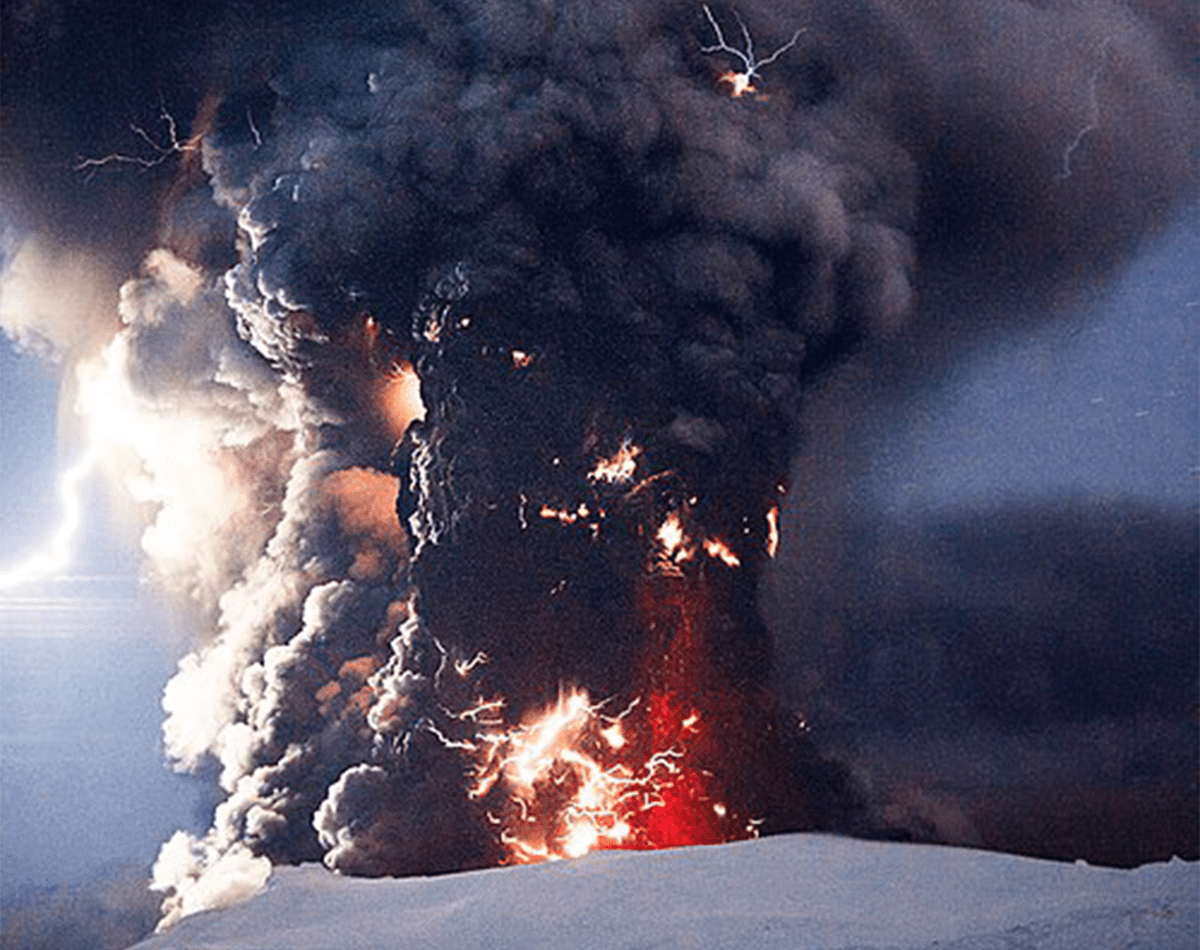
When Mount Vesuvius erupted in 79 A.D., Pliny the Younger described the cataclysmic event writing, “There was a most intense darkness rendered more appalling by the fitful gleam of torches at intervals obscured by the transient blaze of lightning.” While Pliny may not have known it, lightning is a common occurrence during volcanic eruptions and sandstorms too. But what causes it? A study recently published in Nature is shedding light on this strange phenomena.
Scott Waitukaitis of the Institute of Science and Technology Austria experimented on silicon dioxide (also known as quartz), a major component of sand and volcanic ash. Silicon dioxide is an electrical insulator, meaning it doesn’t conduct electricity. When two quartz particles meet, they shouldn’t exchange an electrical charge. And yet they do.
To investigate how these crystals can produce a spark, Waitukaitis and his team levitated tiny quartz grains with sound to prevent any contact charges, and then subjected them to a battery of experiments. Water, the polarized molecule responsible for the lightning from thunderclouds, turned out to be a dead end. Eventually, they found that heating the quartz crystals could produce a negative charge.
Read more: “What Volcanoes Tell Us”
The reason, the researchers say, has little to do with the crystals themselves. Instead, a fine layer of atmospheric carbon settled on the quartz, and when it was stripped off by heat, the crystals became charged. Repeating the experiment with other naturally occurring dioxide insulators yielded similar results.
“Most of these materials in nature are little particles smaller than one millimeter. They charge by colliding, rubbing, and rolling all over each other,” Waitukaitis said in a statement. “That’s why desert sand, volcanic ash clouds, and dust particles get charged.”
But these findings go beyond merely explaining the awe-inspiring sight of volcanic lightning. In fact they could help explain how planets are formed from dust and how primordial amino acids made the leap to assemble and form complex proteins.
“Some current models of planetary formation rely on a predominant effect of charge,” Waitukaitis said. “As such, our research might have just shed light on the mechanism underlying the sparks of creation.”
Not bad for a few grains of sand. 
Enjoying Nautilus? Subscribe to our free newsletter.
Lead image: Terje Sørgjerd / Wikimedia Commons