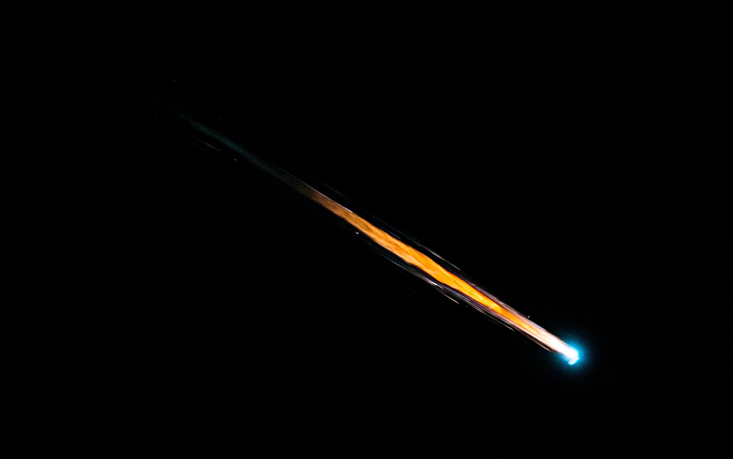
This Friday, NASA’s Cassini probe will run out of fuel and take pictures as it plummets at 75,000 miles per hour through Saturn’s atmosphere. It won’t be crashing—the heat from friction will make Cassini immolate in the sky.
Cassini has had a good run. Since arriving at Saturn in 2004, the probe has transmitted stunning images of the ringed planet, including its uncanny hexagonal storm, and of its many moons. It found the largest, Titan, harboring methane oceans and icy Enceladus venting water-rich plumes from over 100 so-far identified geysers; the latter might bear ocean life beneath its miles-thick ice cover. Cassini’s dive towards Saturn’s surface will present scientists with a never-before-seen perspective of the planet, along with its atmosphere and magnetic fields, and data on Saturn’s rings’ age and make-up.
It’s the possibility of contaminating Saturn’s moons, though, that is the more interesting motivation for what NASA has been calling Cassini’s “Grand Finale.” “Whenever NASA plans any missions, they always include plans for what we call spacecraft disposal,” said Morgan Cable, a NASA research scientist working on the Cassini mission. Even the best sterilization methods can leave some bacterial spores behind, which can survive in space for years in a sort of hibernation. “We have to follow that planetary protection rule of trying not to leave any evidence of Earth-based life anywhere that we’re trying to look for other types of life.”
Saturn, a gas giant, doesn’t have conditions suitable for life, so there’s no worry there. “The worst thing would be going to say, Enceladus, or Titan, and finding life and realizing that we put it there with Cassini or one of our previous missions,” Cable said. “‘Are we alone? ‘Is there other life in solar system?’ We want the real answer, not the ‘oops’ answer.”
Titan may already be contaminated. In 2004, Cassini sent its passenger, the Huygens probe, down there. “There is a small chance that we did bring some bacterial hitchhiker along with us, but the conditions that are present on the surface of Titan,” Cable said, “are not conducive to letting life grow and metabolize.” It was a risk worth taking, largely because Titan is chilly—minus 290 degrees Fahrenheit, to be precise. Under these conditions, water becomes as hard as granite. No Earth-based life we know of would be able to thrive and reproduce there. “If we did bring a hitchhiker along, it’s just going to stay there,” Cable said. “Attached to the probe forever, frozen in time.”
Enceladus is different. Astrobiologists generally agree that Enceladus is the most promising place in the solar system for extraterrestrial life. Underneath a solid shell of ice lurks an ocean of salty, liquid water. If Cassini crashed into the surface of Enceladus, according to Cable, falling water from the jets could drift down to the surface as snow, covering and protecting it. Under this blanket of snow, microbial hitchhikers on Cassini could survive and one day make their way into warm interior oceans, contaminating them.
Even critics of NASA’s planetary protection, like Alberto Fairén, a planetary scientist at Cornell University, believe that keeping Cassini well away from Saturn’s moons is the right choice. “The costs [of cleaning] are high, and go up as the cleaning gets more thorough,” he said. “These high costs are actually delaying the biological exploration of Mars.”
The Viking rover missions to Mars, for example, spent about a quarter of its nearly billion-dollar budget on sterilization. Nevertheless, a couple hundred of thousand microbes were left to piggyback on the rover. Since then, sterilizing has been less stringent. A perfectly clean spacecraft, scientists have come to realize, is a pipe dream. Cassini, for its part, will leave almost no trace of itself after its swan dive.
Still, contamination fears shouldn’t hamper our ventures into space. “We need to try to avoid contamination of other planets,” Fairén said, “but our protective approaches should never be an obstacle to continuing exploring our planetary neighborhood.”
As Cable put it, “At the heart of everything is our drive to explore.”
Dan Garisto is an editorial intern at Nautilus.