You die at the beginning of Mass Effect 2. It’s 2183, and you—Commander Shepard—have just saved every space-faring species in the Milky Way from an extra-galactic threat. You’re on a scouting run for any remaining foes when an unfamiliar vessel somehow intercepts your course and attacks. In the resulting explosion, you’re flung into the void, drifting as you struggle to breathe. The military logs you as “killed in action.”
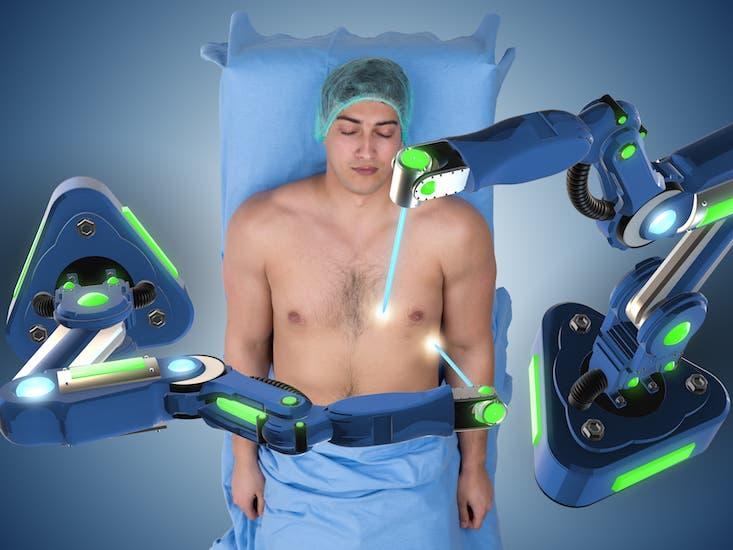
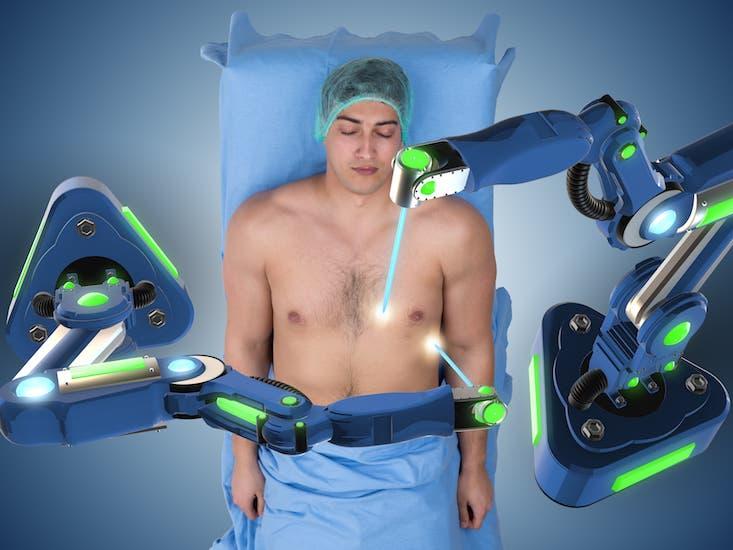
But of course, a deceased protagonist does not a sequel make. Your corpse is soon found and brought back to life. Much of the work seems automated. Robot arms bearing scalpels and needles and cybernetic gadgets tend to you. But, when you come to, two years later, two human doctors are standing above you. One wonders: In 2185, why are surgical robots still overseen by human doctors?
The idea that a surgical robot could ever substitute for the real thing is “a real stretch,” Ken Goldberg, a distinguished U.C. Berkeley roboticist and researcher, told interviewer Jeanne Carstensen in a conversation with Nautilus in 2015. “Creativity and ingenuity does come up all the time in surgeries, where surgeons come up with new instruments. They have a new way of doing something. There’s all kinds of clever instruments.”
The most recent case of surgeons using a clever instrument to do something new: Transoral robotic surgery. It was invented at the University of Pennsylvania just over a decade ago to treat cancer patients. “It allows us to use a robot, which we guide and control, to work through the mouth using a laser to resect the tumor completely…It’s changed the lives of our patients,” says Eric M. Genden, chairman of Mount Sinai’s Ear, Nose, and Throat/Head and Neck Surgery department. Before transoral robotic surgery, patients would typically be treated with “an incision through the lip and the jaw to gain access to the tumor. That’s a 10-12 hour surgery. They’re typically in the hospital for up to two weeks,” he said. “Now patients who are typically in the operating room for 12 hours are only in the operating room for an hour and half to two hours.”
Last year, doctors used transoral robotic surgery to treat a 27-year-old’s chordoma, a rare form of cancer arising in the bones of the skull base and spine, for the first time. The news was announced last week. “The capability of this technology and procedure is revolutionary,” said Bert W. O’Malley Jr., a surgeon at Penn involved in the operation. “It’s a wonderful example of how versatile [transoral robotic surgery] is for tumors in the head, neck, and now spine.”
To Goldberg, it’s versatile only by virtue of a surgeon’s creativity. “I don’t see how the robot itself would be able to innovate in that way,” he told Carstensen in the 2015 interview. “When we build these robots, we want them to do very mundane things reliably. They might be able to do a better stitch, a more symmetric, elegant stitch. More consistent than a human. We hope that would be the case, the same with a sewing machine. But to take out a gallbladder in a new way or something like that—I don’t see a robot doing that. I just don’t see any evidence. To my mind, what’s interesting about this is that as robots get more advanced, the question becomes more subtle. It throws into sharper and sharper relief what’s different between us and robots.”
Watch our whole conversation with Goldberg here, in which he discusses, among other things, “telepistemology,” a term he coined, and why A.I. proponents think machines will one day be like humans.
Brian Gallagher is the editor of Facts So Romantic, the Nautilus blog. Follow him on Twitter @brianga11agher.