Just about every schoolkid in the United States learns about an eccentric-sounding experiment conducted by one of the country’s founding fathers, Benjamin Franklin.
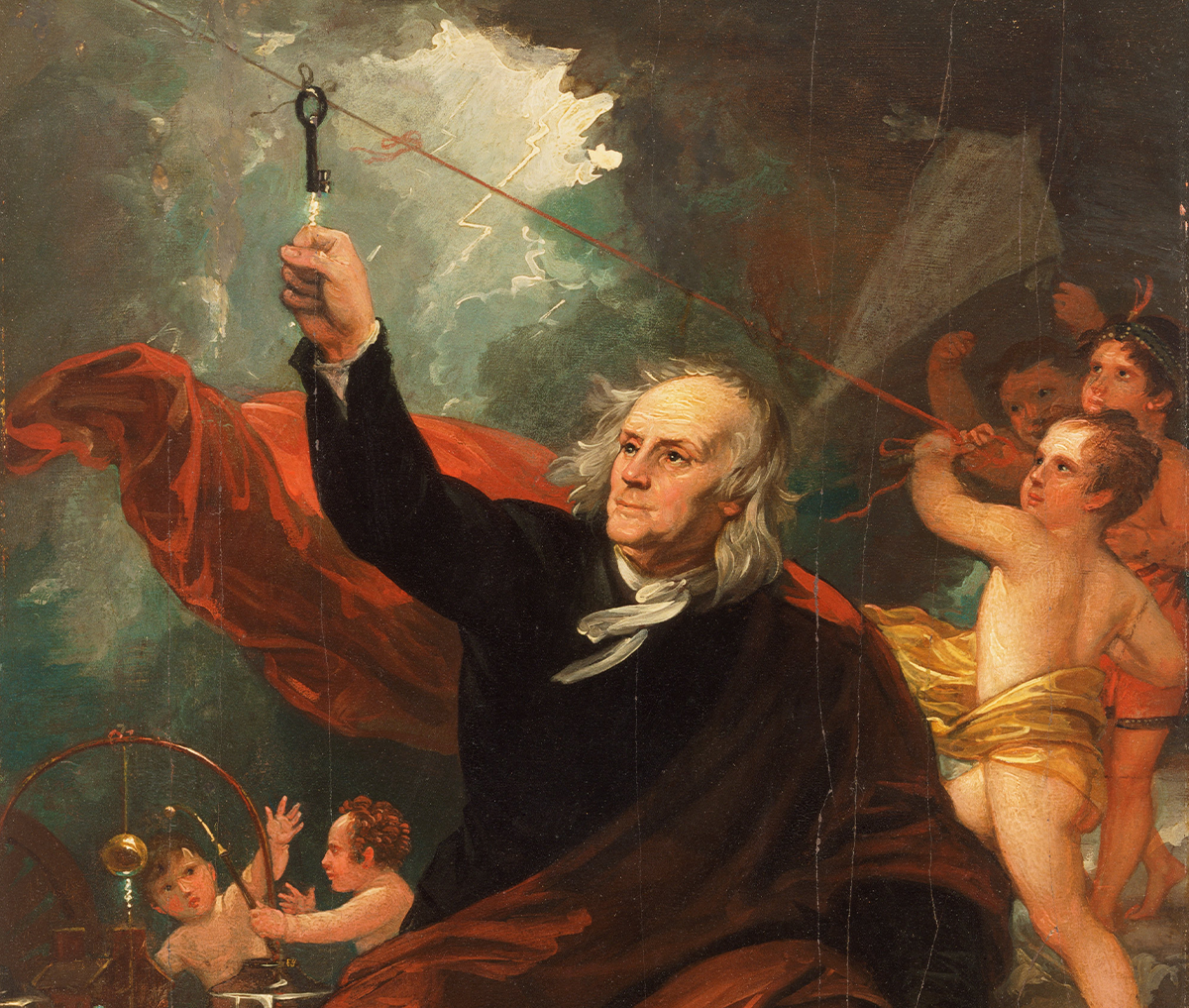
On June 10, 1752, the polymath and diplomat flew a kite in Philadelphia beneath a gathering storm cloud trying to attract a lightning strike generated by the atmospheric unrest. The kite was fitted with a metal projection at its apex and a metal key affixed to the end of its hemp string. Lightning struck a spark, traveled down the string to the key, and in a flash, Franklin proved the electrical nature of lightning, something that was not known at the time.
It’s a good story. But it’s not exactly true.
First, Franklin’s kite was likely not struck by lightning. If it had been, the patron saint of the City of Brotherly Love would probably have died of electrocution, and therefore wouldn’t have gone on to edit Thomas Jefferson’s draft of the Declaration of Independence, sign the U.S. Constitution, found the American Philosophical Society, or any number of other accomplishments history recalls.
Read more: “The Genius of Benjamin Franklin”
Second, that key wasn’t the end of the line. According to English chemist Joseph Priestly, who received a first-hand account of the experiment from Franklin, there was a length of silk tied to the key to act as an insulator. This protected Franklin from electrocution as he held that instead of the key or the damp string.
As he and his adult son William flew the kite, they sheltered in an open shed. And when the elder Franklin noticed that the shaggy threads of the hemp kite string were repelling each other, he deduced that it had built up an electrical charge from the kite’s proximity to the storm cloud. Franklin then touched the key to a specially designed jar that accepted the charge.
He may not have caught lightning in a bottle, but Franklin had conducted one of the first experiments that showed the electrical nature of storms using his kite set up. He likely wasn’t the first, though.
Franklin had devised the experiment after he realized that none of the church spires in Philadelphia at the time were tall enough to tap into atmospheric electrical charge. He published his plans for a similar experiment in 1750 and shared them with French physicist Thomas-François Dalibard, who he had met and befriended during one of Franklin’s frequent visits to Europe. Dalibard erected a 40-foot long metal rod beneath gathering clouds on May 10, a month before Franklin flew his kite.
Using wine bottles at its base (oui!) to ground his conducting pole, Dalibard reported successfully extracting electricity from the cloud.
Wine bottles and the primacy of being first, aside, Dalibard’s experiment lacked some of the panache and daring of Franklin’s kite set up. Indeed, experimenters attempting to replicate Franklins’ findings later apparently died from electrocution. 
Enjoying Nautilus? Subscribe to our free newsletter.
Lead image: Benjamin Franklin Drawing Electricity from the Sky by Benjamin West / Wikimedia Commons