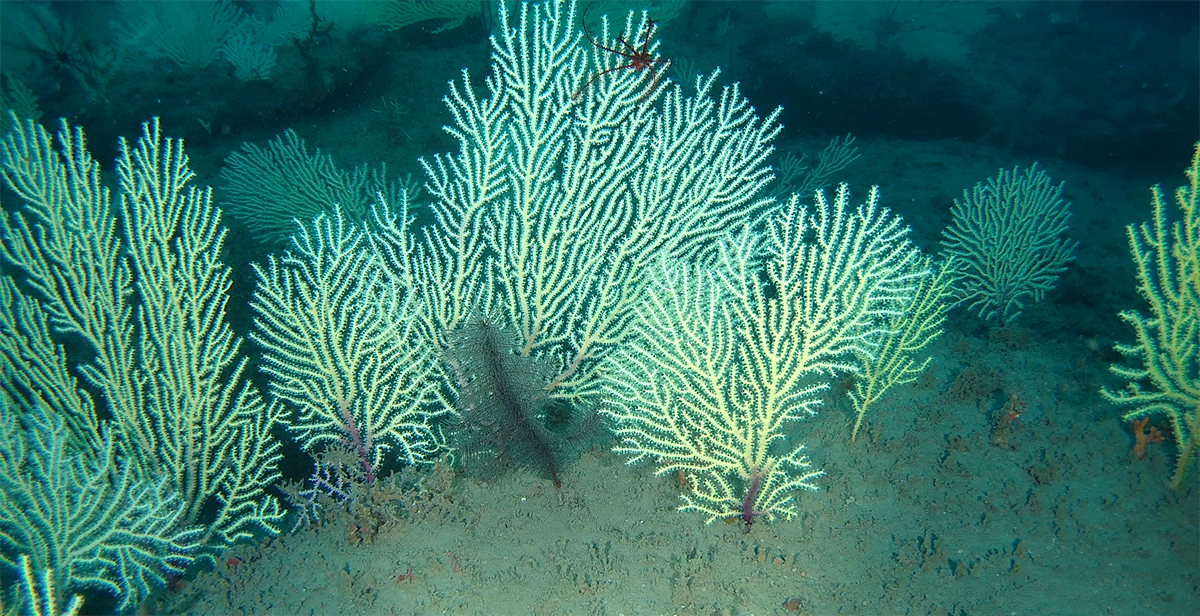
More than 175 feet beneath the waves off the West African country of Benin, a coral reef, once considered a graveyard by scientists, is thriving. The deepwater reef was written off as a relic of a bygone area by researchers surveying the Gulf of Guinea in the early 1960s. But more than six decades later, scientists returned, armed with underwater drone technology, to document patches of vibrant reef, housing at least eight different types of coral and eight fish species. Finding a thriving ecosystem situated in deep, light restricted water—a so-called mesophotic reef—is rare, and the underexplored area could yield more such surprises with increased study.
“To our knowledge, this is the first confirmed record of a living mesophotic coral ecosystem on the Gulf of Guinea continental shelf,” said Gérard Zinzindohoué of the Institut de Recherches Halieutiques et Océanologiques du Bénin, in a statement announcing the discovery. “However, I think what we found is probably not an exception. It is more likely a reflection of how little we still know about coastal regions in West Africa and elsewhere. If we were able to find this reef again after 60 years, how many others are still undocumented or simply forgotten?”
Zinzindohoué and colleagues published their findings yesterday in Frontiers in Marine Science, and in the paper they recount the story of the reef’s initial detection in 1963-64. “These surveys, carried out at the request of the governments of Dahomey (now Benin) and Togo, aimed primarily to map trawlable seabed and document fish diversity,” they wrote. But these earlier researchers, relying on the tools of the time, including dredging records and acoustic methods but not in-situ visual observation, presumed the reefs to be dead.
When Zinzindohoué’s team returned to the site and deployed underwater drones equipped with a camera system, they saw intact ecosystems teeming with life. “That was a big moment for us, because suddenly we could actually see the seafloor,” he said. “I still remember seeing those first images. It was a mix of excitement and disbelief, because after all this time thinking about this reef, suddenly there was something real in front of us.”
The fish species the researchers saw included golden African snappers, blackbar soldierfish, Guinean angelfish, West African goatfish, the Monrovia doctorfish, three-banded butterflyfish, and two species of damselfish, flitting in and out of octocorals, a type of soft coral that spread like fans from the rocky seafloor.
Read more: “A Critical Moment for Corals”
Beyond the discovery that an ecosystem presumed to be dead has emerged from the depths, documenting the reef off Benin could also offer a blueprint to find other undiscovered reefs around the world. “This is still an initial exploration,” Zinzindohoué added. “We only surveyed a small section of this area and we had a limited number of visual transects. If I had all the grant money in the world, the first thing I would do is return to the site with a proper scientific diving and sampling program. These are ecosystems that are still poorly known in this part of the world, and every additional piece of information matters.”
Indeed, in recent years researchers have been discovering more deepwater reefs around the world that had eluded detection. Ten years ago, for example, scientists working in the muddy waters of the Amazon River mouth off Brazil and French Guiana found a reef stretching 3,600 sq miles in depths of up to 390 feet. 
Enjoying Nautilus? Subscribe to our free newsletter.
Lead photo by Gérard Zinzindohoué