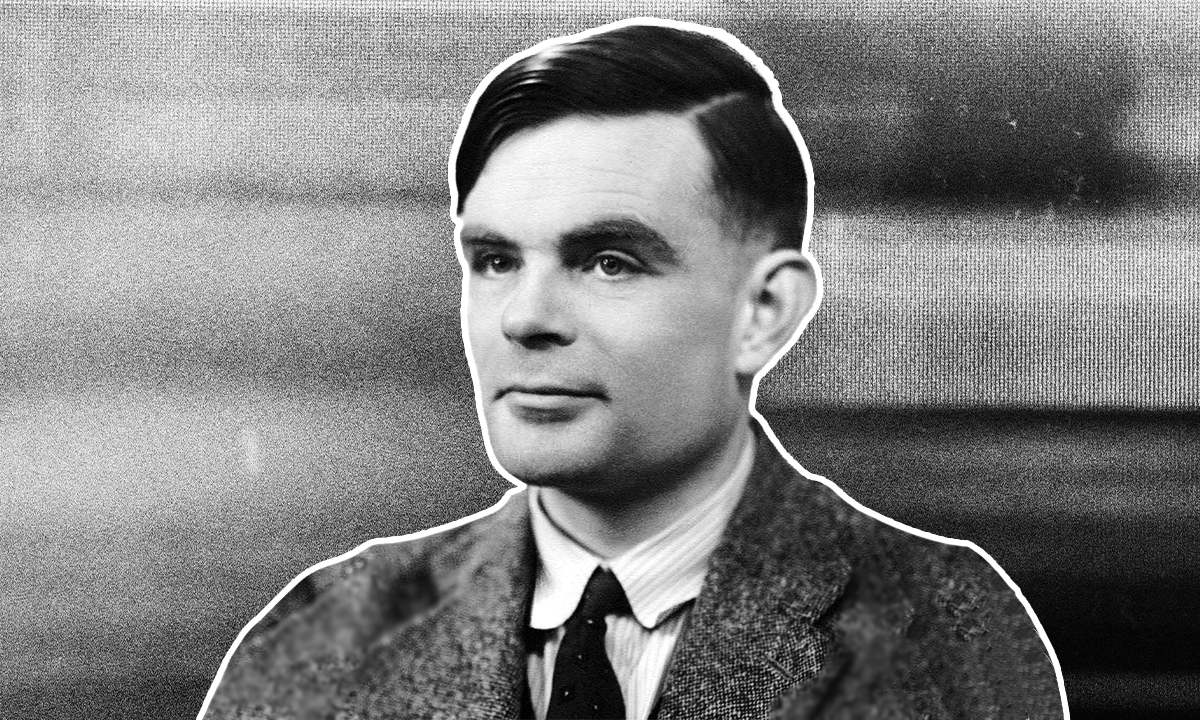
Alan Turing is a towering figure in the history of computer science. The British mathematician’s work in the early- to mid-20th century established a foundation for digital computer processing and artificial intelligence, played a pivotal role in cracking the German Enigma code during World War II, and launched the concept of morphogenesis, which uses physics and math to describe how biological patterns emerge.
But the man often touted as the father of modern computational science, also lived something of a tragic life. Accused of “gross indecency” by United Kingdom authorities in 1952 for having an intimate homosexual relationship, Turing pled guilty and underwent chemical castration with synthetic estrogen designed to reduce his libido in a probation deal that allowed him to continue his research. He died two years later, at age 41, as a result of cyanide poisoning under somewhat suspicious circumstances.
In the modern popular imagination, Turing’s persona is largely shaped by the 2015 movie, The Imitation Game, starring Benedict Cumberbatch as the visionary mathematician, Although the film was nominated for several Academy Awards (it won only one, for Best Adapted Screenplay), it was roundly criticized for downplaying Turing’s homosexuality.
Now, a previously unpublished short story penned by Turing sometime in late 1952 or early 1953—as he was living through the repercussions of his indecency conviction—is tweaking his popular image, showing that the researcher has not just a brilliant, socially awkward thinker, but had a vibrant inner life as well. Archivists at King’s College Cambridge have fully transcribed the six-page, hand-written manuscript, publishing an analysis of the work in The Review of English Studies yesterday.
Read more: “Goodbye, Turing Test; Bring on the Turing Decathlon”
“We’ve distilled a version of Turing that is a two-dimensional stereotype,” said Sarah Dillon, an English professor at the University of Cambridge and author of the paper, in a statement. “He’s come to be seen as socially unaware, entirely concerned with logic and numbers, and pretty isolated. His short story reveals a very different man: playful, funny, cheeky, literary, and someone who really liked sex.”
Dillon suggests that the untitled story, which is known as Pryce’s Buoy, is semi-autobiographical, as it follows a gay scientist named Alec Pryce as he initiates a sexual encounter with Ron Miller, a working-class young man looking to profit from such a tryst. In one scene, Miller thinks to himself, “If he let someone take him under the arches for ten minutes he might get five bob.” As Pryce sizes up Miller he thinks, “Not a real beauty, but had a certain appeal. Beggars couldn’t be choosers.”
The fictional couple’s brief courtship ends up in a restaurant, where the story abruptly ends with the line, “Ron wouldn’t.”
“There was clearly more and that's so frustrating,” Dillon added. “We don't know where the rest of it went. We don't know if Turing's mum censored it. Did it get more sexually explicit? How did it end? That’s frustrating but everything else is so exciting.”
Dillion writes in the paper that Turing was likely heavily influenced by the most significant gay writer in the post-war era: Angus Wilson. The mathematician, she notes, was quite interested in gay fiction of the day, including Wilson’s most notable work, a novel titled Hemlock and After, according to accounts from his friends. “Given this interest in homosexual fiction, it is not unreasonable to think that Turing would have read Hemlock and After closely upon its publication in July 1952, which would mean he encountered this quite remarkable novel shortly after his own prosecution,” she writes. Turing, Dillon suggests, imitates Wilson’s style of visiting the inner thoughts of several characters, weaving those into a broader narrative set in a particular social scene.
Beyond expanding the scope of the popular perception of Turing the person, the newly transcribed short story contains broader lessons about who and what scientists can be, Dillon adds. “We need to stop thinking that the literary and the scientific are binary opposites. They're not,” she said. “Lots of scientists read and write literature, and lots of literary people are very skilled at science. If you polarise or aggrandise one over the other, you lose the mix we need to function as individuals and communities.” 
Enjoying Nautilus? Subscribe to our free newsletter.
Lead image: By Elliott & Fry / Wikimedia Commons