The psychedelic experience has been described a thousand ways over the decades. But one analogy seems to repeat, according to German-American psychologist and writer Ralph Metzner, who participated in psychedelic research with Timothy Leary at Harvard University in the 1960s: the so-called microscope metaphor. “It has been repeatedly said that psychedelics could play the same role in psychology as the microscope does in biology,” Metzner wrote, “opening up realms in the human mind to direct, repeatable, verifiable observation that have hitherto been largely hidden or inaccessible.”
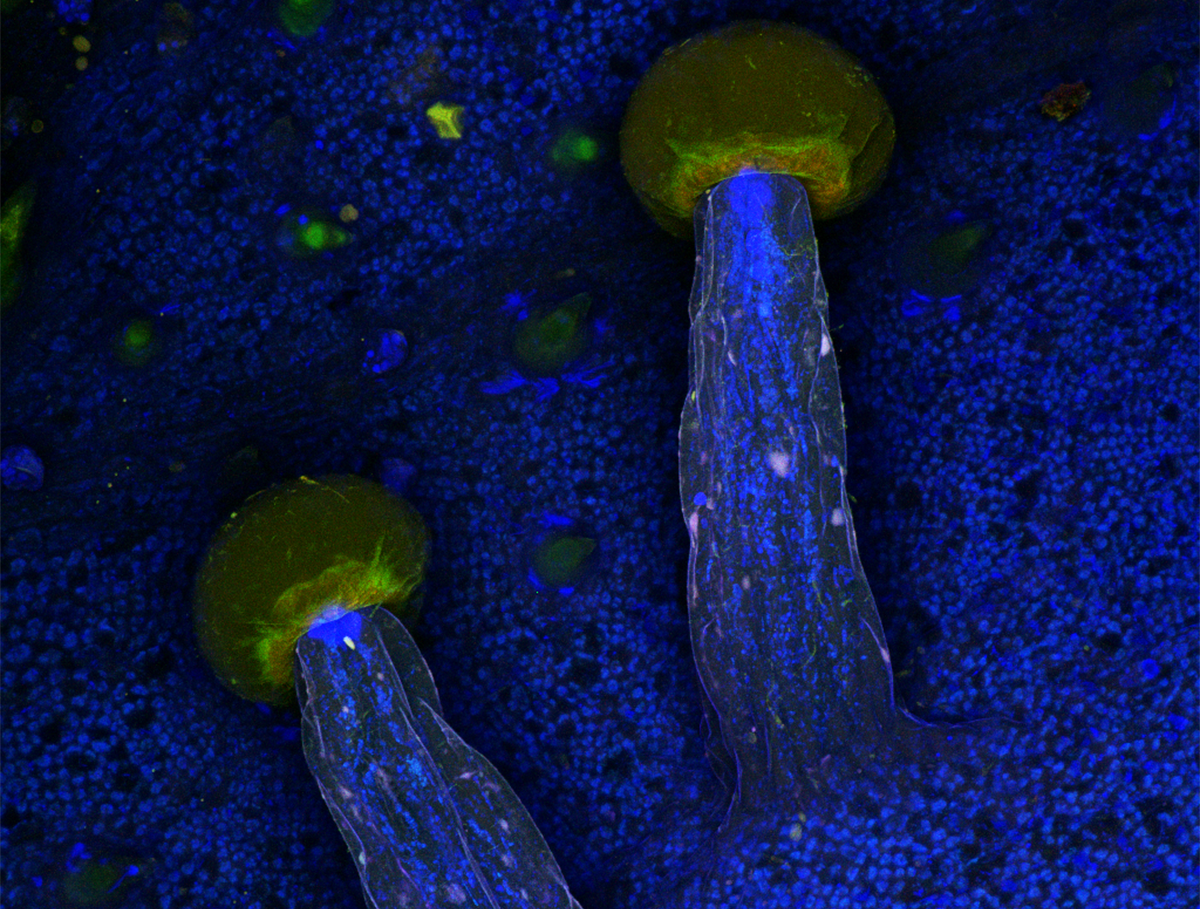
The Metzner anecdote appears in the introduction to a new edition of Sacred Plants of the Americas, co-authored by biomedical researcher Jill Pflugheber and historian and former professor of Latin American literature and film Steven F. White. White and Pflugheber have turned the microscope metaphor idea on its head. The book is a catalog of trippy, dazzling images of the interiors of psychedelic and other sacred plants composed with the help of an advanced kind of microscope called a confocal microscope, which relies on laser beams to produce sharp high-contrast optical slices of thick living tissue—in this case plant stems, leaves, and flowers.
The otherworldly materials come alive on the page in energetic patterns of fluorescent purples, blues, and greens. White and Pflugheber say these images offer a brand new way of seeing sacred plants, one they hope will change the way readers understand the plants and the natural world.
The book is meant not only to create a dialogue between science and art, but also to bring Indigenous knowledge to the conversation through stories and cultural wisdom as it relates to the individual plants. I spoke with White and Pflugheber about what they want readers of their book to feel, the concept of two-eyed seeing, and how they think the relationship between humans and sacred plants may have evolved.
Read more: “The Long History of Psychedelic Theft”
How did this book of sacred plant images come to be?
Jill Pflugheber: I got into this because of a chance collaboration with Steven. I was teaching a course at St. Lawrence University on confocal microscopy to undergraduate students, and every semester, I’d have a competition amongst my students for the best image. I posted electronically to the university and the world at large, and everybody would vote on it. Steven had seen the contest because he was also working at St. Lawrence, and he voted, too.
I used plants to help teach my students the technique because plants are auto-fluorescent. You can go outside, snip a leaf, put it on a slide with a mounting medium. I figured out that plants give you some cool images. I’d gotten a copy of Steven’s Ayahuasca Reader from a previous exhibit he did with Eduardo Luna. Steven came down, and he looked at some of the images posted on the wall. He was like, “Did you ever wonder what Banisteriopsis caapi (the plant that is at the core of ayahuasca) would look like under the confocal microscope?” That opened the floodgate. Three images became thousands.
Steven F. White: It took us eight or nine years to bring the project to fruition. We were focusing at first on the plants that are used to make the sacramental brew ayahuasca, but it quickly became something much more expansive. And I’m glad that it did because we wanted to talk about culturally significant plants, plants that have ceremonial uses in society, plants that are kind of spiritual—sweet grass, corn, the ancestor of potatoes—but also peyote and San Pedro and other plants that are psychoactive and sacred in that way.
How did you choose which plants to include in the book?
White: This required a great deal of research and careful planning. Even though there are more than 50 species of plants represented in the book, many more could have been included. But we did what we could because we needed to work with living material. That meant getting seeds, germinating them, getting live plants, and taking care of them. Years later, I’m still taking care of many of the plants.
What we wanted to create was an experience of microscopic awe. Confocal microscopy allows us to encounter plants at a scale where science and beauty become inseparable. Once you begin to see the stomata and the trichomes and the xylem and pollen as intricate works of living architecture, it’s a lot harder to think of plants merely as resources. Technology extends our perception. But its purpose is ultimately ethical: to cultivate attention, wonder, and a more reciprocal relationship with the living world. That was my hope as the co-author of this book—to create that sense of wonder that Dacher Keltner has talked about in his work.
Jill and I have a joke between us that she calls the images “data” and I call them “art.” We would get together with the new images from a night’s work, and we’d pick the ones that most touched us and impassioned us.
You suggest in the book that the confocal microscopy offers a genuinely new way of seeing. How did you balance the science with the art? How much of what we see is aesthetic choice versus what’s actually there at scale?
Pflugheber: Plants are naturally autofluorescent, but if you look at them through a fluorescence microscope, which is a fairly standard lab item, it’s ugly. You can’t see anything because it’s just a green blur of nothingness. That’s why confocal is so cool. What happens with a fluorescence microscope, you’re seeing all the in- and out-of-focus fluorescence because the plant isn’t unicellular. It’s thick. What the confocal microscope does is scan a specific area within a field of view. It scans with three lasers across in a square pattern, line by line by line. The fluorescent laser light excites the fluorescent molecules within the plant, and those fluorescent submissions are picked up by a photo multiplier tube.
So these aren’t pictures. They’re images, because the fluorescent light is turned into an electronic signal which is then carried to the computer and reconstructed in three-dimensional formats. They’re colorized images. It’s reconstructed.
I started with a regular white light microscope that has GPS locators, so I could find spots that I thought might be interesting and mark them. Then I’d switch it over to the confocal and let it start scanning. I’d set the laser intensities and the gains for each channel so that it wasn’t oversaturated. I’d set everything up the night before and just let it run overnight. In the morning, we had maybe 20 images. Then I used the software to flatten it from a three-dimensional image into a two-dimensional image with the maximum fluorescence intensity for each of the different channels displayed. When you look at the images, you see clearly what the structures are. We did no staining. I didn’t use fluorescent markers, the way we do in biomedical research.
We just let the plants emit what fluorescence they had. I also made the choice early on not to fix the plants with a fixative, which can change the fluorescent properties of the molecules contained within. The plants had to be alive. Dead plants don’t fluoresce. The proteins have started to break down. It was critical to have as close to living as possible leaf, stem, or plant. You could pick a leaf and fold it into wet paper towels, put it in a plastic bag, as Steven knows, because he’s done this for me multiple times.
White: There would be like a 100-degree difference in temperature between our farm in Nicaragua where some of the plants came from and the lab in the United States in winter. I’d be traveling with these specimens and trying to make sure that they were as fresh as possible. We’re just talking about a leaf, a stem, and a flower, when we were lucky. But what most surprised me about this project was that the deeper we entered the microscopic world, the less isolated each plant appeared. So that every stoma, every trichome, every pollen grain seemed to me like they were revealing relationships with insects, fungi, climate atmosphere, timescales, and geologic time.
It felt like we were seeing human culture in a different way. And at the microscopic scale, individuality gives way to interdependence. To me, that realization changed how I thought about plants and ultimately about ourselves and how we live in the world.
What kinds of aesthetic choices did you make in these images?
Pflugheber: The colors are representative of the wavelengths of light that I used to excite the molecules. I use three different laser lines with specific wavelengths of light from start to finish, and I use the same color scheme for each. It’s a little bit backward from the way it might normally be, but blue is the farthest red, the longest wavelength. Green is the shortest, and red is the middle wavelength. I kept it consistent throughout. Any colors that aren’t red, green, or blue are mixtures of red, green, and blue. Green and red in confocal makes yellow. Red and blue make sort of purple or magenta.
White: As a point of comparison, some readers will be interested in the work of Rob Kesseler. He has done some amazing books with an electron microscope, one on pollen, another on seeds, and another on fruit. We had the amazing privilege of getting a tour of Kew Gardens with Rob Kesseler a month or two ago when we were in London. When Rob works with these images of the electron microscopes, he makes decisions about colorization himself, with his artistic sensibilities based on his knowledge of the plants, so his work is different. With electron microscopy, you definitely get shades of gray. And he colorized by hand different areas of the images.
In the book, you call yourself a plant ally, Steven. I wanted to know what that means to you.
White: A plant humanist, an anthologist of vegetal lives. I’ve had to look for different ways to describe my role in the project. As an undergraduate, I was an English major at Williams College. I later taught Latin American literature and film. I traveled extensively in Latin America. I feel really comfortable that this book is limited to the Americas, because I know Latin America personally very well.
When I graduated from Williams College as an undergraduate, I had this grant from the Hubbard Hutchinson Fellowship to research poetry for two years, so in 1977 and 1978, I traveled to Ecuador, Peru, Bolivia, and Chile. And then I went to Nicaragua in 1979. I ended up learning how to speak Spanish, really getting into Latin American poetry and learning a lot about the secret protagonist in Latin America, which is the landscape: the mountains, the rivers. It’s an amazing continent, the American continent.
Read more: “How Indigenous Knowledge Could Save Fishing”
You mention ethical responsibility, and in the book, you write about our ethical responsibility toward this concept of two-eyed seeing, where Western science and Indigenous knowledge meet and work together. How did you handle the ethics of collaborating with the communities whose sacred plants are in the book?
White: It’s really important, this concept of etuaptmumk, the two-eyed seeing that was developed by the Mi’kmaw elders: Albert and Murdena Marshall. They belong to the Eskasoni First Nation. It’s a way for two kinds of knowledge, the Western and the Indigenous, to work together with mutual respect, and, in my case, admiration. Throughout my research, I was always looking for ways to find and emphasize the Indigenous research paradigm and to include those points of view. It’s a very small gesture of reciprocity.
We, the people who produced the book, are supporting a really interesting project in Southern Colombia in the Putumayo, working with Bernardo Chindoy. Some Nautilus readers will remember the name Richard Evan Schultes, the legendary Harvard ethnobotanist. In the 1940s, his mentor in Colombia was Salvador Chindoy. And in the work that he did with certain plants, most of which were psychoactive, it was absolutely key for him to be able to consult with Salvador Chindoy. We are working now with Salvador Chindoy’s grandson. It helps me remember the idea that these shamanic or healing traditions are part of a lineage, a family tradition. We have supported the establishment of a garden of medicinal Brugmansias, the angel’s trumpets, in Southern Colombia. Bernardo and his daughter are using these Brugmansias to help women with pain during childbirth, for example.
So we wanted to work with this concept of two-eyed seeing, and also to learn from Robin Wall Kimmerer and her grammar of animacy, the notion that Indigenous languages treat rocks, water, plants, and places as living beings, and Enrique Salmon’s concept of iwígara, which proposes that all life-forms are interconnected and that we share breath with the plants.
Are there other collaborations underway between Western science and Indigenous knowledge in this area of sacred plants?
White: In the first part of September, there’s going to be a World Ayahuasca Forum that’s going to be held in Spain. More than 100 Indigenous leaders and healers are going to be participating in this gathering. It’s going to change the direction of how knowledge is shared and appreciated, including intellectual property rights. But many projects are underway. Our project is a reflection of that interest.
Will people who know ceremonial plants find any surprises in the book?
White: In some cases, yes, there is new scientific research. For example, in the case of cacao, we’ve learned that ceremonial cacao is excellent for cardiovascular health. Also, a common misconception might be that in the ancient Indigenous societies, cacao was only for the elite. But new archeological research has shown that in some Maya societies, just about everybody had a cacao plant in their yard, and they’d use it for their own medicinal purposes. It was much more egalitarian in terms of its use.
Pflugheber: One of the things that I particularly love is that these confocal images show biology in action. One of the functions of trichomes of the plant is protection. The trichomes carry terpenes, which are chemical messengers. They’re for protection against predators or attraction of pollinators. You can see most of the terpenes traveling through the trichomes with these images. I love seeing that. You can see open versus closed stoma and the guard cells around the stoma, the different proteins that light up when they open versus when they close.
White: On the one hand, science has given us the James Webb Space Telescope, which has expanded humanity’s vision out into the cosmos. On the other, confocal microscopy has expanded it inward into these living plant worlds that have always surrounded us but have remained largely invisible. It’s a different kind of expansion, but it’s still showing how technology is enlarging wonder rather than diminishing it.
In the chapter on ayahuasca, you ask, “Why did humans evolve this connection with mind-altering plants that can mitigate our destructive relationship with the natural world?” I recently came across a study in the Proceedings of the National Academy of Sciences that suggests that, in fact, this relationship with humans is just a side effect, a consequence of shared brain chemistry with the real targets of these chemical compounds: slugs and other creatures of the forest. What do you think about that?
White: I read it, too. I think it’s great. It’s something that we need to continue to explore. A group of Chinese scientists published the article, and I found their work fascinating. But before we accept definitively a conclusion like the one that they proposed, perhaps we should consider all the Indigenous knowledge and shamanic practice that would challenge those conclusions.
The human relationship with these plants is quite old. There’s archeological evidence, not for ayahuasca so much as peyote, San Pedro the cactus, the coca leaf, the Anadenanthera plant. You can show archaeologically that we’ve had a relationship to tobacco for 12,300 years or more. It’s been a long time that humans have been engaged with these plants and using them for healing purposes, for social cohesion. Let’s stop, think, and reflect, but not forget the Indigenous contribution to this discussion.
Enjoying Nautilus? Subscribe to our free newsletter.
Lead image: Cannabis sativa (marijuana). Scanned at St. Lawrence University’s Microscopy and Imagery Center, from Sacred Plants of the Americas (Princeton University Press), used with the permission of Jill Pflugheber & Steven F. White, © 2026.