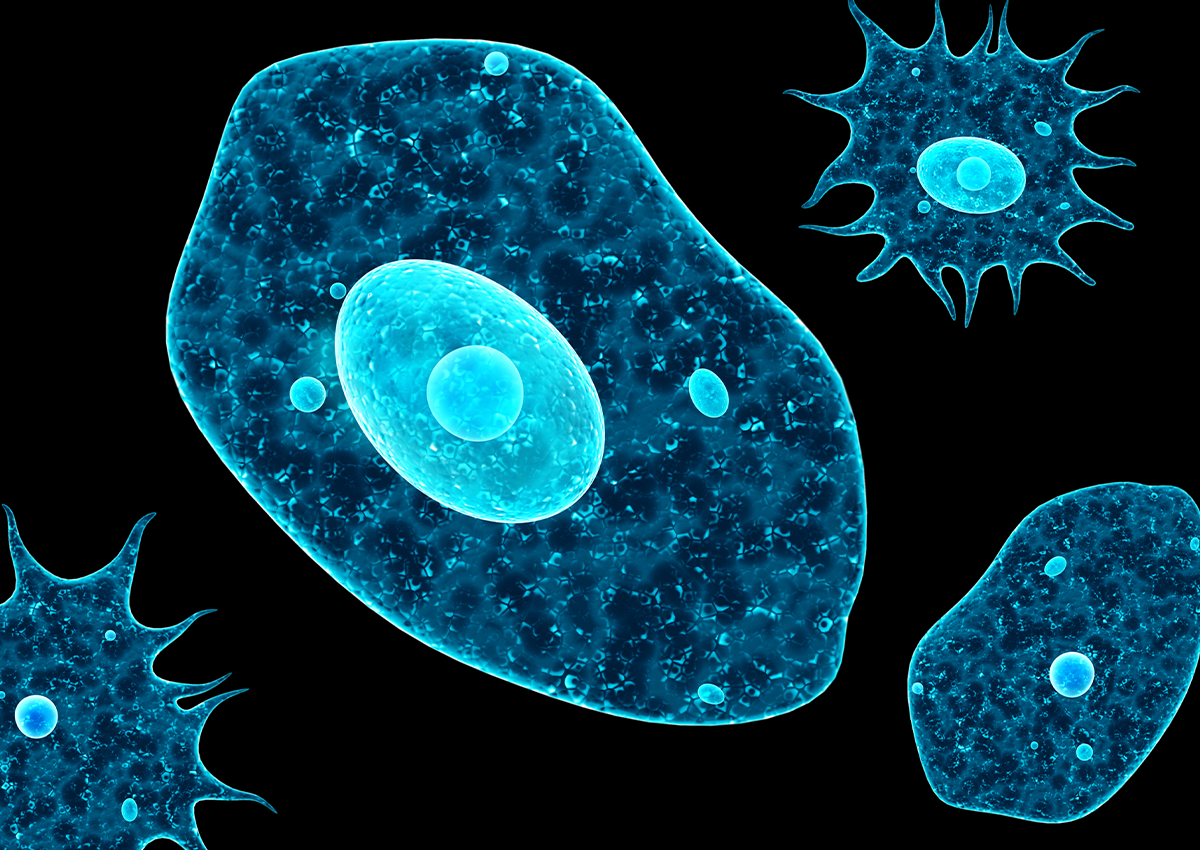
You are a marvelous menagerie of cells, the building blocks of life. Some 30 trillion or so of these cells compose the human body, each of them operated by a walled-off command center—the central nucleus stowing DNA—along with smaller bits of machinery surrounding it that work like little organs. These organelles are responsible for specific tasks like generating energy, making proteins, and disposing waste.
For decades, scientists have been trying to match nature’s virtuosity, tinkering with different methods and types of materials to piece together an artificial cell that mimics what living cells can do. The effort to overcome this challenge is aimed not just at solving the origin of life, but increasingly at biotechnology applications. Scientists have shown that such artificial cells can be integrated into living systems and complex genetic circuitry and can perform specific tasks, such as biosensing, drug delivery, anti-cancer therapeutics, and artificial photosynthesis.
Imagine an artificial cell that can sense cancer, produce a drug, and release it inside the body.
One of the main engineering challenges for artificial cell design has been building the spaces where the little organs can reside. “The cells in your body are more complex than a bacterium, because they have this really complex spatial arrangement of things inside of them,” says Yuval Elani, a biophysicist at Imperial College London.
Recently Elani’s team made an important advance on this front: They demonstrated a new way of producing these compartments that allowed them to easily insert multiple synthetic organelles with different functions in a single cell. For example, they were able to introduce magnetic particles (a rarity in nature) into their artificial cells. This let the researchers move the cell in any direction with a magnet. Another synthetic organelle they added enabled the cell to perform certain functions in response to temperature changes. The researchers published their new results in the Proceedings of the National Academy of Sciences.
The findings mark a significant step in the effort to build life-like artificial cells—ones that are able to do things like move around, sense their environment, release cargo, and communicate. Elani and his team used a material called hydrogel, made from a carbohydrate called alginate, to build the cells’ internal environment, which could be likened to the chassis, or base frame, of a car. Hydrogel is an increasingly popular material for scientists engineering synthetic cells because of its versatile chemistry.
Before now, researchers had not endowed hydrogel-based artificial cells with multiple organelles at the same time, Elani says. This creates the potential for, among other things, much more advanced drug-delivery systems. You can imagine injecting someone with an artificial cell that lies dormant for years, and then when it senses a cancerous environment, the cell produces and releases a drug inside the body. “That kills the cancer cells, the cell senses the threat’s been eliminated, and shuts back down,” Elani says.
The researchers also show in their paper how it’s possible, using a technique called microfluidics, to reliably and quickly make the cells a consistent size and shape (around 125 micrometers in diameter). That’s crucial for use in industrial or clinical settings, Elani says. Regulators “really want to know that you have full control over every aspect of that synthetic cell.”
Since they’re so short-lived, synthetic cells won’t be coming to market any time soon. “Once you make them, you have a day or two to use them,” Elani says. This is because they can’t harvest energy and materials from the environment like biological cells—yet. Elani’s team is working on this. “We’re engineering them to photosynthesize just like plant cells,” he says.
Will Elani eventually engineer artificial cells that can replicate like a biological cell can? Sure, in perhaps 15 to 20 years. “It’s a very optimistic guess,” he says. “At the moment there’s no danger.” 
Lead image: Love Employee / Shutterstock