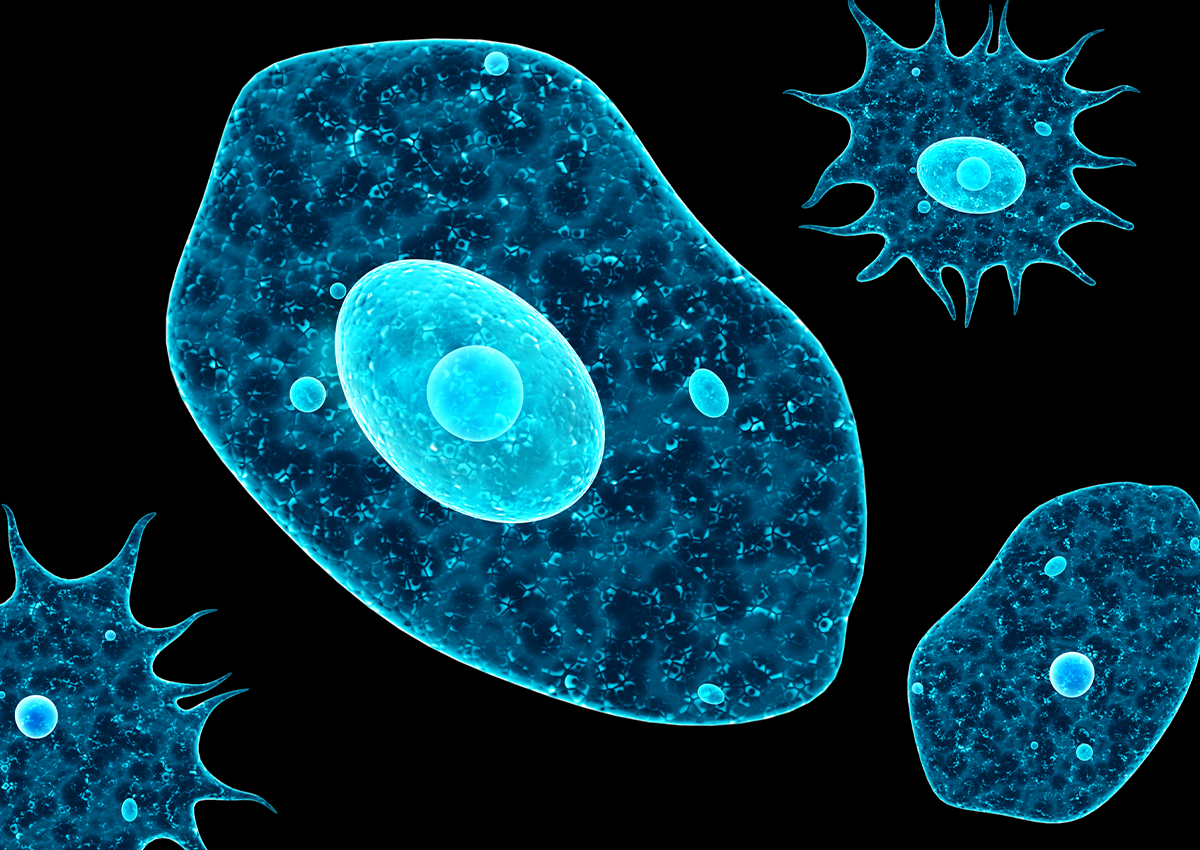
Friedrich Nietzsche thought a lot about the little amoeba, writes mycologist, professor of biology, and author Nicholas Money in his new book, A is for Amoeba. Nietzsche decided that when the single-celled brainless blob reached out with the arm-like extensions on its cell membrane, known as “false feet,” to grab food or move across a surface, that it was expressing a cosmic drive to “grow, seize, become predominant.”
Whether the amoeba is, in fact, driven by such urges isn’t known to science. In fact, this simple form of life, which has up to 100 times more genetic material than a human, is more of a mystery to us than you might think. Money has spent most of his career studying fungi, but to answer certain elemental questions about life on Earth, he decided to turn to the simple amoeba. The riddles he found surprised him.
Money thinks amoebas are gorgeous to look at through a microscope. But, he says, this single-celled creature is more than just a pretty face. It’s both beautiful and intelligent—and likely possesses some form of consciousness.
I spoke with Money about the big mystery at the heart of amoeba life, why the amoeba is like a mirror for those who study it, and what its practice of asexual reproduction and genderless immortality tells us about the evolution of sex and death in the animal kingdom.
You write in the introduction to your book that it was inspired in part by a deepening conviction that you can see a world in something as tiny as William Blake’s “grain of sand.” What deepened that conviction for you?
When you’re trying to understand big questions in biology about how things grow and reproduce, how organisms have evolved, it makes sense to start with something small, a single-celled organism. And the Amoeba proteus is this iconic organism that almost everyone recognizes. You could be in a classroom in North Korea, and if you draw a squiggly outline with a dot in the middle, everyone will recognize it. So that seems like a good place to begin.
I’ve spent most of my research career studying fungi. I’m a mycologist and most of the books that I’ve written have been about fungi, but in a sense, they’re too complicated to really get at these basic questions. I’ve also always been interested in looking at pond organisms, and amoebas are just beautiful to look at under the microscope.
But I made a bit of a mistake because as you learn more about any organism, particularly amoebas, you realize they’ve got their own tricks and sophistries. Amoebas are quite difficult to understand in their own right. Scientists have been trying to make sense of them for a lot longer than a century. And there are still all these questions that we cannot answer—for example, about amoeboid movement, which is something that’s spread throughout the tree of life and is in our bodies, too. I find that sort of frustrating, but also inspiring. There’s still so much to learn about how cells grow, about how cells move.
Read more: “Tiny Volcano-Dwelling Creature Breaks Heat Record”
Yes, in the book you cite a 2013 paper by a team of Cambridge scientists who admit that we still don’t really have a good understanding of how amoebas crawl or swim. Why is it so difficult to get a handle on this basic feature of a creature that seems so simple?
We’ve done a really good job, just during my life as a scientist, of teasing out a lot of the details. We know a lot about the molecular machinery. We know a lot about the genes involved. But putting that together into a satisfying and comprehensive picture is something that still eludes science.
I was fascinated to learn that amoebas had such an influence on thinkers like Nietzsche and Freud. Of course, they’ve also played this huge role in pop culture, from movies about the blob to SpongeBob SquarePants. Why do you think this one microbe keeps showing up as a metaphor for human nature?
Yes, it has fed into these primitive or simplistic notions of human behavior. Nietzsche and Freud used the amoeba as a model for their big ideas about the self. I love that Nietzsche was a fan of amoebas. But I think it’s partly related to the role that amoebas have played in the classroom. You can go back more than a century and look at what science students were being taught in classrooms throughout North America and elsewhere—certainly in Europe, where schoolchildren looked at them under the microscope to learn about cell structure. Most classrooms also had these beautiful wall charts, these gorgeous illustrations of amoebas. They’d show the mitochondria, the nucleus. It’s the model organism for understanding how eukaryote cells work, and how humans work.
You describe some eccentric characters who studied amoebas across time. Did any one of those stories stand out to you most?
Some of these people are truly disturbing individuals. They may have been great scientists, but in their personal lives, they behaved in an appalling fashion, sometimes criminally. I don’t want to talk about the worst ones, but I like the German investigator who played a really important role in studying the causes of amoebic dysentery, infections of the gut. He carried out self-experimentation. He deliberately infected himself with this pathogenic amoeba, and then appears to have died as a result of that infection.
We’d frown on this kind of behavior today, but there’s a rich history of scientists who engaged in self-experimentation. He sacrificed his life to understand these organisms. He named one of the principal pathogens, pathogenic amoebas. We’ve got this iconic amoeba that we all learned about in the classroom, Amoeba proteus, but there are thousands of other species of amoebas, and then a subset of those cause disease in humans.
What kinds of diseases can amoebas cause in humans?
Many of them act as opportunists, so they’re not the most powerful infectious agents, but if they have an opening, if we suffer some kind of injury, they can infect us. Or in the case of brain-infecting amoebas, if we snort them high up into the nasal cavities, at least in some people, these amoebas can crawl into the brain and cause a lethal brain infection.
Every summer we see reports in the tabloid press of these tragic cases of children who become infected with these amoebas after splashing around in rivers and lakes and so forth. They inhale water that’s contaminated with these pathogenic amoebas. The amoebas can make their way across what’s called the blood-brain barrier. And the infections that they cause in the brain are extremely difficult to treat. There is an experimental drug that’s showing some promise, but it’s quite troubling.
This may be related to climate change in the sense that these amoebas are in warm, fresh-water habitats, and as rivers, lakes, and creeks get warmer, these amoebas may be increasing their distribution. There’s some evidence to support that.
You mention in the book that not only are many amoebas infectious, they have a lot in common with other infectious life forms—bacteria, fungi, and viruses—and even with cancer cells. Has studying amoebas themselves taught us anything about how cancer spreads?
Cancer cells, when they move from tissue to tissue, use a couple of different mechanisms of movement. One of them is an amoeboid form of movement, so they’re able to crawl and squeeze through obstacles in our tissues and move around. This is the basis of metastasis, which is really troubling. There’s certainly a lot of research interest among oncologists in looking at amoeboid locomotion and figuring out if we can stall the movement of these cancer cells by interfering with the way that they pour themselves from one location to another.
There are also these awful structures called tumor spheres that are collections of cancerous cells, and sometimes they bundle immune cells into their interior, and the whole sphere moves in an ameboid fashion. That’s another area of research that some oncologists think is very important, and it might lead to some promising new treatments in the future.
Amoebas reproduce by splitting in half and copying themselves, which grants them a kind of genderless immortality, as you write in the book. Does an amoeba “die” in any meaningful sense?
Of all of the thousands of species of amoebas, a lot of them are related to Amoeba proteus, the iconic cell, and those don’t reproduce sexually. Some of the genetics supports the idea that this represents an advancement in evolution: that exclusive reproduction through an asexual mechanism, at least in amoebas, might be a secondary event in evolution—that at one time their ancestors reproduced sexually, and they lost that in favor of living these solitary lives and just reproducing by mitosis, by cell division.
Whether they die depends on your definition of immortality. The mother cell divides and forms two daughter cells that are identical or almost identical to the mother in terms of their genetics. They will then divide. As long as that lineage continues, as long as the DNA present in that mother is transmitted through time, one could regard that as a form of immortality. That doesn’t work for humans. The best that we can do, if we have biological children, is give them half of our genes, and that percentage diminishes with each generation. So yeah, I think amoebas have immortality. They’re closer to being immortal than any animal.
If asexual reproduction represents an evolutionary advance over sexual reproduction, then why did sex and death evolve at all in the rest of life? Or perhaps the question is why have other species not evolved to reproduce asexually?
This is one of the big questions in biology. Why do organisms reproduce sexually? There are several answers to this question. One thing is that, in evolutionary terms, there are many advantages to sex. It helps to shuffle genes around it and make new combinations of genes. That obviously has a selective advantage. But then you have to ask the question, “Well, how the heck has the amoeba been around for hundreds of millions of years without doing this?” And that brings us to one of the real surprises about Amoeba proteus and its relatives. They’ve got these enormous genomes—the largest genomes that we’re aware of. They’re so big we haven’t yet been able to sequence the whole genome of Amoeba proteus or some of its relatives. Its genome is up to 100 times bigger than the human genome. That’s a huge surprise.
One compelling answer to why is that they’ve got many backups for every gene. We’ve got two copies in each of our cells. They’ve got lots of copies, so when mutations occur, they’ve got reference points that they can use to find corrected versions of these genes. There’s a mechanism called gene conversion. And perhaps they use this to keep their genomes healthy. That might be a reason for hanging onto these vast numbers of copies of each gene. But the question won’t really be solved until we’ve got more genomic data on amoebas.
You say that amoebas are considered simpletons, but in fact, they’re quite sensitive organisms and even have the rudiments of consciousness. Do amoebas challenge our understanding of the nature of consciousness and intelligence?
They do. The thing is that we lack compelling universal definitions of intelligence and consciousness. But certainly, amoebas are exquisitely sensitive to their surroundings. And they act in a fashion that can be compared with animals with brains, in the way that they chase their prey. They eat these little pond things called ciliates that swim with hairs. And amoebas will chase them. Then, when amoebas are attacked by predators, they’ll go to immense lengths to evade their predators. They’re showing this sensitivity in everything they do.
Does that represent consciousness? One could argue that they have a sense of self, that they possess a minimal level of selfhood, but also they seem to have a kind of memory. They show conditioned responses over time. If they’re stimulated in one particular fashion on repeated occasions, they’ll continue to respond in the same way. It’s a little bit like Pavlov’s dogs.
It’s difficult for us to really think about the consciousness of an amoeba, but since we lack a definition, I prefer to stretch the idea of consciousness along a continuum. And then we can add organisms. Like we can say, “Well, what is it that amoebas can do? And what is it that fungi can do?” It’s a really interesting area of investigation, and there’s lots of experiments going on in labs in different parts of the world on the behavioral sophistication of single cells, including some brilliant work in Japan.
One of the examples of this is the shelled amoeba that assembles its own casing out of little fragments of rubble in their environment, broken diatoms and tiny gravel fragments. They’ll use their pseudopodia, their cell extensions, to arrange these fragments on their cell surface. And they do it in a very particular fashion. They’re arranging them by size and shape. There’s nothing random about this. It’s absolutely beautiful how they can swiftly assemble these shells on their surface. I’d use the word intelligence there. It’s pretty smart, this construction of your own house. It helps protect against predators, but also, according to my own research, it seems to act as a kind of diving bell that adds weight to the cell. This is a hypothesis, not proven. But the measurements support this. It provides them with this weight so that they can remain attached to plant surfaces in the water rather than getting swept away.
Read more: “Evolution, You’re Drunk”
Is there anything that you’ll take from researching and writing this book back to your work with fungi?
I found it really interesting to learn something about a different chunk of nature and then to relate that to these big questions, one of which is the cellular basis of consciousness. What does it mean to be conscious? That’s certainly a subject that I’ve written about in relation to fungi, looking at fungal consciousness, which, you know, sounds batshit crazy. But if you really begin to think about the definitions that we use for consciousness, all of our emotions are based on what? The movement of sodium and potassium ions across the membranes of our nerve cells and the transmission of nerve impulses. Everything has a cellular basis. So I want to understand that at the level of simpler organisms, single cell amoebas, and then multicellular fungi.
Some scientists are now building artificial amoebas to help with research into AI, robotics, and bioengineering. Can you tell me what they’re learning from these artificial blobs?
They’ve learned quite a lot, and they’ve developed a number of programs that are referred to as amoeba algorithms. In nature, an amoeba may find that one place doesn’t seem to work very well so it will quickly move somewhere else, and then explore. In a virtual space, these amoeba algorithms will explore the available options to solve problems. They will try to figure out how to create the simplest connections between a number of locations, or even look for patterns within big datasets, like in population studies. And they’ll use these amoeba programs to find these patterns like an amoeba would. There are also these giant amoebas that we call slime molds, which have been used in some very famous experiments that look at the way that they can explore space. There have been analog computers developed whose design is inspired by the behavior of these giant amoebas.
What was the most shocking or surprising thing you learned about amoebas while researching the book?
One thing that’s interesting is that we live in this age of artificial intelligence and increasing computer power, and yet, even using these powerful tools, we can’t come close to emulating the sophistication of the single cell, the amoeba. We’re thwarted in the end by this. I find that fascinating—that at this stage in the 21st century, we’re still not close to understanding how an amoeba explores its surroundings. And that wasn’t what I was expecting to find. I went into this as a novice amoeba-ophile, not knowing the number of questions that are unanswered.
I hope some readers take the time to actually go find some amoebas, which you can find in pond water anywhere, and look at them under the microscope. They’re breathtaking in their beauty and the way that they pour their substance from one place to another through these arms that we call pseudopodia. They’re absolutely gorgeous. It’s like honey spilling from a spoon, the difference being that they’re controlling the direction of that spillage. I find that absolutely inspiring.
Is there a particular kind of amoeba that you find especially beautiful?
I like the shelled ones.—when I look at them and I see what lengths they’ve gone to assemble these gorgeous shells. And no two are exactly the same, because they’re picking up debris from their environments. There was a really interesting study, too, that showed that if amoebas are provided with microplastics, they’ll incorporate them into their shells. That’s scary, thinking about the concentration of microplastics in the environment. And it isn’t a good thing for an amoeba. It creates a weak shell. They lose that ability to control their buoyancy.
There’s another kind of amoeba that I’ve never seen in person and I probably never will, but they’re these deep-sea giant amoebas I write about in the book. They don’t have a common name, so I gave them the name sea scrunchies, because they’ve got this gravelly consistency. They, too, accumulate particles from their surroundings. They’re right in the deepest parts of the seafloor, places like the Mariana Trench, so kilometers below the surface of the ocean, and they’re planted there.
We know so little about the way that they work, but some of them are huge, the size of a golf ball or a grapefruit. They’re single cells. They’ve got probably millions of nuclei spread within this continuum of cell substance. They’re feeding on bacteria. The reason that we don’t know much about them is that we can’t do research at that depth, and if we bring them up to the surface, they just fall apart. They lose their structure. These scrunchies may take a long, long time to grow. The photographs taken with submersibles are fascinating. They look like ghostly vegetable gardens, each one like a white cauliflower on the seafloor sediment.
In the opening to the book, you write that looking at an amoeba in the microscope is like looking into a mirror. It’s an exercise in self-examination. Did you learn anything about yourself while writing the book?
Yes. I’m more amoeboid than I imagined. I’ve got a kilogram of white blood cells in me that move with amoeboid motion: neutrophils and macrophages and dendritic cells. They’re moving like amoebas in all of us all of the time. And they’re clearing away our dead cells. They’re combating bacterial infections. They’re destroying bacteria that would otherwise grow in our bodies and removing cancer cells, too.
It’s difficult to wrap your mind around that. That’s an almost impossible thing to do in an imaginative sense—to close your eyes and think about yourself as this ecosystem made from trillions of cells, tens of billions of which are acting as amoebas. It’s breathtaking, but it’s confusing, too. It’s discombobulating. It’s difficult to grasp that relationship that we have with the microscopic world. 
Enjoying Nautilus? Subscribe to our free newsletter.
Lead image: frenta / Adobe Stock