April Fool’s Day is upon us once again, which makes this a great time for a reminder of the value of scientific skepticism. It’s also a good time to take a look back at when scientific skepticism failed, even briefly, to ferret out convincing scientific hoaxes.
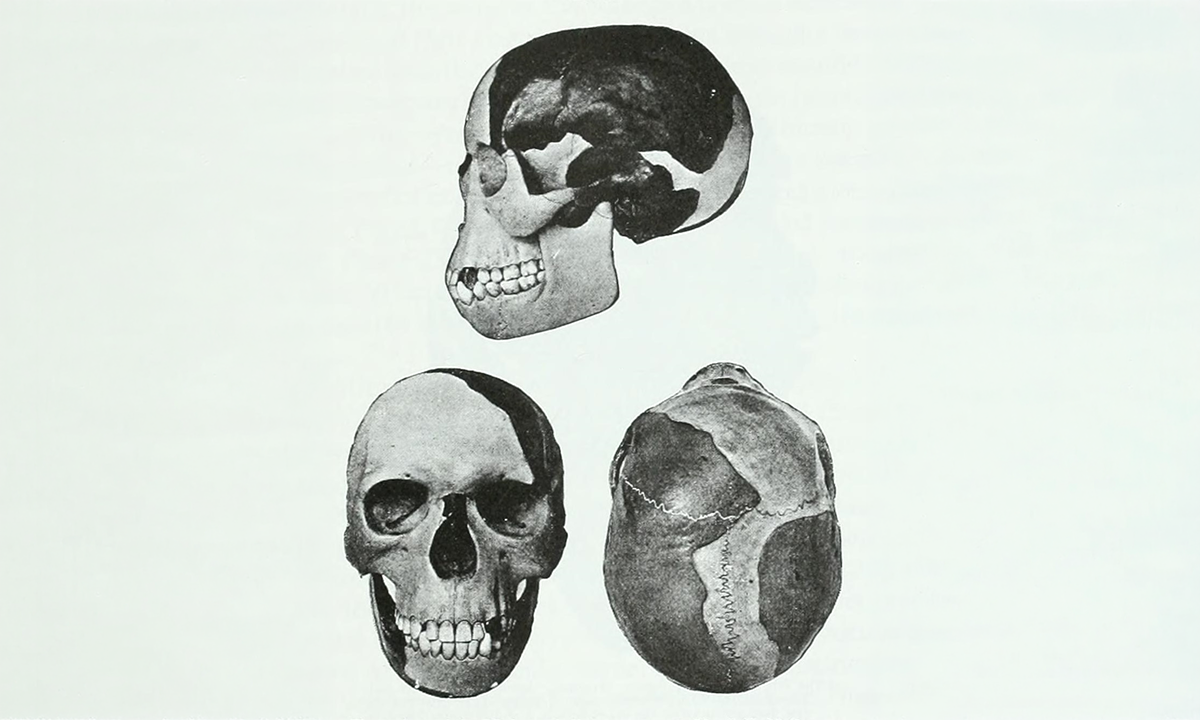
The most famous scientific hoax might be the case of the so-called “Piltdown Man.” Discovered in a gravel pit near Piltdown in East Sussex by amateur archaeologist Charles Dawson in 1912, the Piltdown Man’s skull was thought to represent the “missing link” between man and apes, and supported a Eurocentric theory of human evolution. While the find had its share of skeptics at the time, it wasn’t fully exposed as a fraud until four decades later when an analysis revealed it was cobbled together from a Medieval-era human skull, an orangutan jaw, and modified ape teeth.
Still, there may be another layer to the mystery, and scholars spent the decades that followed debating who perpetrated the hoax. The short list of suspects ranged from everyone from the unlikely Sir Arthur Conan Doyle to the slightly more likely Pierre Teilhard de Chardin, who helped uncover part of the specimen.
Different theories of the case involve the suspects either playing a prank on Dawson, colluding with him, or a mix of the two scenarios. Still, Occam’s razor—and a preponderance of the evidence—point the finger at Dawson himself. A more recent analysis suggests a single forger was responsible for the specimen, and Dawson was found to have dozens of faked artifacts and specimens in his collection.
Read more: “7 Famous Fossil Hoaxes”
The Piltdown hoax was uncovered through advances in technology, but that doesn’t mean we’re immune to scientific fraud in the modern era. In 2004, South Korean animal cloning expert Hwang Woo-suk (born the same year the Piltdown affair was revealed in 1953) announced his team had successfully replaced the nucleus of a donor’s egg cell with the nucleus of a skin cell, creating the first human embryonic stem cell line via somatic cell nuclear transfer. In 2005, he published another breakthrough performing the same procedure using material from different donors.
Considered the holy grail of stem cell therapy, Hwang’s breakthrough rocketed him to fame, with TIME magazine lauding him as one of the most influential people of 2004. His research gave hope to tens of millions of people suffering from degenerative diseases or waiting for organ donations, and even demonstrated the viability of human cloning.
Unfortunately, after a flurry of media probes and investigations, the stem cell lines were revealed to be falsified. Science retracted Hwang’s papers, and he apologized and resigned in disgrace from his official posts. After being convicted of embezzlement and escaping prison time, Hwang made a quiet retreat to his earlier research on cloned animals, and as of 2023 was cloning racing camels in the United Arab Emirates.
Hwang’s hoax stands out as a particularly odious one, but not everyone who falsifies research does so with malicious intent—there are also “white hat” hoaxters, like science journalist John Bohannon. Skeptical of the proliferation of “pay to publish” open access journals in the early internet age, Bohannon designed a ploy to find out if they would publish papers with glaring problems.
With the help of molecular biologists at Harvard University, Bohannon created more than 300 fake studies purporting to show the cancer-fighting properties of chemicals extracted from lichens. The process, Bohannon said in a 2013 article revealing the sting in Science, was akin to “a scientific version of Mad Libs” showing “molecule X from lichen species Y inhibits the growth of cancer cell Z.” The errors in the paper were carefully crafted to be both mundane and obvious so that even the laziest peer-reviewer might catch them. The results? Of the 304 journals he targeted, a depressing 167 accepted the bogus studies for publication.
And with the widespread availability of artificial intelligence, the problem could get even worse. What took Bohannon months with the aid of Harvard biologists and a custom computer program could be accomplished in mere moments with AI. In fact, a 2023 study found that ChatGPT’s model 3.0 was already adept at creating high-quality fraudulent medical articles; the large language model is currently operating model 5.4.
With the barriers to churning out counterfeit research so low, we may be entering a new era of scientific hoaxes. 
Enjoying Nautilus? Subscribe to our free newsletter.
Lead image: James Howard McGregor / Wikimedia Commons