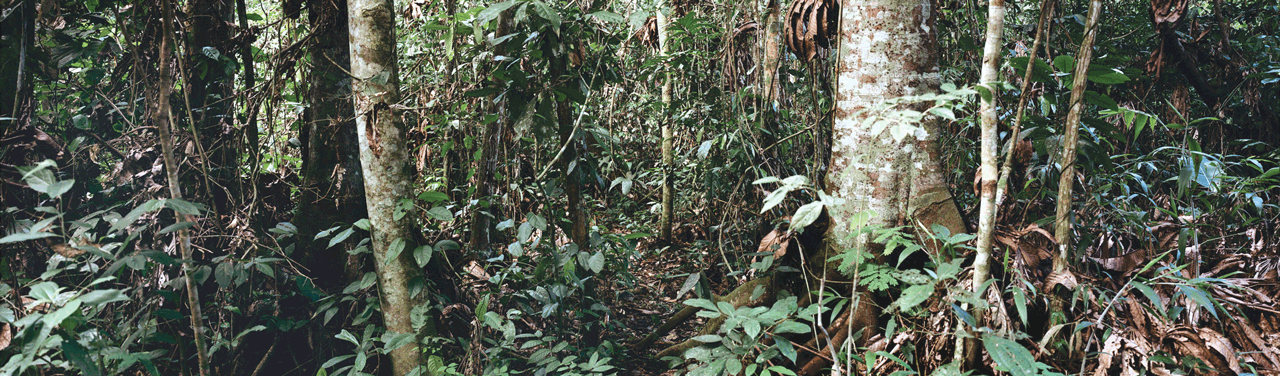
My day job is in science, and at the same time I was working on my 2014 Nautilus essay about Thomas Struth’s photographs of Amazonian forests (“Six Pictures of Paradise”) some colleagues and I were also working on a technical paper about Amazonian trees. The two pieces are so different in style and content that it only recently occurred to me that they share some common themes.
Among other things, our paper tried to answer the question of how many tree species there are in the Amazon (about 16,000) and how abundant each of those species are (anywhere from dozens to billions of individual trees). Our estimates were respectable enough to be published in Science, but in retrospect one of our main findings seems almost preposterous. What the models tell us is that several thousand of the tree species that grow in the Amazon are so rare that scientists will never find them.
The math is straightforward. If you are one of the species that the models estimate has a population of fewer than 1,000 individual trees in the Amazon, then the probability of finding you among all 390 billion trees in the basin is so infinitesimal that it’s hardly worth calculating. For a boots-on-the-ground example, a couple of months ago I was in a remote area of Peru where I spent practically every daylight hour surveying trees. In two weeks I looked at about 2,000 trees. According to the numbers in our paper, the chance that I encountered one of the rarest species is about one chance in 200,000.
A colleague of mine calls this our “dark biodiversity” problem. Just as the astrophysicists’ models tell them that half of all the matter in the universe is invisible to science, so our models seem to be telling us that a large portion of Amazonian biodiversity is invisible to science—that is, lives and dies at densities below our capacity to see it. The numbers are pretty unforgiving. If instead of two weeks in Peru I had stayed on for 20 years—no weekends, no holidays, no sick days, just tree after tree after tree—my odds would have improved to about 1 in 4,000.
Where does it all leave us? Back in a dark wood, apparently.
Ars is undoubtedly longa, but at least when artists set their sights on the horizon they have some small chance of actually reaching it. Scientists never do. Every day we look out at horizons that we’ll never possibly reach, and beyond them we can see a thousand more. Because even invisible species have genomes, and pollinators, and extinction risks. As Chekhov put it: “Science has a beginning but not an end, like a recurring decimal.”
Which brings us back to Thomas Struth. In his paradise series, Struth seems to have been seeking out forest scenes whose appearance is beyond our reckoning—a kind of recurring decimal that a person can gaze at and get lost in but never really make sense of. In my Nautilus essay I tried to push back at that meaninglessness by describing some of the human stories that were going on in those forests, behind the scenes of his images. Behind those trees gold mining operations were rumbling, scientists were tracking white-lipped peccaries, and our field station was struggling to keep its head above water. The irony is that behind the scenes of my stories, my own data were doubling down on Struth’s position, by suggesting that the forest really is fundamentally unknowable.
Where does it all leave us? Back in a dark wood, apparently. The trees that Struth photographed are still standing where he left them; the gold miners and scientists are there, too. It’s rainy season, and when a storm rolls in from the east the trees in the photographs come to life and shake their canopies in the torrent, dropping fruits and flowers onto the forest floor. By the time the sun comes up the next morning, the forest is so beautiful, so rain washed and flower-strewn, that no one who looks out their window is thinking of invisible trees.
Nigel Pitman is a tropical botanist based at the Field Museum. His work on South American plants has appeared in Science, Ecology, and Conservation Biology, and his non-scientific writing has been published in Orion, DoubleTake, and Sage. He recently finished a 9/11 novel set entirely in the Amazon.