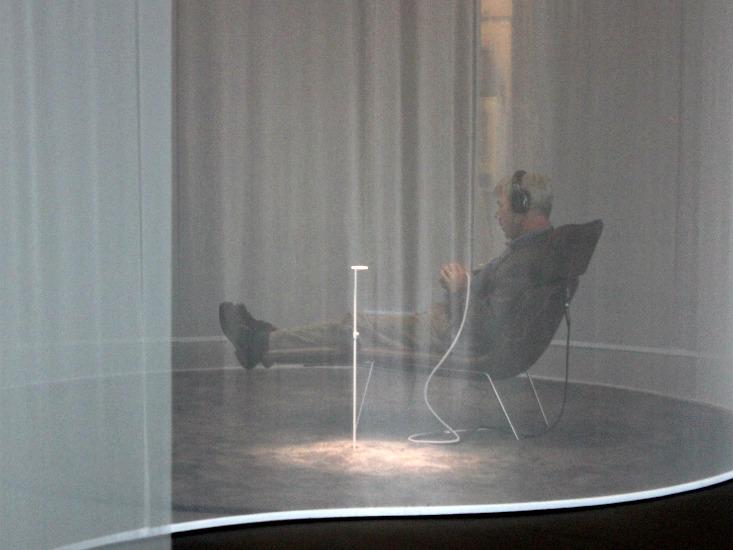
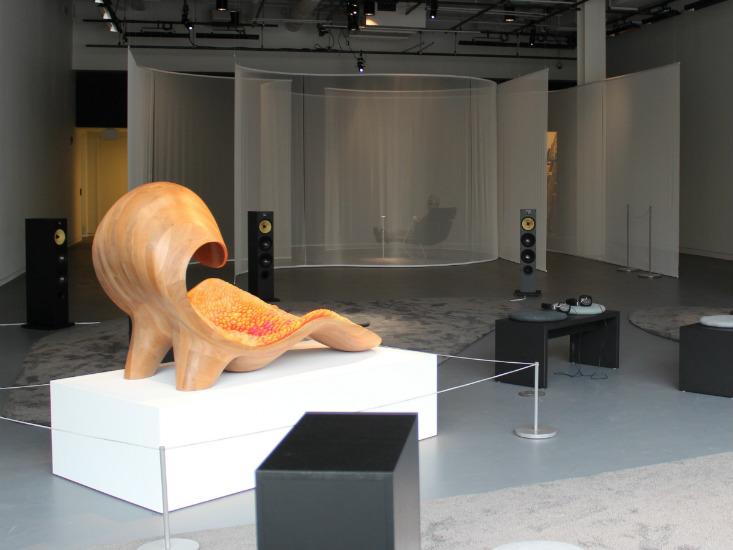
Upon entering the Vocal Vibrations installation at Le Laboratoire Cambridge, visitors are directed to a room called the chapel, where a haunting vocal composition plays out of nine speakers positioned around the room. After relaxing on a bench to focus on the music, people are led one-by-one through a winding hallway to the Cocoon, where they can privately experiment with their own vocalizations. Sing aloud and you can feel the vibrations of your voice in an egg-shaped, hand-held device called an ORB. The vibrations shift as your pitch and tone change, sliding up and down the device, oscillating between dull and strong. (Read more about the science of Vocal Vibrations [pdf].)
“This is a musical experience, a meditational concentration experience,” says Tod Machover, composer and inventor at the MIT Media Lab. He created Vocal Vibrations with architect and designer Neri Oxman and with the help of Al Grodzinsky, a bioengineer at MIT and an expert in biological tissue.
Machover and Grodzinsky hypothesize that harnessing vibrations could have a beneficial effect on certain biological tissues. “Medication can’t fix deteriorating cartilage,” Machover says. “It’s possible that regulated vibration from within the body could be incredibly powerful, so it’s worth exploring.”
Modeled after a Paris lab that opened in 2007, Le Laboratoire Cambridge is part of a network of exhibitions called ArtScience labs. The labs are the brainchild of David Edwards, biomedical engineer and Harvard professor of Idea Translation, a program that turns concepts into medical technologies, in the university’s School of Engineering and Applied Sciences. Edwards established the labs as a place for researchers and artists to conduct cultural experimentation in science. “I believe that invention, innovation, in art as in science, occurs through a common universal mindset where intuition and deduction, ambiguity and simplification, all coexist,” he says.
Later in the year*, Le Laboratoire will host an exhibition that combines contemporary art with experimental ways to save ocean biodiversity. To design the exhibition, New York–based artist Mark Dion will work with marine biologist Lisa-ann Gershwin, author of Stung! On Jellyfish Blooms and the Future of the Ocean, and students in Edwards’ course How to Create Things and Have them Matter. Together they will also develop ideas on how jellyfish, which are booming while fish populations decline, could become useful to humans. One concept Edwards mentioned: using jellyfish to create fire-retardant paper towels. The exhibition is scheduled to open in September 2015.
“Invention, innovation, in art as in science, occurs through a common universal mindset where intuition and deduction, ambiguity and simplification, all coexist.”
Next door to the lab is the Art Science Café, which showcases and sells products developed at Le Lab Paris and Le Lab Cambridge. One standout is WikiCell, an edible protective layer that can be wrapped around products as food packaging, similar to the natural skin of fruit. To create the packaging, Edwards developed a gel-type material by combining natural food particles, ions pulled from the food itself, and tough, insoluble polysaccharides. The resulting skin can be washed like fruit and is impermeable to water and oxygen.
Other novel products lining the shelves of the café include Andrea, a plant-based filter system developed by Edwards and designer Mathieu Lehanneur. The device cleans the air faster than plants alone by way of a fan drawing air in and passing it across all parts of the plant—leaves, soil, roots—to more effectively trap and metabolize harmful toxins, before recirculating the air back into the room.
Throughout the lab, items are available for sale or to sample, so researchers can get real time data on their designs to create products that have the potential to improve the ways in which we live today.
“It’s a place to see ideas move from experiment to experience,” Edwards says.
* Correction: The post originally said that the jellyfish exhibition would follow immediately after Vocal Vibrations. Le Laboratoire recently changed their schedule, and the jellyfish exhibition is now planned to run later in the year.