Meteorologically speaking, every day is different on Earth—or every hour, depending on where in the world you live. That’s not the case on the gas giant Saturn, where storms and atmospheric waves can remain relatively stable across decades, or even centuries.
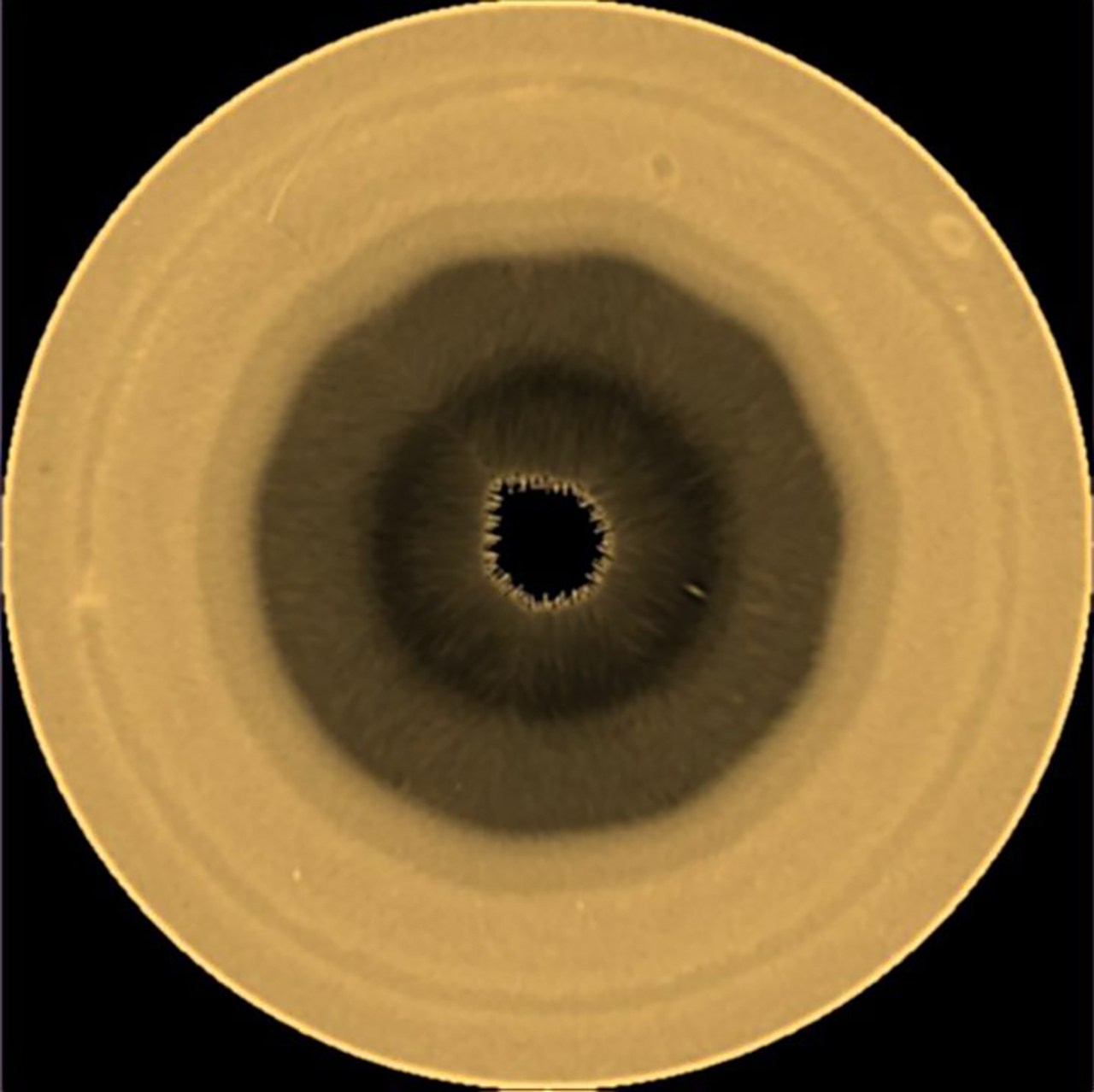
To take as one example: the fixed pattern of hexagonal winds above Saturn’s north pole. It’s been there for the last 40 years or so and was first spotted by the Voyager probes in 1980 and 1981. Now, though, the planet’s south pole has raised the stakes, with its own decagon-shaped (that is, 10-sided) wind pattern that appears to have formed between 2023 and 2025.
Initial images of the wave were captured by the Hubble Space Telescope in 2023, but further photos from Hubble and ground-based stations have provided us with a much better look, helped by the changing (and in this case, accommodating) tilt of Saturn. The results of the latest analysis were recently published in Science Advances.
Read more: “See Saturn Like You’ve Never Seen It Before”
The decagon wave is apparently created by a fast-moving eastward wind current and is moving at a rate of 8.2 feet per second, stretching down into many layers of Saturn’s turbulent atmosphere. It’s huge, too, with each side of the decagon measuring more than 55,000 miles. It’s so big, in fact, that you could fit Earth inside it three or four times over. It has a “wobble” to it as well, shifting its position on a 32-day cycle. This is an interesting comparison point with the north pole hexagon, which is much more fixed.
As for how it’s being formed, the study authors ran simulations of the decagon to try to understand the underlying mechanics. It’s possible that the well-known Red Spot storm on Saturn is having some influence, causing repeated disruption to winds that settles into a pattern. Another theory is that the planet’s rotation and the powerful jet streams that the decagon is flowing inside are creating a trap for atmospheric waves to travel along, creating the distinctive shape.
That said, these are all early observations, and there are still lots of questions to answer about Saturn’s latest feature. So for now, the next time you’re stuck inside of a storm, just be thankful it’s not going to last decades. 
Enjoying Nautilus? Subscribe to our free newsletter.
Lead Image: NASA/ESA/A. Sánchez-Lavega/Basque Country University/EHU