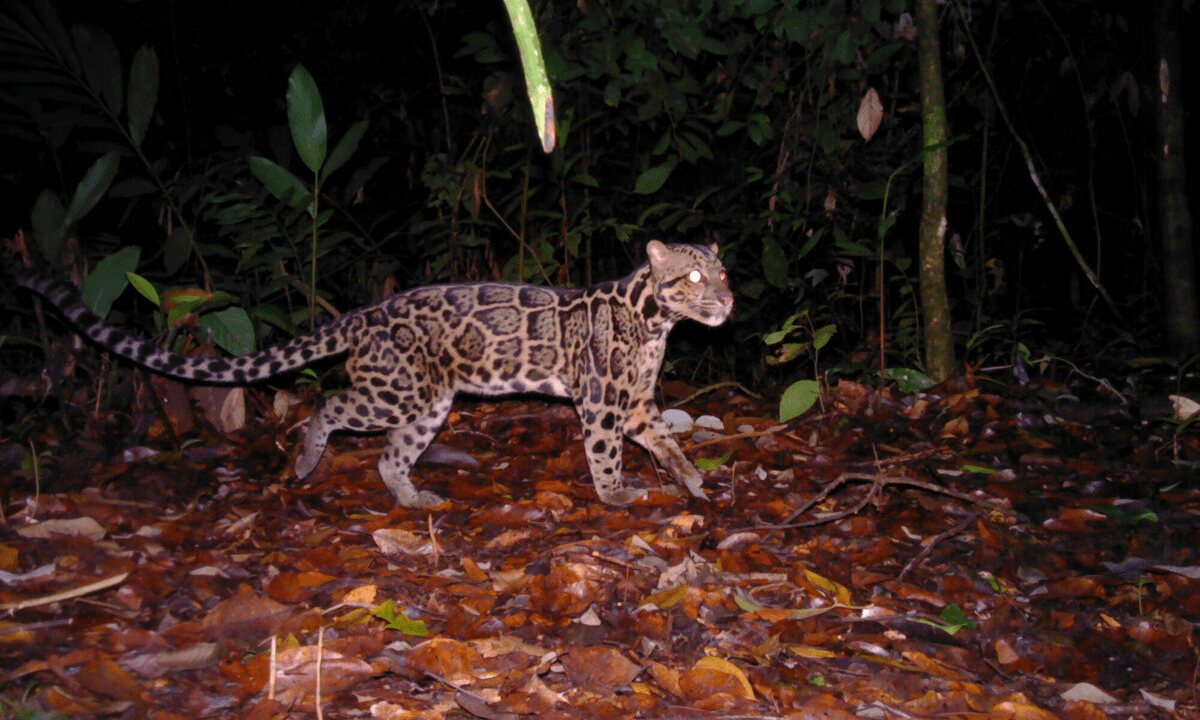
Sunda clouded leopards (Neofelis diardi) are so rarely seen in the wild that they’re dubbed the “ghosts of the forest.” Venturing out at night to hunt primates, birds, and mammals, they’re excellent climbers that prowl through the rainforests of Sumatra and Borneo. Relative to their modest body size, Sunda clouded leopards have the largest canines of any wild cat, harkening back to the specter of saber-toothed cats.
They’ve also become increasingly rare due to the conversion of their forest habitats into palm oil plantations and urban development as well as the illegal wildlife trade. As such, collecting data about them is critical for their conservation. For example, knowing maximum life expectancies allows scientists to model a population’s health and identify changes that signal problems—the exact goal of a study from earlier this year led by ecologists from the Leibniz Institute for Zoo and Wildlife Research in Germany.
With the participation of Malaysian experts from the Sabah Forestry Department on Borneo, including Indigenous wildlife rangers, camera traps were deployed in three forest reserves over nearly 16 years. The data included sightings of 52 adult clouded leopards on multiple occasions. Based on repeat records of individuals, the researchers determined that Sunda clouded leopards can live for at least 6.5 years.
Their lifespans might be substantially longer, but because clouded leopards range widely, with individuals traveling as far as 22 miles between camera traps, they may be transient in any given locale.
Read more: “Counting Animals Is a Sloppy Business”
Females proved much harder to spot than males, with males seen on 354 separate occasions and females on just 83. The difference, according to the study authors, probably reflects the boldness of males in passing along roads, trails, and ridgelines, the locations where camera traps are more easily deployed. Meanwhile, females may spend more time in trees, facilitated by their lighter bodies.
Either way, they more than lived up to their nickname. Despite this long-term dataset ranking as among the largest ever collected for clouded leopards, they were still only very rarely caught on camera.
Ghosts of the forest indeed. 
Enjoying Nautilus? Subscribe to our free newsletter.
Lead image: Panthera/SFD