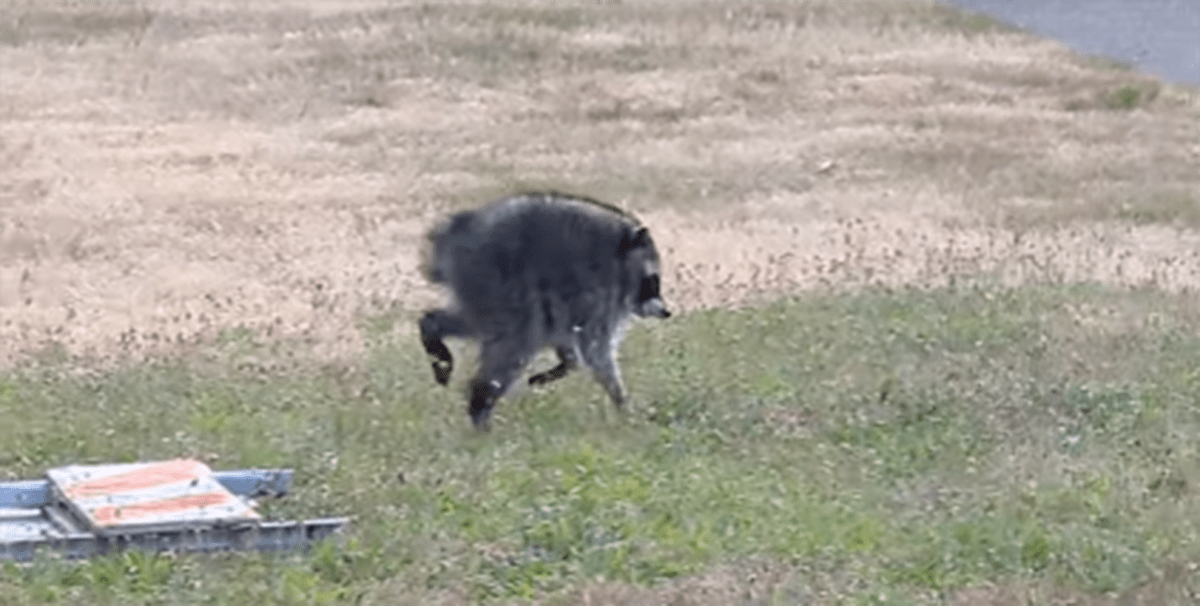
As a neuroscientist who studies raccoon and rats, I see the viral story of Jimothy the raccoon as a compelling tale of an animal overcoming disability and surviving in the wild.
Jimothy, the unique-looking raccoon living in Seattle, became an internet celebrity over the course of a week in July 2026, thanks to a viral Instagram post that has amassed millions of views and thousands of comments cheering for the proverbial underdog. Jimothy has even been honored with a city proclamation.
Something about him was obviously different. His body and tail were unusually short, and his back was curved. Although Jimothy hasn’t been officially examined by a veterinarian, he’s thought to have a form of a rare cervical vertebral malformation called short spine syndrome. A handful of cases have been seen in dogs. These animals are born with a condition that prevents their vertebrae from fully developing. With less physical space in the body, organs are crowded into a smaller space than usual, which can lead to mobility issues.
Adaptations are necessary for these animals to navigate their environments and secure the necessary resources for survival. How did Jimothy overcome the odds and emerge as a survivor?
The sophisticated raccoon brain
Although it’s easy to imagine a pet dog that’s under the close care of human pet parents surviving a challenging condition such as short spine syndrome, the probability of a disabled or injured wild animal successfully living in the uncertain outdoors is a different story.
Even for healthy raccoon, it’s a challenge to survive the harrowing time of being a helpless newborn. Up to half of young kits die without emerging from the natal den. If an individual raccoon is among the fortunates to leave the den as a juvenile or young adult, life’s challenges don’t stop there. Typically there are no safe zones that are reliably protected from predators.
Read more: “The Intelligent Life of the City Raccoon”
To survive, raccoon have to be vigilant, persistent, and physically agile to navigate the physical and mental challenges of life in the wild. In fact, it’s so dangerous out in the wild that many raccoon only live two to five years, even though they have the capacity to live for around 12 years in captivity.
It’s difficult to imagine how Jimothy has navigated life’s challenging terrain to survive in the wild. However, if any mammal can transcend the limitations of a disability, raccoon would be at the top of my list.
Very few studies have been conducted on the raccoon brain, but my lab’s limited research has revealed the neuroarchitecture of a complex and sophisticated brain. Raccoon have exceptionally high neuron densities, resembling those of small primates. More neurons lead to greater flexibility in behavior, a characteristic that is likely facilitating Jimothy’s survival.
My team also identified the presence of specialized and fast-conducting brain cells called von Economo neurons, which are typically located in the areas of the brain involved in emotional, social, and internal processing in people.
And perhaps the neuroevolutionary pièce de résistance of the raccoon: their hands. The forepaws of raccoon are extremely dexterous and sensitive, and occupy a large portion of their brain’s motor cortex, like that of people. This investment in hand movement takes raccoon learning abilities to the next level—explaining why Toronto paid roughly $24 million to develop raccoon-proof trash bins.
These brain capabilities likely give Jimothy some neural backup as he navigates narrow fences, climbs trees, searches for food, and scopes out places for rest and refuge.
Jimothy’s mom as hero
Equally impressive as Jimothy’s own adaptations is the continuous care provided by his mother.
As challenging as the raccoon mother’s role is while raising her young, raising a kit with special needs likely requires extra energy and patience. For raccoon families, the mother is very much a single parent. Not only does she not have help from the father, but she often moves the litter to different dens to escape the threat of males potentially harming the kits. She also needs to be an efficient forager to prevent excessive time away from her vulnerable offspring.
Unlike many mammals whose young become independent soon after weaning, raccoon mothers continue taking care of their kits for much longer. Although nursing typically ends around 16 weeks, raccoon youngsters often remain with their moms for up to nine months. From weaning to leaving the natal den, maternal raccoon take their family through something like homeschooling.
One of my favorite examples appears in the PBS documentary Raccoon Nation, where a raccoon mom takes her kits on a field trip to teach them how to collapse their spines to slide past a wooden garage door. For hours, she models the behavior for her young—then observes their attempts, catching them when they fall and nudging them to try again.
It’s apparent that Jimothy’s mother was no exception to the prototypical raccoon mother—serving as nurturer, protector, and teacher. Based on the videos of older Jimothy running across a field, navigating fences, and exploring his world, it appears that his mom’s hard work resulted in a remarkable return on her investment.
Evolutionary perseverance
Even though the odds were stacked against Jimothy from the day of his birth, he persevered.
Jimothy is being celebrated for being different. But, in my opinion, the most interesting aspects of his story are two remarkable evolutionary achievements that all mammals share: a brain capable of adapting to an imperfect body and other life challenges, and a patient and caring mother or guardian who translates her offspring’s capabilities into abilities.
Jimothy’s mom celebrated his value long before his video debut and viral following. 
This article is republished from The Conversation under a Creative Commons license. Read the original article.
Lead image courtesy of c1vrgr1 / Instagram