Basking sharks are wonders of the marine realm. This second-largest living fish species can reach 40 feet long and weigh upward of 4.5 tons—all on a diet of plankton. Perhaps because the ocean behemoths make their livings lolling at the water’s surface (thus the “basking”) vacuuming up the sea’s tiniest animals, they also have the smallest weight-for-weight brain size of any shark. I suppose you don’t need much in the way of street smarts when hunting entails opening your massive mouth and swimming along with the krill-filled currents.
As if basking sharks couldn’t get any more wonderfully weird, they have a seldom appreciated trick up their sleeves: babies with extraordinary honkers.
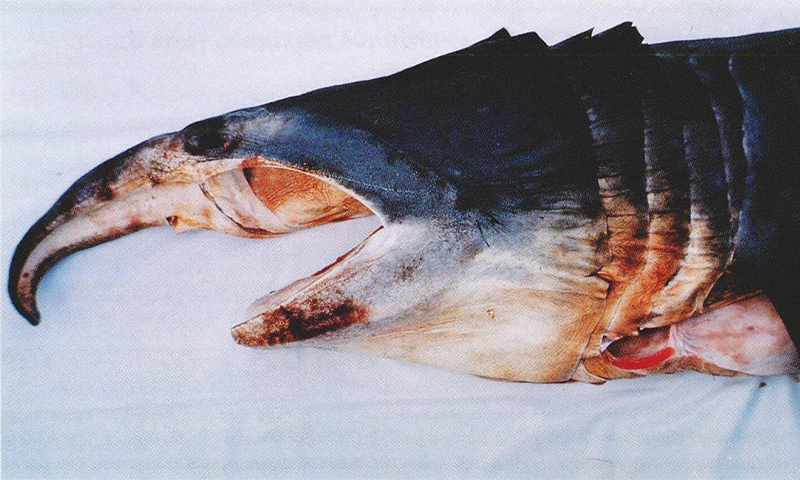
In 2020, Tyler Greenfield, who identifies as a paleontologist and science writer, posted a delightful figure from a Japanese Journal of Ichthyology study that shows a 8.5-foot baby basking shark in all its nasal glory.
The researchers captured the nosy specimen in the photo off the Pacific coast of Honshu, Japan, in 1977, and estimated the female shark’s age to be less than 6 months. The fortuitous catch was an unusual opportunity to elucidate an ephemeral feature of developing basking sharks. “Specimens are rare and growth changes after birth rapid[ly],” the authors wrote.
But the baby basking shark’s impressive nose, which included a groove running down the underside of it that went straight to the fish’s palate, isn’t merely for show. “It is thought that the snout structure is related to juvenile feeding,” the researchers wrote, “during the early, free-living stage, when the snout shape may increase the efficiency of water flow into the mouth.” They suggested that, because a baby basking shark doesn’t quite have the swimming chops of an adult, this specially configured nose helped increase the current of plankton-bearing water into its mouth.
Baby basking sharks grow quickly, though, and soon exit this awkward phase. More recent photos, of a juvenile basking shark feeding off the coast of Scotland, captures a slightly less-Gonzo-esque version of a baby basking shark’s schnozz, though likely serving the same purpose of directing food into its gaping maw. 
Lead image: from Izawa, K. & Shibata, T. Japanese Journal of Ichthyology (1993)