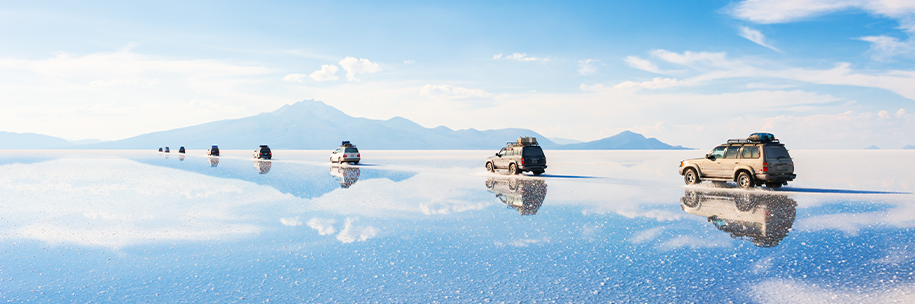
In southwest Bolivia, near the border with Chile, lies what is commonly referred to as “the world’s largest natural mirror.” When it rains on the massive salt flat called Salar de Uyuni, tourists flock from around the world to pose for photos, hoping to capture themselves, their vehicles, and the surrounding mountains, clouds, and sky perfectly reflected in dreamlike mirror scenes.
Although it might not actually be a perfect mirror. This, according to researchers who studied the area using satellite imagery, ground-based measurements, and drone data. They reported their mirror-shattering findings in Communications Earth & Environment recently.
The scientists found that while the ephemeral, shallow lake that forms at Salar de Uyuni is exceptionally smooth and calm, it does not behave like a mirror would, according to satellite data. Particularly in the interior parts that tourists can’t reach. For a surface to behave like a mirror, variations in its surface must generally be smaller than a wavelength of visible light. The research team analyzed more than 390,000 radar measurements—where satellites shoot radio signals at the water in the salt flat and measure the smoothness of the signal that bounces off of it—collected over the course of about 8 years. The scientists concluded that the salt flat’s smoothness and reflectiveness vary over time and across the extent of the surface.
To confirm their remote sensing measurements, the scientists collected data on the ground last year at Salar de Uyuni. They used an optical tool to characterize the lake’s surface, pairing that measurement with similar optical data from drones flying overhead.
It turns out that the lake’s surface is less than uniform. Across its 3,800 square mile surface, some patches wrinkle based on environmental conditions. Remarkably, though, few waves form on the gigantic lake, even though winds do push water around. The researchers suggest that the shallowness of the temporary lake—it averages less than an inch deep—and the presence of salt crystals at the surface help to keep the water so calm.
While its perfect mirrorness failed to stand up to strict scientific scrutiny, Salar de Uyuni is still a marvel. After a good rain, its a dazzling reflection of Earth's capacity to inspire and surprise. 
Lead image: Desizned / Shutterstock