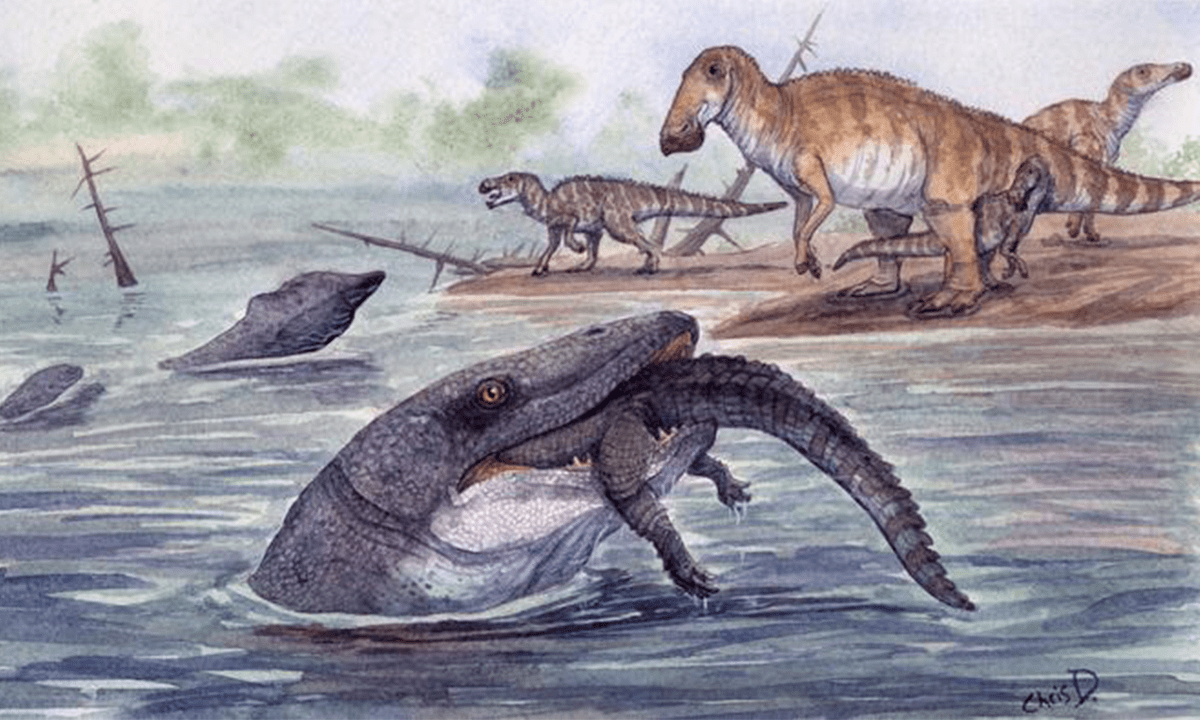
A dental discovery in an ancient riverbed in North Dakota is shedding light on one of the most fearsome reptiles to ever swim the seven seas—the mosasaur.
You may remember the massive mosasaur from the movie Jurassic World. The behemoth was kept in an expansive sea pen and forced to perform for parkgoers before taking down a genetically modified Tyrannosaurus rex (called Indominus rex) in the film’s climactic battle.
In reality, an ocean-bound mosasaur probably wouldn’t encounter a terrestrial T. rex, which is why it was so curious when paleontologists found a tooth from each prehistoric giant in the same riverbed. They published their findings today in BMC Zoology.
Read more: “Conjuring Imaginary Creatures”
Both the mosasaur tooth and the T. rex tooth (as well as a nearby jawbone from an ancient crocodilian) were a similar age, about 66 million years old. So the scientists were able to compare the chemical compositions of the remains, measuring ratios of different isotopes of oxygen, strontium, and carbon. Their results pointed to a startling conclusion: The former owner of the mosasaur tooth lived in a freshwater habitat.
“Carbon isotopes in teeth generally reflect what the animal ate. Many mosasaurs have low ¹³C values because they dive deep,” study co-author Melanie During, a paleontologist at Vrije Universiteit in Amsterdam, said in a statement. “The mosasaur tooth found with the T. rex tooth, on the other hand, has a higher ¹³C value than all known mosasaurs, dinosaurs, and crocodiles, suggesting that it did not dive deep and may sometimes have fed on drowned dinosaurs.”
Rather than these 36-foot-long marine predators suddenly deciding to swim up the river for a snack, scientists believe their environment shifted around them. During the Cretaceous Period, when mosasaurs lived, North America was split in two by a vast saltwater sea covering the prairies. As the Cretaceous drew to a close 66 million years ago, this saltwater sea was gradually diluted by an influx of freshwater that eventually settled on top of the heavier saltwater, forming a stark separation between the two. As the waters around the mosasaur changed, they adapted to their new river home.
This shift from saltwater to freshwater isn’t unheard of in the animal kingdom; it’s been observed in river dolphins, saltwater crocodiles, and some shark species that transition between the two environments. Still, imagining a predator the size of a bus idly paddling up an inland river is a spine-tingling mental picture. 
Enjoying Nautilus? Subscribe to our free newsletter.
Lead image: Christopher DiPiazza