It might seem that we have explored every kind of sport by this point in history. But people get tired of playing the same old games, so they make new ones. Baseball, football, hockey, and basketball were all new once, and they all took decades to grow from their humble beginnings into national obsessions. Newer sports have already had some success. The 1990s saw the rise of the X Games, and Quidditch—the sport based on the Harry Potter novels—gained a small following on real-world playing fields in the mid-2000s.
Today, playgrounds and vacant lots around the world continue to be home to people creating new sports. Gaining wide acceptance among athletes and spectators, however, is hard to do. One tried and true method is to base a new sport on something familiar. The new sports of Foot Golf, Hungerball, and Yakball are loosely based on soccer, and 360ball has its roots in racquetball.
“All codes of football, hockey, and baseball were based on very old ball games that involved kicking and throwing a ball or hitting it with a stick,” says sports historian Professor Tony Collins, of the International Centre for Sports History & Culture at De Montfort University in Leicester, United Kingdom. “So their commercial development into mass spectator sports in the late 1800s was based on a pre-existing appetite for that type of sport.”
Unless new sports find a way to connect with people, they tend to die out, Collins says. Below are some games that may seem vaguely familiar to any players of soccer, basketball, lacrosse, or racquetball. Time will tell if any of them have what it takes to reach the major leagues.
360ball®
Created by: Brothers Mark and John Collins
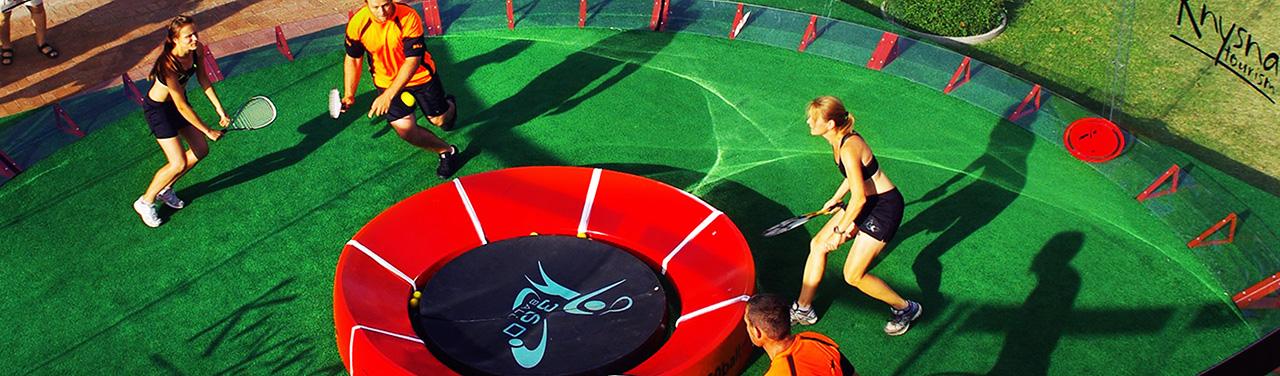
Rules: 360ball is like playing racquetball inside a walled circular court, but instead of hitting the ball off the walls players bounce the ball across a concave disc that is laid flat in the center of the court. The game can be played one-on-one or two-on-two. There are no separate sides of the court. Players may move anywhere around the disc to play the ball. Points are scored when the ball is hit so that it bounces off the disc and an opposing player can’t return the shot. Players or teams may only hit the ball twice before bouncing it off the disc. The first team to reach 21 points wins the match.
Equipment: Racquets and a racquetball-sized foam ball
Playing Field: An enclosed circular court with a 920-centimeter-wide concave disc at the center
Inspiration: “The game of 360ball all started when John and I began bouncing a ball off a square block of slate in South Africa in the early ’80s,” recalls Mark Collins.
Birthplace: Natal Midlands, South Africa in the mid-1980s.
Evolution: “We initially played with our hands and used a garden hose to define a circular outer boundary. We would rotate around the centrally placed disc bouncing the ball off the slate until someone missed. It immediately made for a fun game but player skills advanced quickly and pretty soon we had found new ways to kill the game,” says Mark Collins.
The game progressed from being played with bare hands to mitts, and finally to racquets. Eventually the disc was enlarged, but that made it too easy to hit the ball at angles that were impossible for the other players to counter. The solution to the problem was to abandon the flat disc and switch to a concave one.
Future Outlook: While 360ball was not an overnight success, it enjoyed some regional success in South Africa. In 2010, the first game of 360ball played in a circular court took place in Knysna, South Africa. In 2011, 360ball became the first ball sport to be awarded the Brand New Overall Award at the prestigious ISPO Brand New Awards in Munich, Germany.
There are already leagues in Spain, France, and South Africa. The Collins Brothers actively promote 360ball with a YouTube Channel and website.
Yakball
Created by: Michael Taylor
Rules: The goal of Yakball is to bounce a soccer ball into the target—which is a 3-by-6 foot box painted on a wall 4 feet off the ground. The game is played by two opposing teams of four players. A full game is broken into four, 10-minute periods. Whichever team gets the most points in that time wins. Two passes must be made before a point is scored. The Yakball remains in play even after a goal. Ball possession changes when a team scores a goal. As in lacrosse, the player carrying the ball can be hit, but no hits to the head or back are permitted. The ball can be moved by running, throwing, or heading, but kicking the ball is illegal.
Equipment: A “Yakball” is any spherical ball that is about the size of a soccer ball. Basketballs are banned from the game. A wall with a 3-by-6 foot box painted on it 4 feet off the ground is also required.
Playing Field: There is only one goal in Yakball. The playing field is 36 feet wide at the goal wall, 56 feet wide at the far end and 56 feet long. The playing field is broken up into three zones: A two-point zone; a neutral zone; and a crease zone around the goal.
Inspiration: “Yakball [is] a pretty heady organic mix of half-court basketball, football, soccer, and lacrosse,” says Yakball inventor Michael Taylor.
Birthplace: The Tampa Bay area, Florida, in 2010
Evolution: Taylor played lacrosse in high school. Soon, he began to combine the elements that he loved about soccer, half-court basketball, and lacrosse into Yakball. The game went from him and three of his friends playing against the side of his house, to an “official” Yakball playing field.
Future Outlook: Taylor says that Yakball’s popularity peaked in 2011 during his senior year in high school. Graduation, college, and other life plans caused the devoted 20-plus players of Yakball to go their separate ways, but that doesn’t mean that the sport is dead. 360ball experienced a similar state of flux before renewed interest in the sport helped re-launch it.
Hungerball Soccer
Created by: Father and son team Andu and Toma Iordache.
Rules: A game of Hungerball looks like six people kicking a soccer ball around a bouncy castle. One player takes possession of the ball in the center of the round arena while the other five each defend one of the six goals spaced evenly around the perimeter of the inflatable arena. A six-sided die is thrown to determine which player starts at the center. Once the player in the center has touched the ball, the other players can advance at will—it’s an all-on-all attack.
Players can score in any of the six goals. They cannot use their hands on a ball in play. Players earn points for scoring a goal, but they also lose a point when a goal is scored against them. The player who concedes a goal trades places with the center and resumes play. A full game of Hungerball typically lasts 15 minutes. The player with the most points when time runs out wins the game.
Equipment: A soccer ball and the inflatable Hungerball Arena.
Playing Field: An inflatable circular arena with five goals spaced evenly around the perimeter.
Inspiration: Andu and Toma wondered who would win if the world’s best soccer players were able to play against each other all-on-all. “[Toma and I] developed ‘Hungerball’ individual soccer as a competition game and training hub for soccer skills,” says Andu Iordache.
Birthplace: Auckland, New Zealand.
Evolution: “Hungerball is great fun to play at social events and tournaments,” Andu says, “as well as for training individual soccer skills and self-reliance and a ‘hunger’ for the ball.”
Future Outlook: The Iordaches are promoting Hungerball with public events in partnership with soccer clubs where fans can play with professional players. They also offer birthday and team-building parties. They are in the process of organizing their first series of official tournaments in New Zealand. The sport received a big boost when Ricki Herbert, the former coach of New Zealand’s national team, the All Whites, publicly endorsed it.
FootGolf
Created by: Michael Jansen and Bas Korsten started the first 9-hole FootGolf tournament in the Netherlands in 2008.
Rules: FootGolf is typically played by people wearing golfing outfits and turf soccer shoes. The object of the game is to kick a soccer ball into a hole, and the rules largely correspond to the rules of golf. A FootGolfer must play the ball in a single movement. No pushing the ball with the foot is allowed. At the end of nine holes the player who completes the course using the fewest number of kicks wins.
Equipment: A regulation FIFA #5 soccer ball.
Playing Field: Any golf course facility with 21-inch diameter cups that can accommodate a soccer ball.
Inspiration: “Anyone can kick a soccer ball into a hole,” Balestrini says. “FootGolf combines soccer, which is the number one popular sport in the world, with golf, which is the number one elite sport in the world.”
Birthplace: “Nobody knows who first came up with the idea of FootGolf,” says Roberto Balestrini, founder of the American FootGolf League. “While the exact country of origin is unknown, FootGolf started being played across Europe around 2001.”
Evolution: In 2008 FootGolf went from being played informally in parks to being played on golf courses throughout Europe. FootGolf crossed the Atlantic Ocean in 2010, when it was introduced in Argentina, and the American FootGolf League was founded soon after in 2011. FootGolf is regulated by the Federation for International FootGolf (FIFG) since June 2012. FootGolf in the United States has grown to nearly 500 courses in 48 states, the District of Columbia and Puerto Rico. One-hundred-fifty U.S. golf courses began offering FootGolf in 2015.
Future Outlook: FootGolf has enjoyed phenomenal international growth and popularity since its introduction in the Netherlands back in 2008. “I fell in love with FootGolf back in 2011,” says Roberto Balestrini, founder of the American FootGolf League. Balestrini’s love of the game prompted him to found the American FootGolf League. He was quickly approached by golf course operators looking for an innovative way to bring people and profits to golf courses. More than 80 tournaments will be held in the United States in 2016.
Joseph Baneth Allen writes about astronomy and space exploration from his home in Jacksonville, Florida.