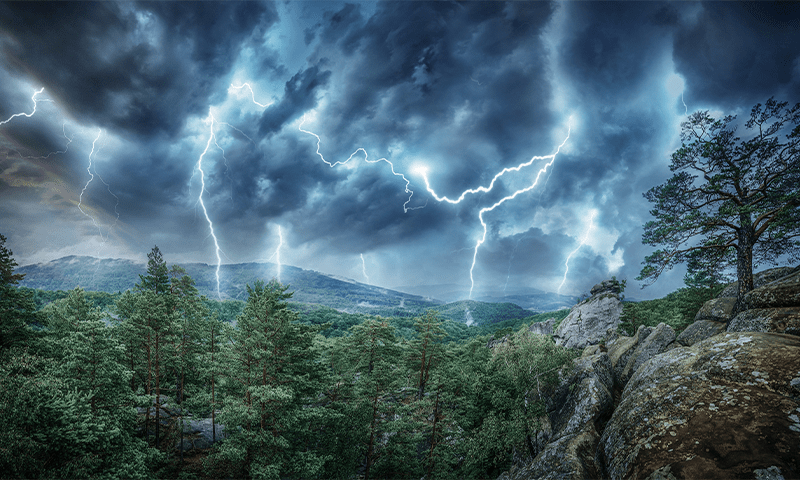
Thunderheads, those massive storm clouds where lightning forms, have harbored a mystery for millennia. Although atmospheric scientists have long understood that lightning arises from differences in electrical fields within clouds and between clouds and the earth, the cascade of events that spark the formation and discharge of the dramatic flashes were not fully understood or described.
Now, researchers at Pennsylvania State University have proposed the most detailed description of those precursory events yet.
First, strong electrical fields build up in the thunderclouds. Then certain kinds of electrons, which have been seeded by cosmic rays from outer space, multiply within these electric fields. Next the electrons smash into nitrogen and oxygen molecules in the air, producing X-rays and triggering huge bursts of additional electrons (awesomely called electron avalanches). These avalanches in turn produce high-energy photons that generate intense bolts of light and heat.
Reporting on their use of complex mathematical models to validate field observations, the scientists published their findings in JGR Atmospheres.
According to the U.S. National Weather Service, lightning flashes somewhere on Earth about 100 times per second. Now science has shed a flash of light on this common phenomenon. 
Lead image: Triff / Shutterstock