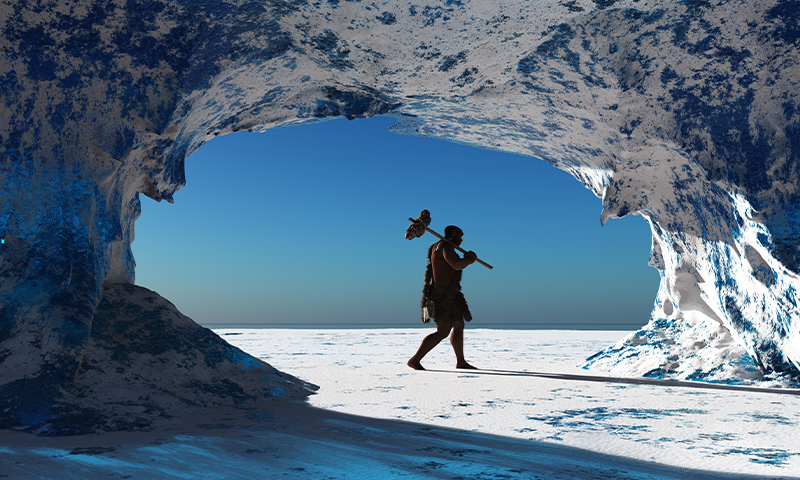
Tens of thousands of years ago, during the Pleistocene epoch, Neanderthals trekked more than 2,000 miles on foot from the Caucasus Mountains in Eastern Europe to a chain of caves in the Altai Mountains of Siberia. The journey likely took them just 2,000 years, a new study finds, a relative sprint considering the many major obstacles in their way: dramatic mountain ranges, massive rivers, and potentially hostile evolutionary cousins.
It was the Neanderthals’ second major migration through the region, according to analysis of DNA found in sediments in caves in Europe and Siberia. (In the years between migrations, glaciers completely separated Europe from Asia.) But until recently, the route of this second wave of Neanderthal migration was a riddle, primarily because of a dearth of archaeological artifacts showing the way.
Now, a team of anthropologists has mapped a potential path into Southern Siberia across the Ural Mountains, which form a rugged gauntlet stretching across what is today west central Russia. Neanderthals taking this route likely relied on river valleys as natural highways and traveled during the warmer months when the terrain was more accessible, according to Emily Coco, now a postdoctoral researcher at Portugal’s University of Algarve, and Radu Iovita, an associate professor at New York University’s Center for the Study of Human Origins. Previous modeling had suggested they might have traveled during the colder months, instead.
The routes Coco and Iovita identified would have taken the Neanderthals into areas already occupied by Denisovans, which squares with evidence that the two species came into prehistoric contact—in fact, research suggests they interbred.
Coco and Iovita published their findings, which were based on computer simulations, this month in the journal Plos One. To build their model, they considered the elevation of the terrain, reconstructed the routes of ancient rivers, mapped glaciers that could have obstructed Neanderthals’ migratory path, and calculated temperatures. They also assumed that the Neanderthals did not have a specific destination in mind and that they could only make decisions about where to migrate based on knowledge of local conditions. This simulated approach has been used to map the migrations of animals and humans in other time periods and geographies but had not previously been applied to Neanderthals.
The researchers note that their model doesn’t take into account every factor that could have influenced the migratory decisions of the Neanderthals: access to resources, distance to water, annual or seasonal weather patterns and climate change, vegetation preferences, locations of previous occupations. But it does begin to map out some possibilities and bring the complexity of our ancient ancestors’ wanderings into clearer view. 
Lead image: iurii /Shutterstock