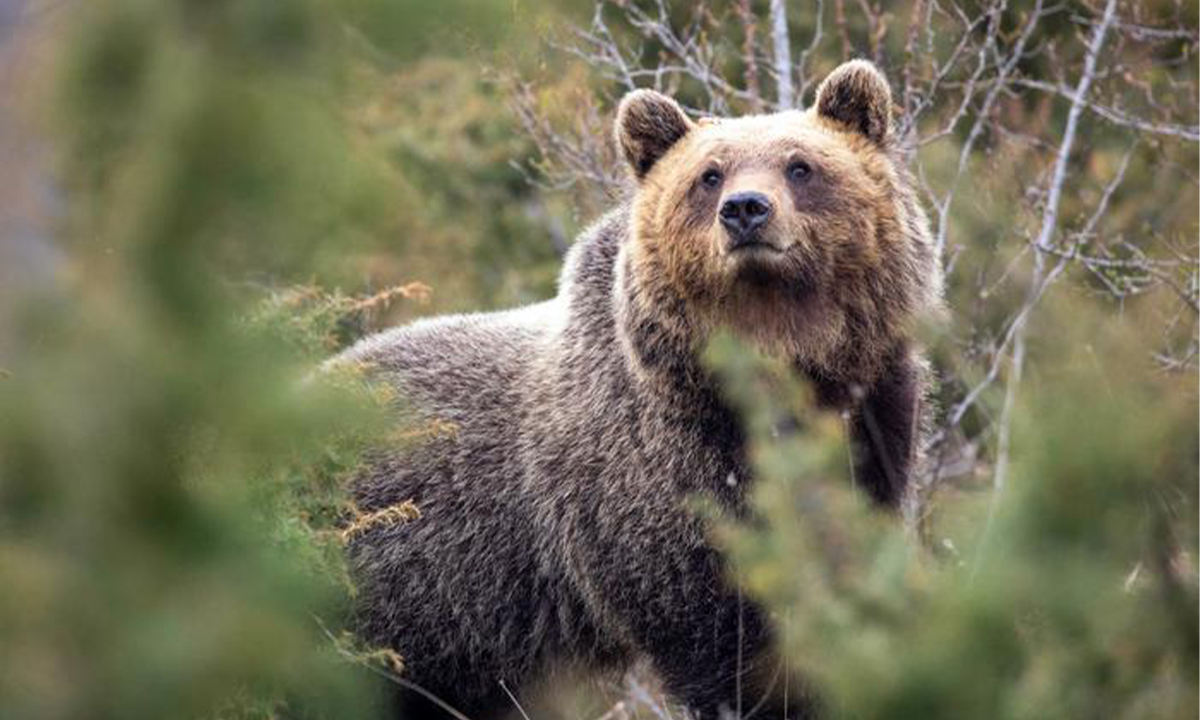
Among Earth’s creatures, brown bears are pretty undesirable to run into as you stroll through the woods. But if you’re hiking through the mountains of central Italy, it might not be so bad.
It’s not like you could sit down and have an espresso with one, but at least in a small corner of Italy, bears have evolved to become less dangerous than they used to be, according to a study published today in Molecular Biology and Evolution. And the change may have been spurred by humans.
Apennine brown bears (Ursus arctos marsicanus), cousins of grizzly bears (U. arctos horribilis), occur only in the mountains of central Italy. These Italian bears diverged from European brown bear ancestors some 2,000 to 3,000 years ago. As they became geographically restricted to the Apennine Mountains, the central Italian population evolved into a subspecies with distinct characteristics, including tolerance of humans.
Read more: “How We Really Tamed the Dog”
“One major cause of decline and isolation was probably forest clearance associated with the spread of agriculture and increasing human population density in central Italy,” said the paper’s lead author, evolutionary biologist Andrea Benazzo at the University of Ferrara, in a statement.
Populations of brown bears were squeezed and persecuted by the spread of agriculture and urbanization starting in Roman times. By about 1,500 years ago, the Apennine brown bears were completely isolated from their closest relatives, and their total numbers eventually dipped to only 50 individuals. Limited to a protected area, the Abruzzo, Lazio, and Molise National Park, Apennine brown bears are currently classified as critically endangered.
Populations of animals that become isolated typically experience reduced genetic diversity and gene flow. But were these genetic changes responsible for the reduced aggression of these brown bears, or was there another force at play? Researchers in Italy and colleagues from France, Brazil, Slovakia, and the United States compared the genomes of 13 Apennine bears to the genomes of brown bears (U. arctos) in Slovakia and grizzly bears in the U.S.
As expected, the Apennine brown bear genome showed the reduced diversity that comes with extensive inbreeding, which corroborated that a population bottleneck had occurred as humans squeezed the bears into a more limited range. Intriguingly, the researchers identified distinct genetic variants in the Apennine bears’ genomes associated with docile behavior in other species, such as dogs and cats. They hypothesized that humans unwittingly exerted selection pressure on this population of bears by killing the more aggressive ones, driving an evolutionary shift toward bears that displayed a higher tolerance for humans.
“Human-wildlife interactions are often dangerous for the survival of a species, but may also favor the evolution of traits that reduce conflict,” concluded geneticist Giorgio Bertorelle, a co-author.
Ironically, by people selectively culling more aggressive Apennine bears to make room for farms and settlements, the subspecies may have gained a greater chance of survival. The more docile individuals left behind were more likely to survive, mate, and pass on their genes. Despite the loss of genetic variation and the increased accumulation of bad mutations, the tolerant bears could persist in a human-dominated environment. 
Enjoying Nautilus? Subscribe to our free newsletter.
Lead image: Bruno D’Amicis/ Molecular Biology and Evolution