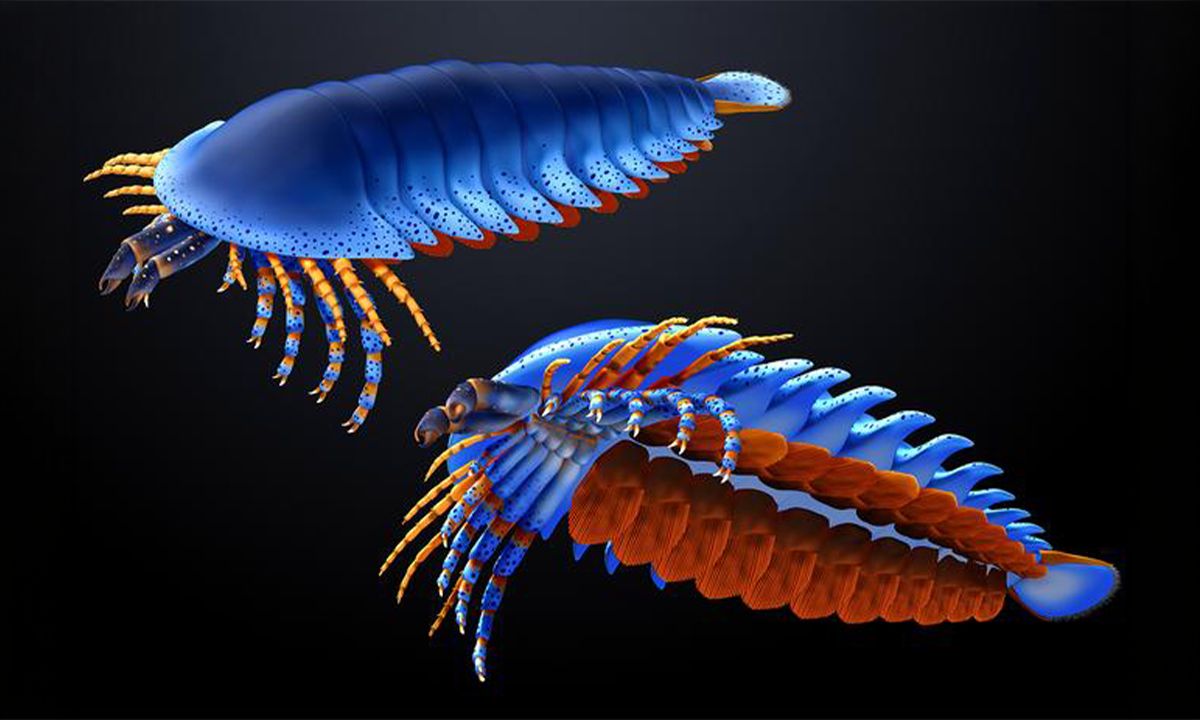
Evolutionary biologist Rudy Lerosey-Aubril was meticulously cleaning a small, 500-million-year-old arthropod fossil with a needle when he noticed something peculiar—there were claws where its antennae should be.
“Claws are never in that location in a Cambrian arthropod,” Lerosey-Aubril explained in a statement. “It took me a few minutes to realize the obvious, I had just exposed the oldest chelicera ever found.”
Unearthed from Utah’s West Desert, the three-inch specimen was the earliest known member of the arthropod subphylum chelicerata, a group that comprises spiders, mites, horseshoe crabs, scorpions, and more. While other arthropods like insects have antennae as their foremost appendages, chelicerates possess specialized mouthparts called “chelicerae” that are typically used to feed. The chelicerae of spiders, for example, have evolved into venomous fangs.
Dubbed Megachelicerax cousteaui after the famed oceanographer Jacques Cousteau, Lerosey-Aubril described the species in a paper published in Nature. The find pushes back the origins of the chelicerate lineage by 20 million years to a time when evolution was tinkering with a number of new designs—the Cambrian explosion. It also represents a kind of missing link in arthropod evolution, bridging arthropods that lacked specialized mouthparts with the primordial horseshoe crab-like chelicerates.
Read more: “In Search of the First Animals”
“This tells us that by the mid-Cambrian, when evolutionary rates were remarkably high, the oceans were already inhabited by arthropods with anatomical complexity rivaling modern forms,” study co-author Javier Ortega-Hernández added.
Such new anatomical complexity didn’t immediately translate to ecological dominance, the researchers said. Instead it appears that the tiny predators languished for several millennia while more primitive arthropods like trilobites prevailed in the ancient oceans.
“A similar evolutionary pattern has been documented in other animal groups,” Lerosey-Aubril said. “This shows that evolutionary success is not only about biological innovation—timing and environmental context matter.”
In the hundreds of millions of years that followed, the descendants of M. cousteaui branched out to colonize land, leaving more than 120,000 living species scattered across a variety of ecological niches. Quite a legacy for a three-inch upstart from the primordial seas. 
Enjoying Nautilus? Subscribe to our free newsletter.
Lead image: Artistic reconstruction by Masato Hattori (© Harvard University).